
E-invoicing in Slovakia
From 1 January 2027, Slovakia mandates e-invoicing for B2B and B2G transactions for local VAT-registered companies. Reporting to the Slovak Financial Administration is automated and near-real-time using the Peppol five-corner model. The mandate doesn't cover non-domestic and B2C transactions.
The obligation to issue e-invoices is limited to domestic taxpayers registered for VAT. However, any domestic taxable person, including non-VAT payers, must be able to receive e-invoices.
Documents must be issued in a structured electronic format that complies with the EN 16931 format. For network exchange, Peppol BIS Billing 3.0 (UBL 2.1) is the expected standard. All documents must be sent using an accredited service provider, known locally as a digital postman.
The sender's digital postman automatically transmits a Tax Data Document (TDD) to the Slovak Financial Administration in parallel with the invoice. The TDD is linked to the invoice. A TDD is only sent if the invoice contains the supplier's VAT identification number. The Financial Administration and the receiver's digital postman must acknowledge the documents received by issuing a Message Level Status (MLS).
E-invoice data must be stored for 10 years, starting from the end of the calendar year to which the invoice relates. This is extended to 20 years for transactions involving immovable property. You must also retain TDD and MLS data.
Terms and abbreviations
The following terms and abbreviations are specific to e-invoicing in Slovakia.
| Abbreviation | Term in Slovak | English translation | Description |
|---|---|---|---|
| DIČ | Daňové identifikačné číslo | Tax Identification Number | 10-digit unique number that identifies a legal entity for tax purposes. |
| DP | Digitálny poštár | Digital postman | Accredited Peppol service provider. |
| FS | Finančná správa | Financial Administration | Slovak tax authority. |
| IČ DPH | Identifikačné číslo pre daň z pridanej hodnoty | VAT Identification Number | Identification number assigned to VAT-registered entities. It starts with SK followed by a 10-digit number. |
| IS EFA | Informačný systém elektronickej fakturácie | Information System for E-invoicing | Slovakia's centralised platform for B2G, decommissioned on 1 January 2027. |
| MF SR | Ministerstvo financií Slovenskej republiky | Ministry of Finance of the Slovak Republic | Government body responsible for tax-related legislation. |
| PFS | Portál finančnej správy | Financial Administration Portal | Internet portal of the Finance Administration, used for selecting a digital postman. |
Mandate at a glance
The following table contains a summary of the Slovak e-invoicing mandate.
Learn more about compliance transaction terms and concepts.
| Aspect | Description | Requirement |
|---|---|---|
| B2B | Invoices exchanged between businesses. | Mandatory from 1 January 2027 |
| B2C | Invoices issued by businesses to consumers. | Voluntary |
| B2G | Invoices issued by businesses to public administrations for public procurement. | Mandatory |
| Electronic signature | Signature or seal rules for authenticity and integrity of e-invoices. | Not required |
| Legal archiving | Minimum retention period for e-invoices. | 10 years, starting from the end of the calendar year to which the invoice relates. Extended retention of 20 years for transactions involving immovable property. |
| Model | E-invoicing flow model used by the country. | Decentralised continuous transaction control and exchange model |
| Platform | Government-managed platform or network used for e-invoicing. | Five-corner Peppol model using accredited digital postmen |
| Supported format for e-invoicing | E-invoicing format legally required by the country. | |
| Supported format for e-reporting | E-reporting format legally required by the country. | Slovak Republic Tax Data Document (TDD) |
| Automatic updates | Whether invoice status updates synchronise automatically in the Monitor. | Yes |
Timeline
IS EFA introduced for B2G invoice exchange
Mandatory e-invoicing and near-real-time reporting to the tax authorities using Peppol five-corner model for all local VAT-registered companies
Mandatory cross-border intra-EU B2B e-invoicing, aligned with the ViDA initiative
ecosio's solution
ecosio is an accredited digital postman in Slovakia. This means that ecosio acts as your sender access point for the accounts receivable flow and the receiver access point for the accounts payable flow. ecosio also automatically sends the TDD to the FS in near real time.
Accounts receivable
The following diagram and steps illustrate the AR process.
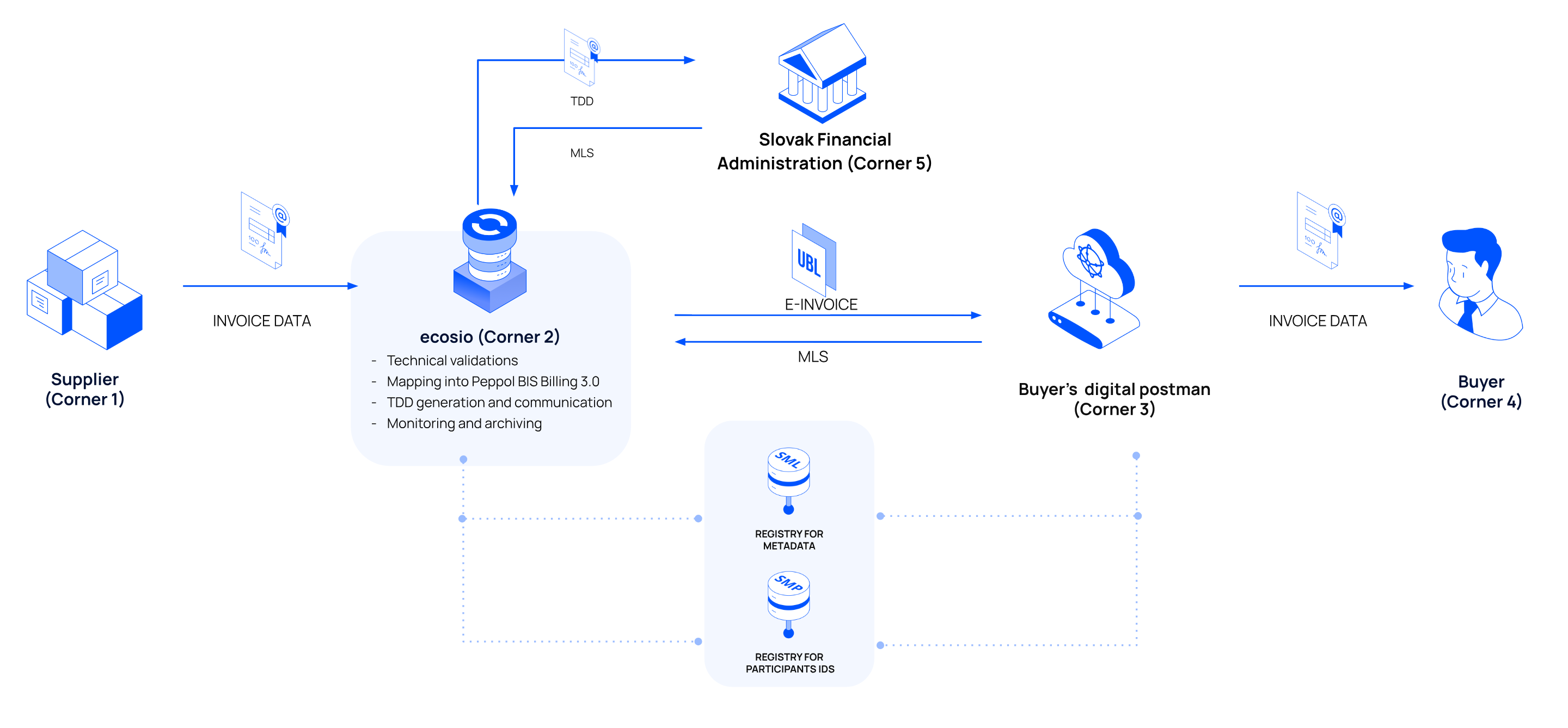
- You (corner 1) send the invoice data from your ERP system to ecosio in the agreed format.
- ecosio (corner 2) validates the received invoice data and converts it into the Peppol BIS Billing 3.0 format.
- The following steps happen in parallel:
- ecosio sends the invoice to the buyer's DP (corner 3).
- If the invoice contains your IČ DPH, ecosio generates the SK TDD and sends it to the FS (corner 5). If the invoice doesn't contain your IČ DPH, no TDD is sent.
- The buyer's DP validates the invoice.
- Depending on the results of the validation, one of the following happens:
- If the validation succeeds, the buyer's DP transmits the invoice to the buyer's ERP system (corner 4).
- If the validation fails, the buyer's DP doesn't forward the invoice to the buyer and notifies ecosio with a negative MLS.
- Once the FS accepts the tax data, it sends a confirmation to ecosio.
- ecosio stores the e-invoice data so that you can access it via the Monitor or the Messaging APIs.
Accounts payable
The following diagram and steps illustrate the AP process.
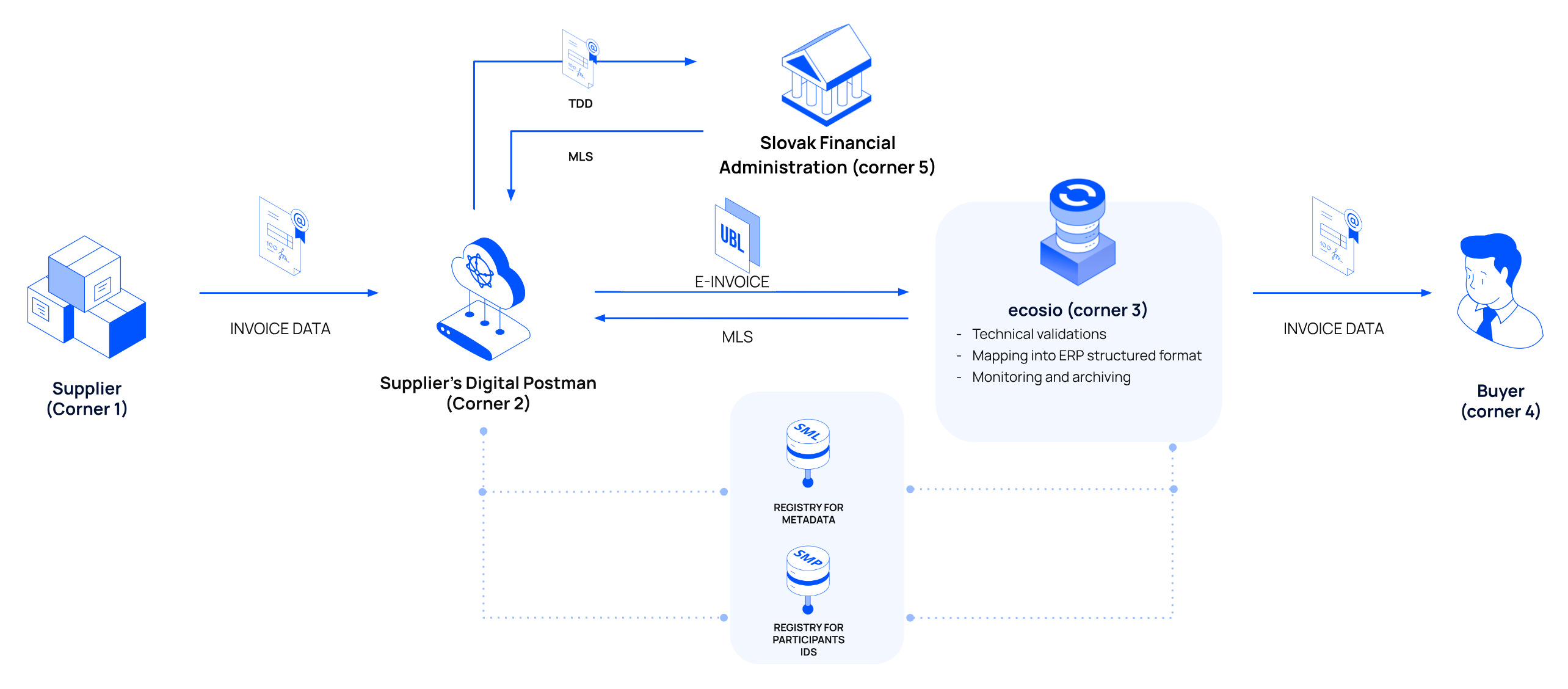
- The supplier's ERP system (corner 1) sends the invoice data to their DP (corner 2).
- The supplier's DP transmits the invoice to ecosio (corner 3) in the Peppol BIS Billing 3.0 format, generates the SK TDD, if required, and sends it to the FS (corner 5).
- ecosio validates the invoice.
- Depending on the results of the validation, one of the following happens:
- If the validation succeeds, ecosio converts the invoice to the agreed format and makes it available to you (corner 4).
- If the validation fails, ecosio notifies the supplier's DP.
NoteIf you have a self-billing arrangement with a supplier, ecosio sends the self-billed invoice to the supplier's DP on your behalf. If the supplier is VAT registered in Slovakia, ecosio also generates the TDD and sends it to the FS. If only you are VAT registered, no TDD is sent.
Archiving
ecosio stores technical log files proving successful delivery and receipt for a minimum of six months. In addition, ecosio stores invoice, TDD, and MLS data for three months. During this time, you can download all the required data for long-term archiving.
Updated 1 day ago