
Search for a message
Full-text search is a core feature for the Message Overview page inside the Monitor. By leveraging it, you can get to specific messages or groups of messages faster from the overview page, so that you can better view them, or download them (as a quick download or as an archive in the Downloads section).
Introduction
Full-text search is a core feature for the Message Overview page inside the Monitor. By leveraging it, you can get to specific messages or groups of messages faster from the overview page, so that you can better view them, or download them (as a quick download or as an archive in the Downloads section).
The full-text search feature can be found here:
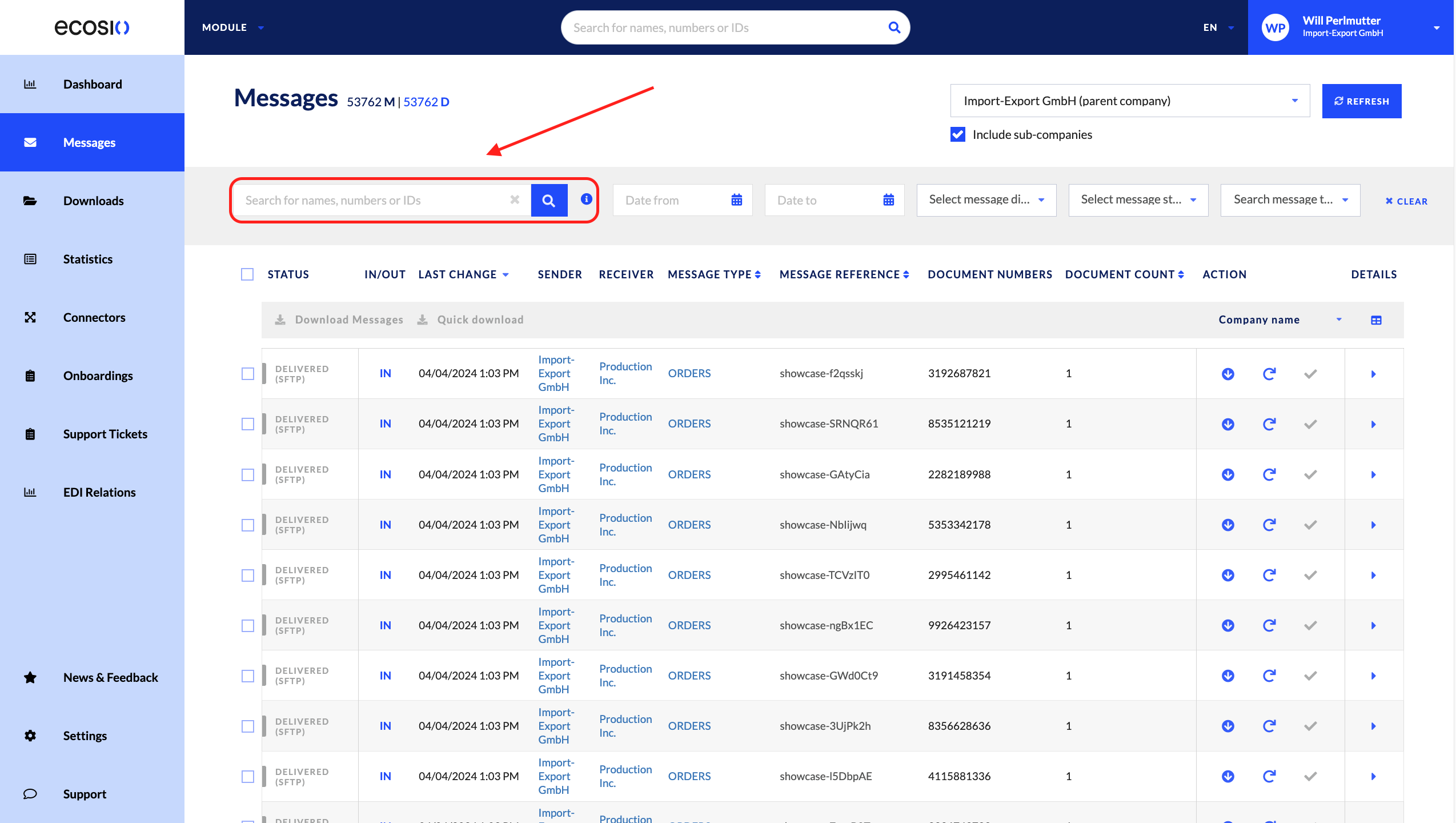
As part of the full-text search functionality, you will be able to do the following:
- Search inside the contents of messages
- Leverage advanced search commands
- Combine search commands
- Search for incomplete information (e.g. “PRODU” when the company name is “Production Inc.”)
Prerequisites
You should be aware of a few items while using the search bar in the message overview page (”Full-text search”).
- The top search bar which appears throughout the Monitor is a global search bar. Currently, it is configured to only pull up messages in the same fashion that the full-text search operates. In the future, there are plans to expand this so that you can see all information across the Monitor as it relates to your search.
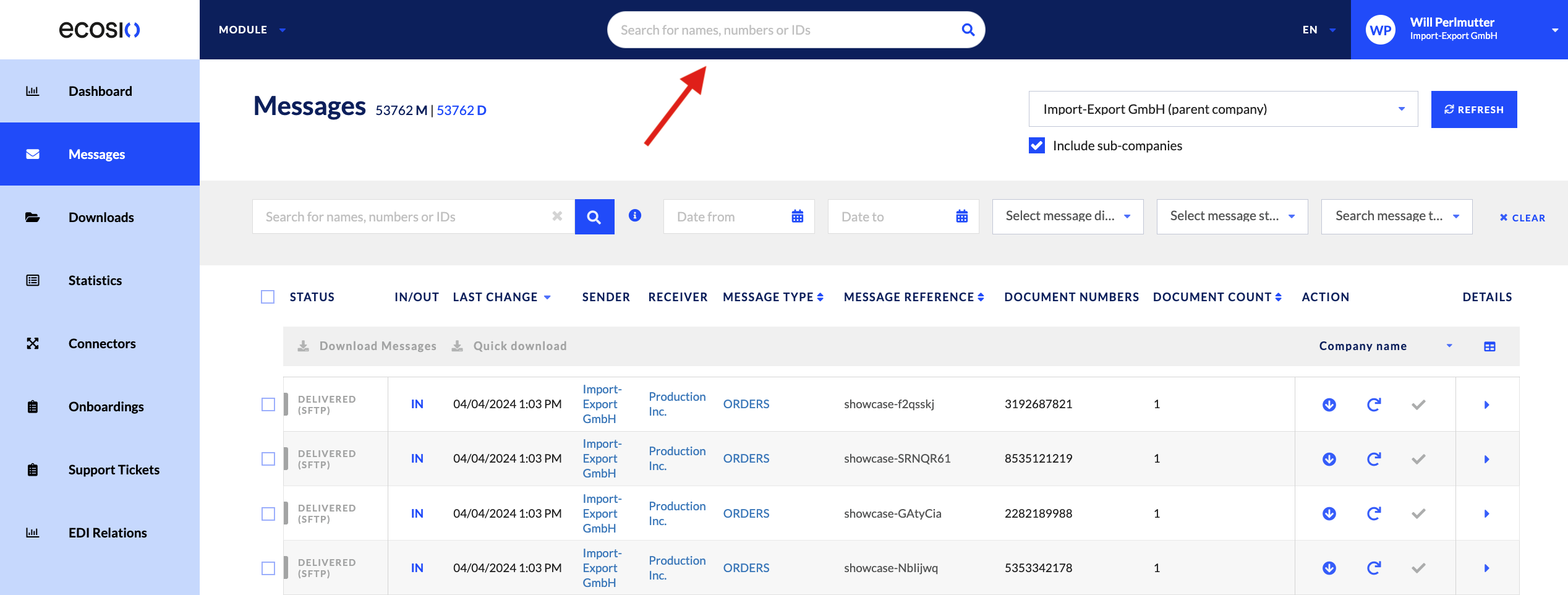
- Search bars within the EDI Relations, Onboardings and Support Tickets menu entries have different scopes and functionalities. For more information on these search bars, see the respective documentation pages on the aforementioned menu entries for more information.
- Wildcard searches, defined as using special characters to match multiple variations of a word or group of words, are not supported by the full-text search feature inside the Monitor.
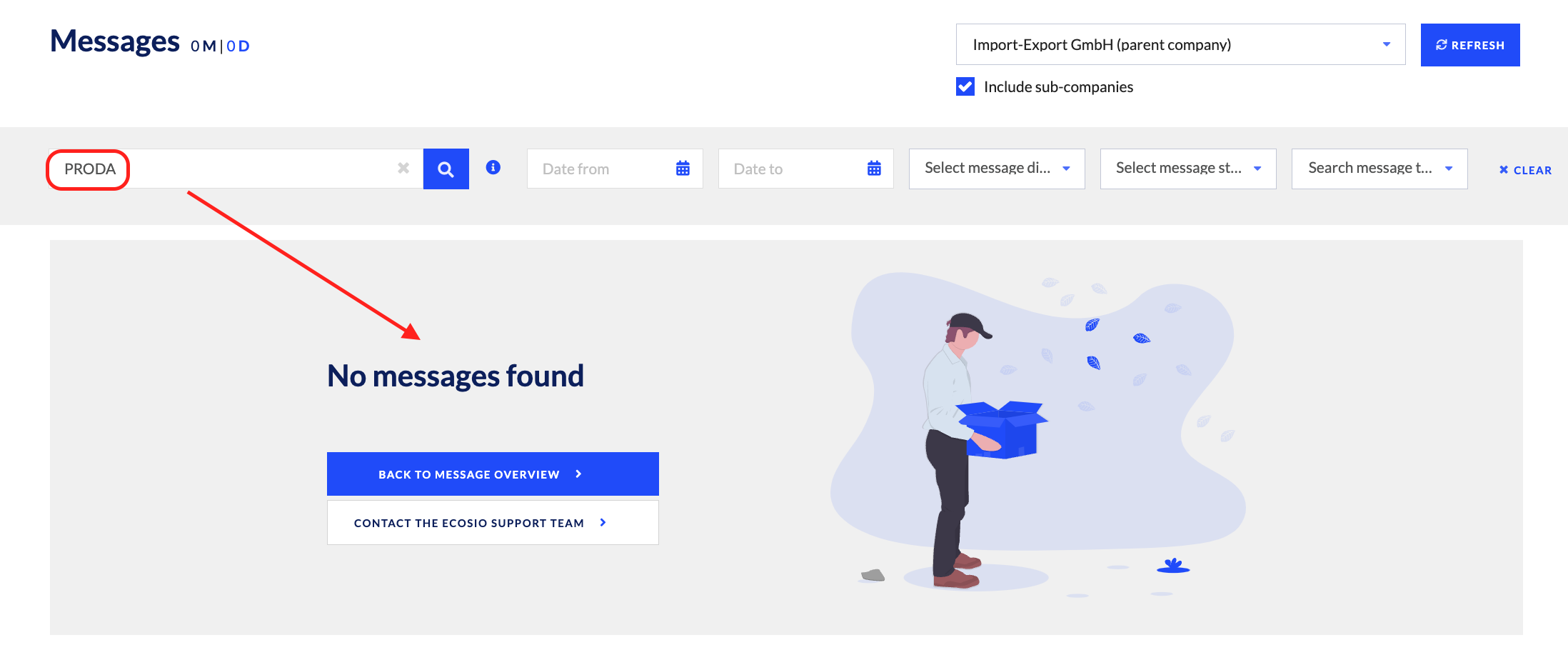
- Although partial terms can be searched and found (e.g. “PRODU” when the company name is “Production Inc.”), “incorrect” terms cannot be searched and found (e.g. “PRODA” when the company name is “Production Inc.”).
Testing
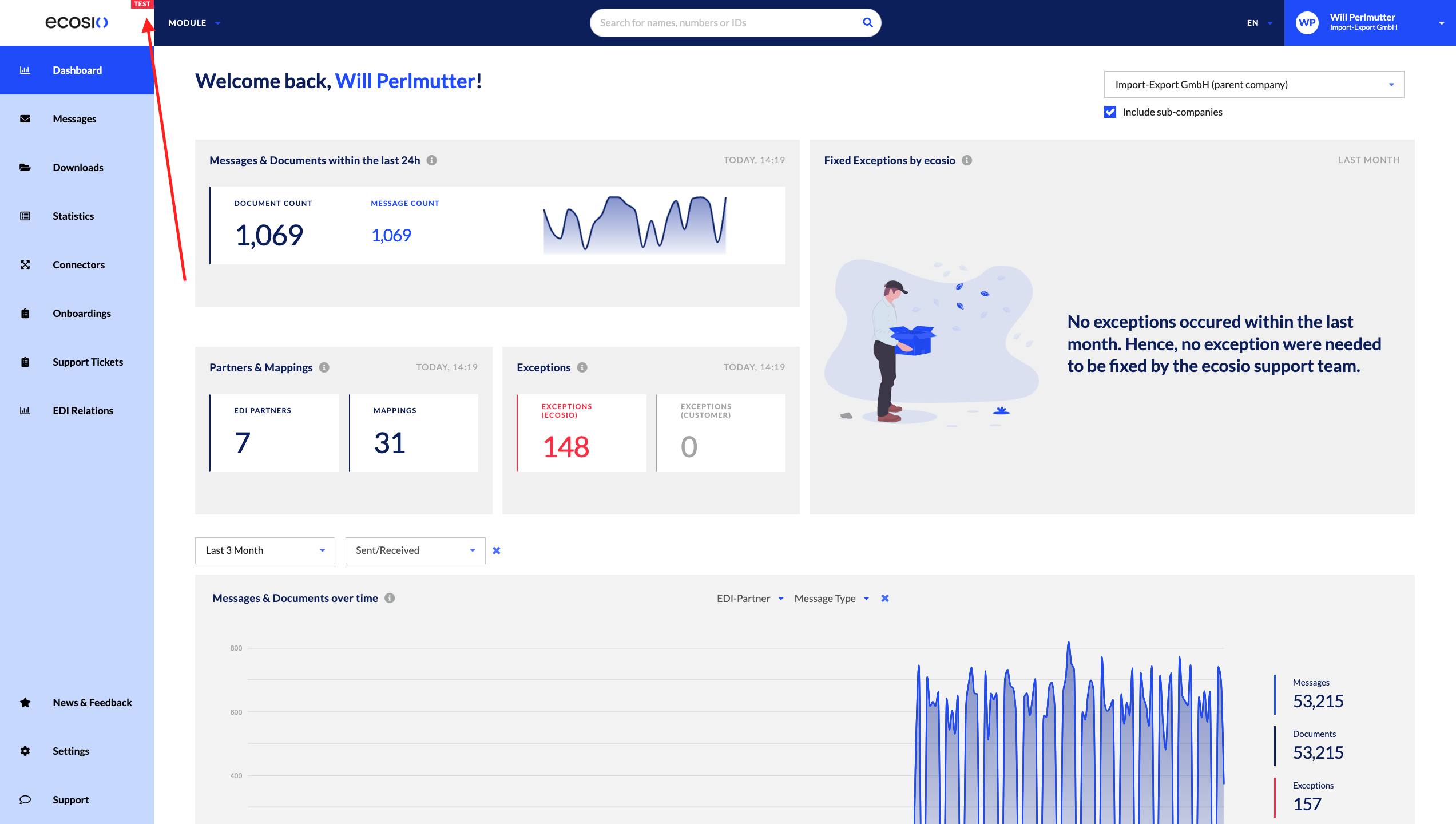
When onboarding, you can verify that the full-text search is fully operational This can be done by searching based on the step-by-step guide below within the TEST instance of the Monitor. You can ensure that you’re using the TEST instance of the Monitor by seeing the red “TEST” label applied to your Monitor instance in top left-hand corner of the screen:
Which actions can you take by using the full-text search feature?
While in the Message Overview menu entry, you can do the following while leveraging full-text search:
- Search to find messages based on content contained within the message
- Leverage advanced search commands
- Search for incomplete information (e.g. “PRODU” when the company name is “Production Inc.”)
- Is + is not (!)
Search based on message content
While using the full-text search functionality, you can search based on any of the columns listed in the message overview page. They are as follows:
- Status: The state the message is currently in as it passes through the ecosio integration hub. The following message statuses are listed:
- Received:
The message has been successfully parsed. Message type, sender and receiver have been successfully identified, and the message is ready for further processing. - Master data request received:
The message was received from ecosio Master Data and is further processed on the ecosio Integration Hub. - Request received:
This is the first state upon receipt of a message. The message has been stored as is, but message type, sender and receiver have not yet been identified. - Applied script:
A script has been applied to the message. - Converted:
A mapping (step) has been applied to the message. - Onboarding:
The message has been marked as test message during onboarding (setup) of a new relation and will not be processed further. - Re-sent:
The message has been queued for re-processing (re-sending). Configured mappings, scripts, etc. may be applied again. Then the message is sent out again via the configured communication channel. - Send-retry:
An attempt has been made for the message to be resent. After the maximum send attempts has been exhausted, the message becomes an EXCEPTION. - Parked:
The message has been stopped yet billed. - Halted:
The message has been stopped and not yet billed. - Picked up:
The message has been picked up from the receiver via Web EDI, API or SFTP (if hosted by ecosio). - Forward queue:
The message has been queued and will be sent out immediately (interim state). - Delivered (Web EDI):
The message is available to be picked up by the receiver via ecosio Web EDI. - Forwarded:
The message has been forwarded to the recipient and the receipt has been technically acknowleged. - Under review (ecosio):
The message exception is currently under review by ecosio. - Decoded:
The message has been decoded (decrypted) following its receipt. - Delivered (API):
The message is available for the receiver via the ecosio Integration Hub API. - Exception (ecosio):
The message is currently in an error state. Our ecosio support team has already been notified and will take care of it. We will contact you if required for mitigation. - Exception (customer):
The message is currently in an error state, which the customer needs to take care of. This is typically related to incorrect master data or double submission of the same message, etc. - Handled (customer):
The message was in an error state before, that required the customer to act (please see description of the preceding exception state). The sender was notified about this issue. Afterwards,the message has been marked as handled and won't be processed further. In case of questions, please contact ecosio’s support team. - Merged:
The message (document) has been merged with other messages (documents) into a single (batch) message. - Waiting for merge:
The message (document) is waiting to be merged by a periodic merge process. - Signed:
The message has been digitally signed. - Picked up, unacknowledged:
The message has been picked up by the receiver. The receiver is expected to acknowledge the receipt of the message soon. - Draft:
The message is currently stored as a draft. - Archived:
The message has been archived. - Forwarded part:
The message (containing multiple documents) has been split into single documents upon forwarding of the message. This state indicates that one of the split documents was forwarded. - Persistence queue:
The message has been processed on the hub and is ready to be delivered to the receiver (interim state) after checking if this relation is active. - Sent unacknowledged, long wait:
The message was sent out, but the recipient has not yet acknowledged the receipt of the message. However, acknowledgments from this recipient may take multiple hours or even days. - Sent unacknowledged:
The message has been sent to the recipient, but the receipt was not yet acknowledged. - Delivered:
The message has been processed on the hub and is ready to be delivered to the receiver (interim state). - Prepared for sending:
The message has been prepared (wrapped) according to the requirements of the protocol and is ready to be sent out. - Handled:
The message was in an error state before (please see description of the preceding exception state) and the ecosio support team has resolved the issue. You may have been notified about the error by the ecosio support team. Since this specific message can't be further processed, the message has been marked as handled. In case of questions, please contact the ecosio support team. - Processed:
The recipient has acknowledged the receipt and technical processing of the message. - Split:
The message contained multiple documents and has been split into multiple messages with a single document in each - Delivered (SFTP):
The message is available for the receiver via the ecosio-hosted SFTP server. - FORWARDED (on ecosio):
The message has been forwarded to the recipient and the receipt has been technically acknowleged.
- Received:
- In/Out
IN: Your company is the receiver of the message
OUT: Your company is the sender of the message - Last change: A timestamp of the last change made to the message.
- Sender: Which entity (partner or company) is sending or sent messages.
- Receiver: Which entity (partner or company) is receiving or received messages.
- Message type: A category of EDI messages containing the requirements for specific types of business transactions. Examples include: ORDERS, DESADV, INVOIC, etc.
- Document count: The number of documents contained within the message.
- Message reference: This is a unique identifier of the identified message. It is extracted by the integration hub from the document that has been transmitted by the sender.
- Document numbers: The invoice number(s) of an invoice contained in a message or interchange. It is extracted from EDIFACT BGM segments or from XML or json documents.
- Application reference: This reference is only available for EDIFACT document types, as part of the UNB segment of an EDIFACT document.
An example of searching based on a document number is shown below:
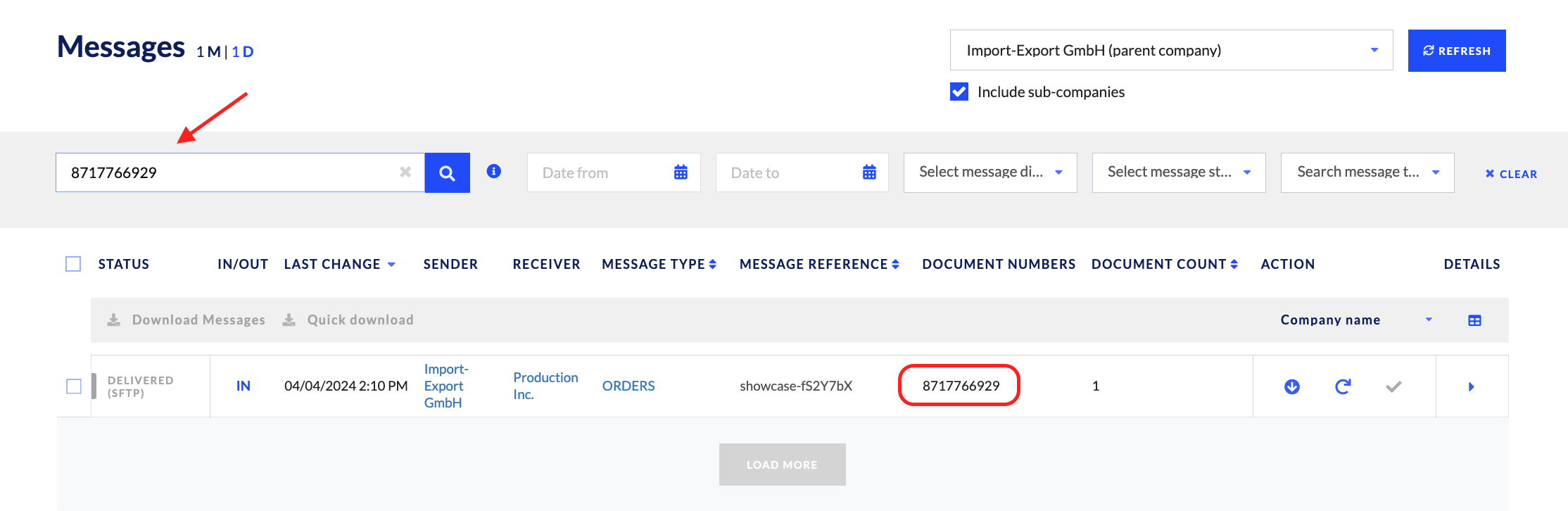
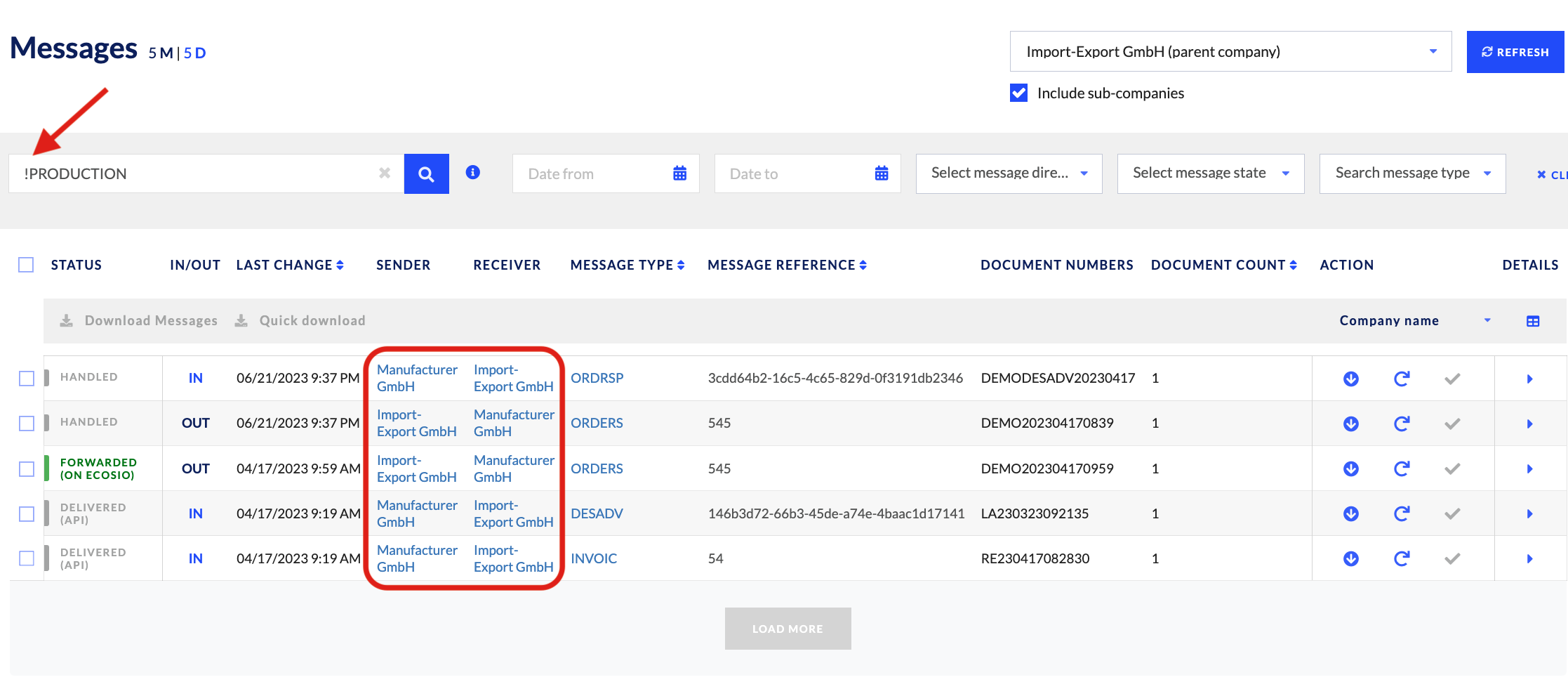
TipFor every search command, if you place an exclamation point (!) in front of the search query and it will pull up every message that is NOT mentioned in the string. An example is shown below with the search query “!PRODUCTION”:
Search based on “advanced search commands”
While using the full-text search functionality, you can search based on “advanced search commands”; the list of commands is available here:
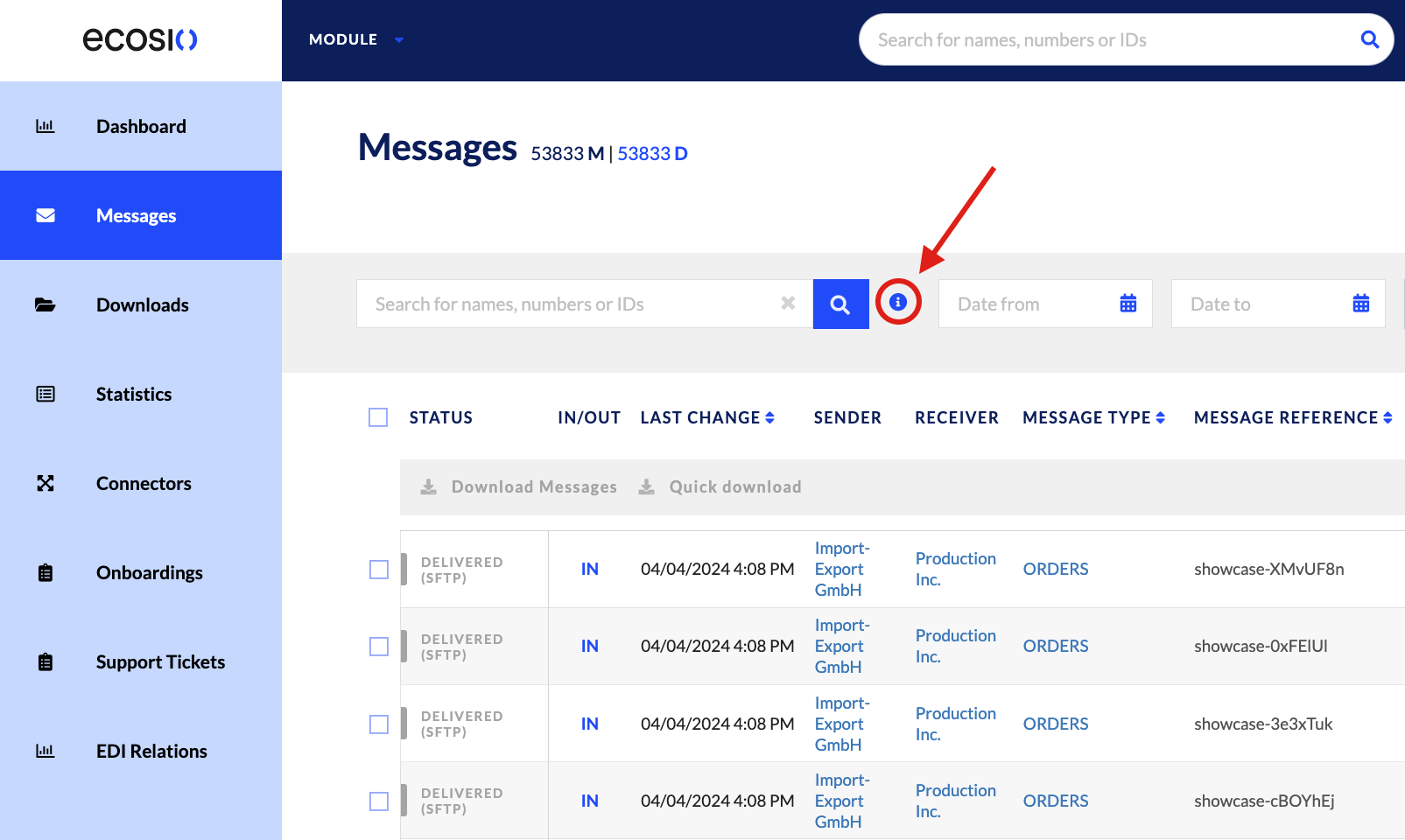
When clicking on the information icon, the following expands:
The following information is available in the “Advanced message search” modal that pops out upon clicking:
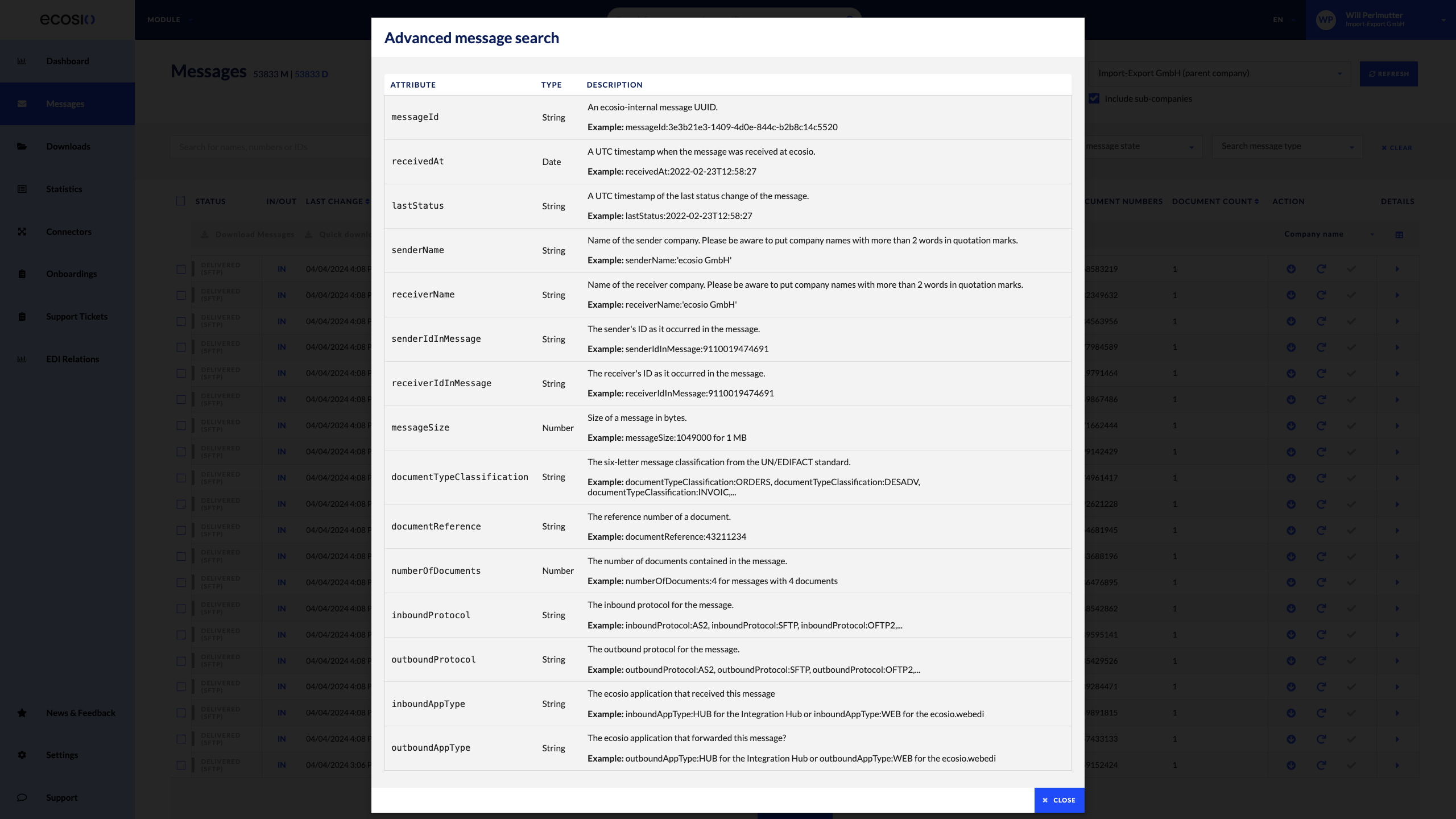
| Attribute | Type | Description |
|---|---|---|
| messageId | String | An ecosio-internal message UUID. Example: messageId:3e3b21e3-1409-4d0e-844c-b2b8c14c5520 |
| receivedAt | Date | A UTC timestamp when the message was received at ecosio. Example: receivedAt:2022-02-23T12:58:27 |
| lastStatus | String | A UTC timestamp of the last status change of the message. Example: lastStatus:2022-02-23T12:58:27 |
| senderName | String | Name of the sender company. Please be aware to put company names with more than 2 words in quotation marks. Example: senderName:'ecosio GmbH' |
| receiverName | String | Name of the receiver company. Please be aware to put company names with more than 2 words in quotation marks. Example: receiverName:'ecosio GmbH' |
| senderIdInMessage | String | The sender's ID as it occurred in the message. Example: senderIdInMessage:9110019474691 |
| receiverIdInMessage | String | The receiver's ID as it occurred in the message. Example: receiverIdInMessage:9110019474691 |
| messageSize | Number | Size of a message in bytes. Example:messageSize:1049000 for 1 MB |
| documentTypeClassification | String | The six-letter message classification from the UN/EDIFACT standard. Example: |
| documentReference | String | The reference number of a document. Example: documentReference:43211234 |
| numberOfDocuments | Number | The number of documents contained in the message. Example: numberOfDocuments:4 for messages with 4 documents |
| inboundProtocol | String | The inbound protocol for the message. Example: inboundProtocol:AS2, inboundProtocol:SFTP, inboundProtocol:OFTP2,... |
| outboundProtocol | String | The outbound protocol for the message. Example: outboundProtocol:AS2, outboundProtocol:SFTP, outboundProtocol:OFTP2,... |
| inboundAppType | String | The ecosio application that received this message. Example: inboundAppType:HUB for the Integration Hub or inboundAppType:WEB for the ecosio.webedi |
| outboundAppType | String | The ecosio application that forwarded this message. Example: outboundAppType:HUB for the Integration Hub or outboundAppType:WEB for the ecosio.webedi |
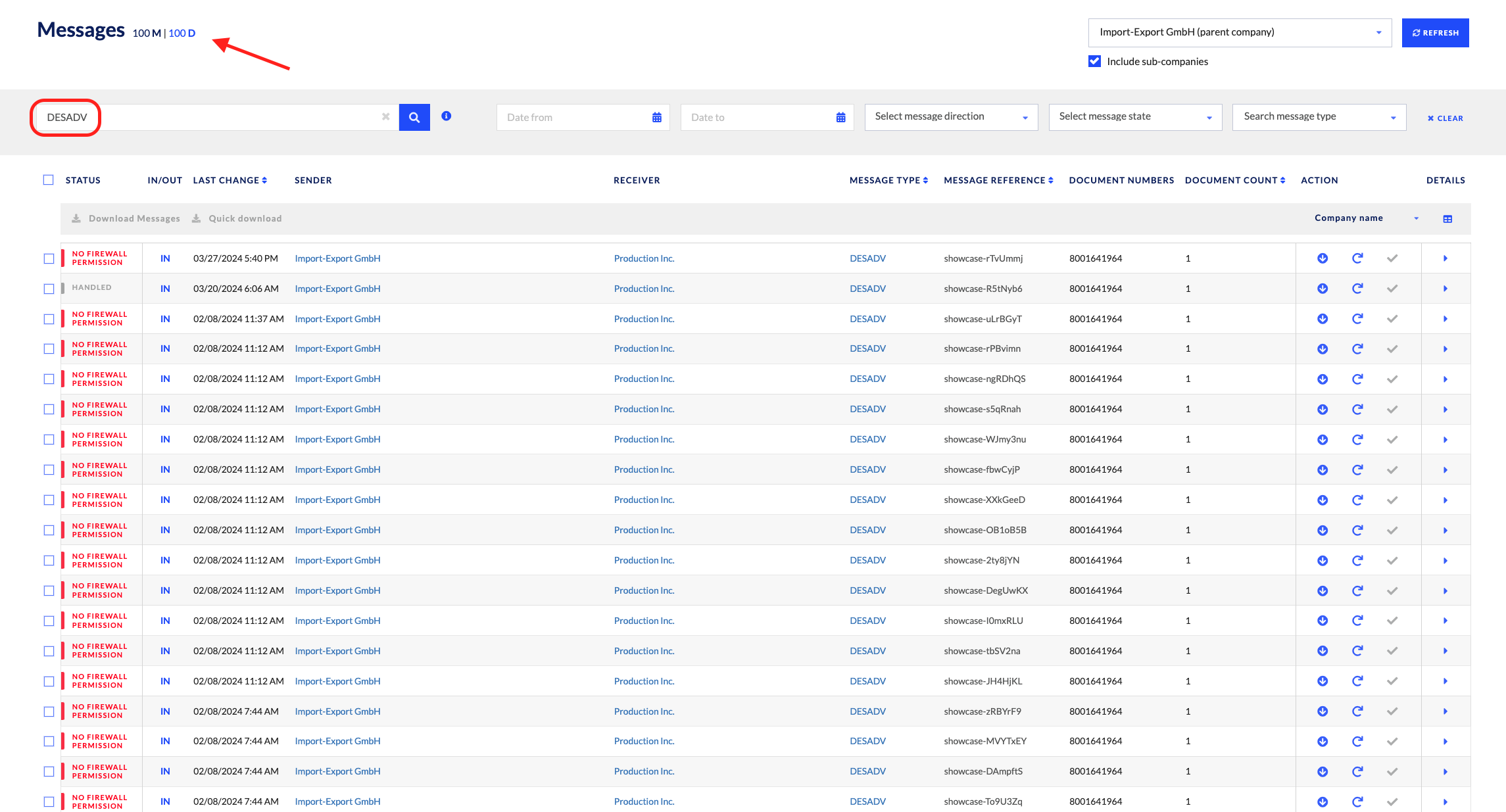
Below is an example of a “documentTypeClassification” advanced search command:
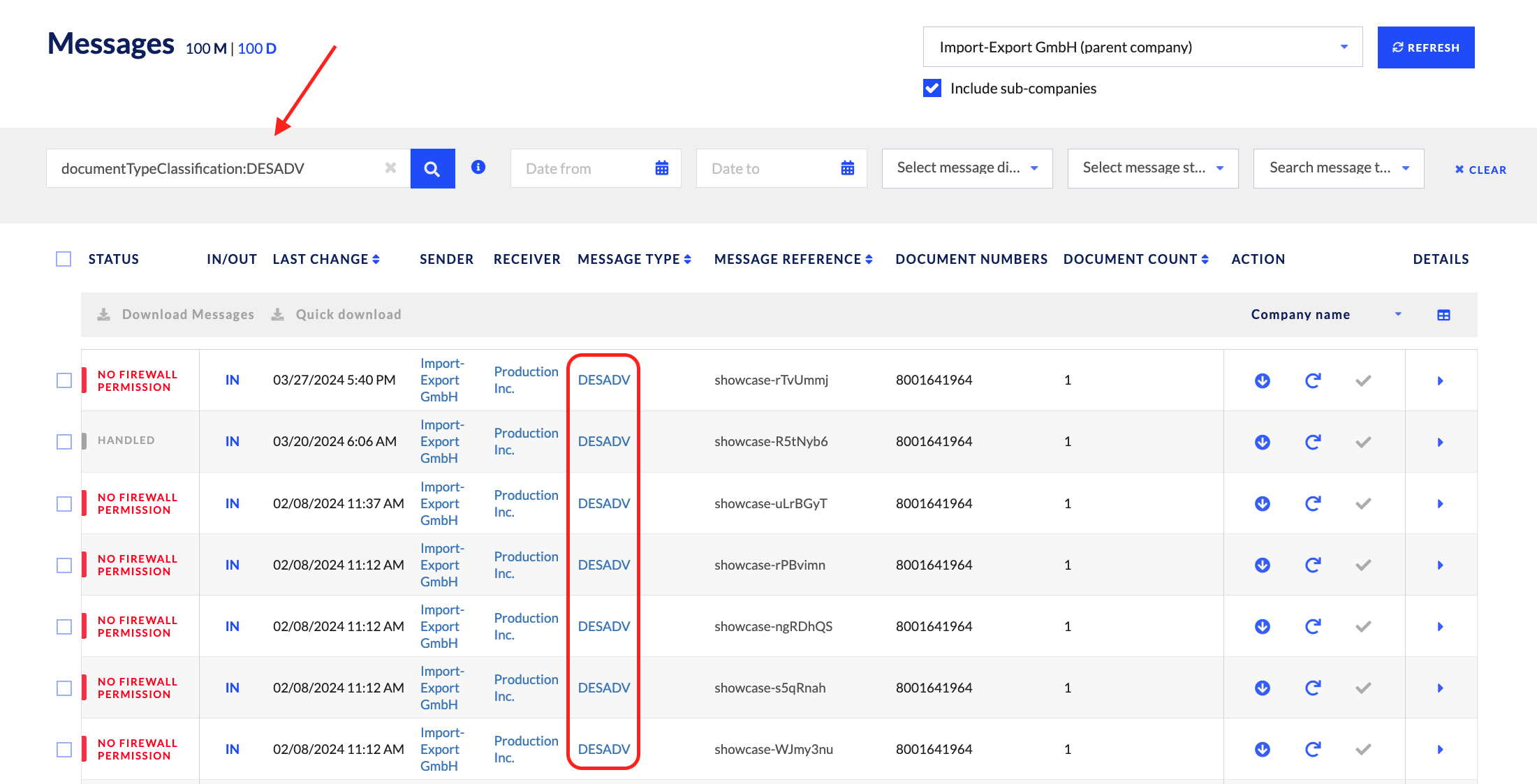
TipBesides the advanced message search strings, you can also search directly by typing what you see in a message column.
The example above would also work by searching for “DESADV”, as seen below:
You’ll see the message and document count in this example is the same in both images; however, in order to be absolutely certain of all messages fitting certain search criteria, the advanced message search is the best way to ensure that all messages are counted.
Search based on incomplete strings (but not incorrect strings)
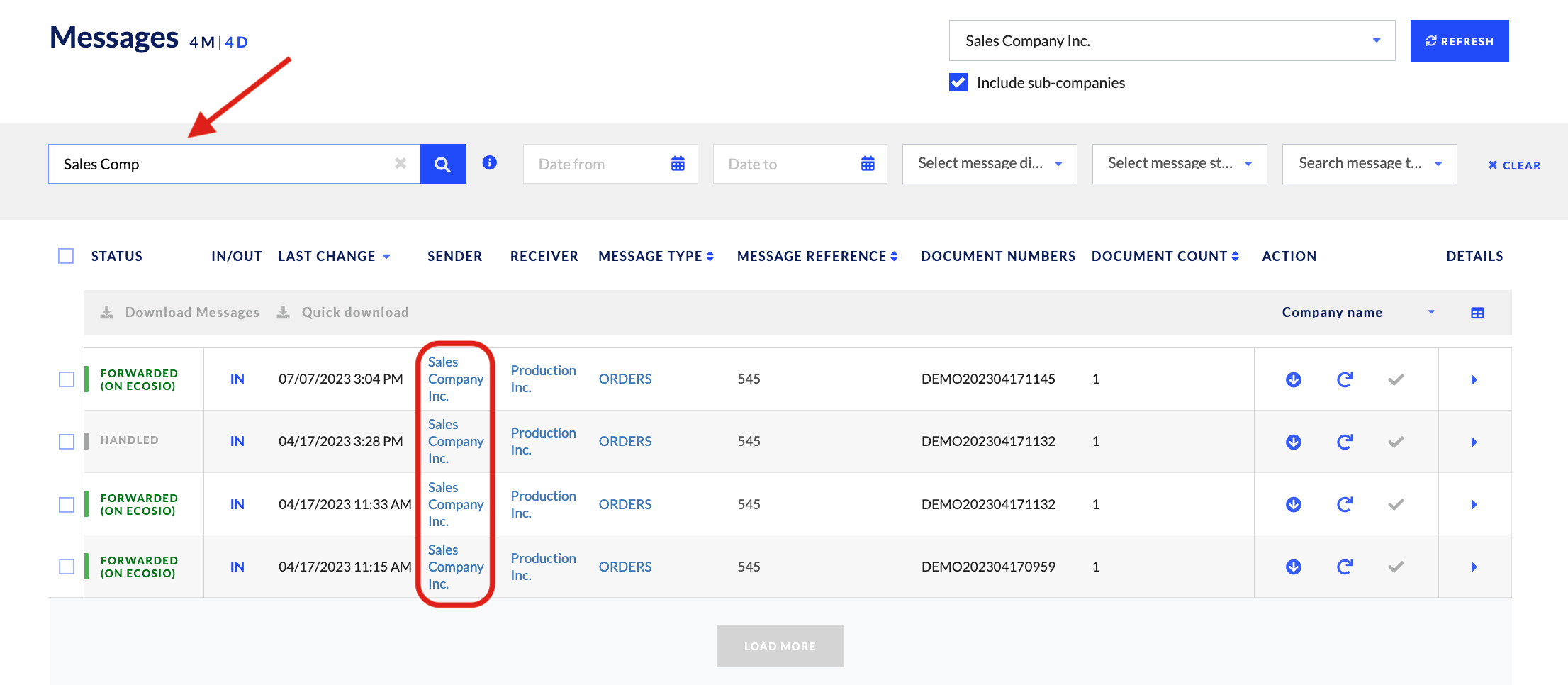
You can use the full-search functionality to find messaging information based on incomplete strings. Below is an example where the search query is “Sales Comp”; by doing so, all messages where the sender is “Sales Company Inc.” appear.
TipAlthough partial terms can be searched and found (e.g. “PRODU” when the company name is “Production Inc.”), “incorrect” terms cannot be searched and found (e.g. “PRODA” when the company name is “Production Inc.”). See the example below for a clear view on what happens when the string is “incorrect”:
FAQs
If messages aren’t being displayed with my search query, what is the problem?
- There is a either a bug or misconfiguration of the document type. No matter the case, please file a bug report via featurebase by hitting the “News & Feedback” button.
Why are senders and receivers appearing in search queries that were not searched for?
- The search query is not specific enough. In order to narrow down search commands, users should use advanced search commands as described above.
- The sender or receiver is mentioned within the contents of the message(s) being queried. To check, view message contents and see if indeed the undesired sender or receiver searched is in the message contents.
Updated 10 days ago