
Peppol overview
Peppol is a global network for the secure and standardised exchange of structured business documents such as electronic invoices (e-invoices). It’s a set of technical standards and protocols that enable uniform data exchange across diverse business and government systems.
Businesses connect to all participating countries via a single Peppol certified Access Point. This ensures consistent e-invoicing across different countries and ongoing compliance with evolving regulations. A certified Peppol Access Point is a gateway that connects businesses to the Peppol network, enabling businesses to send and receive electronic documents that meet Peppol interoperability requirements. For more information on Peppol, see the official guide.
Format
The core of a Peppol document is an XML file that must meet strict hierarchy of standards.
- The document must be an XML file using UBL as the base format.
- Within the EU the content must adhere to the EN 16931 standard for e-invoicing, ensuring data consistency. Outside of the EU the document must comply with Peppol International Invoice (PINT), which is based on EN 16931 but adapted for global use.
- The document’s technical rules are defined by Peppol Business Interoperability Specifications (BIS). These profiles control the exchange protocols and content for specific documents, such as invoices.
- If necessary, the document is localised using a country-specific CIUS. This ensures the document meets all national legal and fiscal requirements.
Automated document transmission flow
The following diagram and steps illustrate the Peppol 4-corner flow.
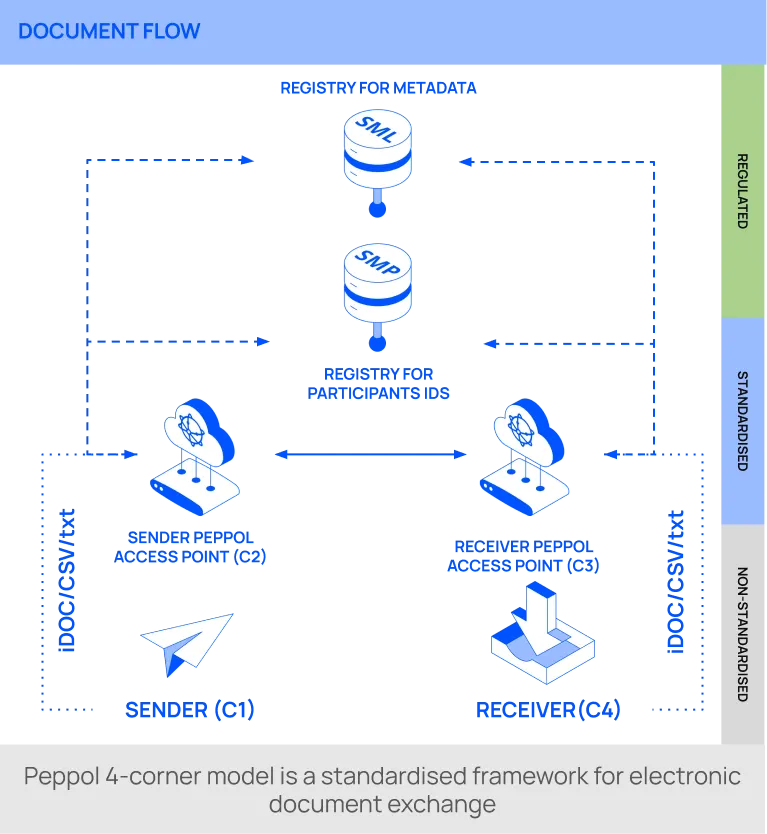
- Corner 1: The supplier sends the document to their Peppol Access Point in a structured format, such as CSV or XML.
- Corner 2: The supplier’s Access Point performs the following actions:
- Queries the Service Metadata Locator (SML), which maintains the participant registry to identify the Peppol participant.
- Queries the Service Metadata Publisher (SMP), which stores the participant’s Access Point and documents they can receive.
- Validates and converts the document to the buyer’s required format.
- Corner 3: The buyer’s Access Point retrieves the document and converts it into the format required for their ERP or business software.
- Corner 4: The document is delivered to the buyer’s ERP or business software.
Some governments are transitioning to a 5-corner model. This model adds a fifth corner such as a tax authority clearance platform between the two Access Points. This ensures the tax authority has a record of the transaction before it’s completed.
Updated 10 days ago