
Compliance for Portugal
Portugal mandates e-invoicing for B2G transactions, and e-reporting for all transaction types. Invoice data must be produced by billing software certified by Autoridade Tributária e Aduaneira (AT) and reported using the Portuguese version of Standard Audit File for Tax Purposes (SAF-T (PT)) billing process.
NoteThis page covers B2G e-invoicing exchange only. SAF‑T (PT) data is generated by your AT‑certified billing software and included in the invoice data sent to ecosio. For more information about SAF-T (PT), see Decreto-Lei n.º 28/2019 and Portaria n.º 302/2016.
Document requirements
In Portugal, all invoices must be generated and signed using AT-certified billing software, and the resulting invoice data must be reported to the Tax Authority via the SAF-T (PT) billing process. This applies regardless of whether invoices are exchanged as structured e-invoices or in other formats.
For B2G transactions, invoices must also be exchanged as structured e-invoices in a CIUS-PT compliant format through designated government channels. Exchange with public administrations is typically handled via the Fatura Eletrónica na Administração Pública (FE-AP) platform, managed by Entidade de Serviços Partilhados da Administração Pública (eSPap), Portugal’s Public Administration Shared Services Entity. Some public entities may exchange invoices through alternative service providers in specific cases.
Portugal compliance summary
Learn more about compliance transaction terms and concepts.
| Aspect | Description | Requirement |
|---|---|---|
| Invoices exchanged between businesses. | Mandatory reporting via SAF-T Billing process | |
| Invoices issued by businesses to consumers. | Mandatory reporting via SAF-T Billing process | |
| Invoices issued by businesses to public administrations for public procurement. | Mandatory exchange and reporting via SAF-T Billing process | |
| Electronic signature | Signature or seal rules for authenticity and integrity of e‑invoices. | Qualified electronic signature (QES) mandatory on PDF e-invoices from 1 January 2027. A hash value must be generated by certified billing software for every invoice, regardless of format. |
| Legal archiving | Minimum retention period for e‑invoices. | 10 years |
| Model | The e-invoicing flow model used by the country. | Clearance via the SAF-T billing process, previous to e-invoice exchange |
| Platform | The government-managed platform for e-invoicing. | FE-AP (eSPap) central platform, though not all public administrations are obligated to use this. |
| Supported format | The e-invoicing format legally required by the country. | |
| Automatic updates | Whether invoice status updates synchronise automatically in Monitor. | Yes |
Format
B2G invoices must align with the EN 16931 standard and follow the country-specific CIUS known as CIUS-PT. For technical specifications, see the CIUS-PT Technical Standard.
Invoice types
The following invoice type codes are used in CIUS-PT for B2G invoices.
| Document | Code | Description |
|---|---|---|
| Accepted reinsurance | RA | Document used for reinsurance operations. |
| Allocation to co-insurers | CS | Document type specific to insurance co-insurers. |
| Allocation to lead co-insurer | LD | Used when the lead insurer issues to co-insurers. |
| Credit note | 381 | Used to correct amounts or settle a balance between a supplier and a buyer. |
| Credit note | NC | Equivalent to code 381. |
| Debit note | 383 | A document issued by a supplier to apply additional charges or increase the total value of a previously issued e-invoice. |
| Debit note | ND | Equivalent to code 383. |
| Invoice | 380 | Standard sales invoice. |
| Invoice issued under Article 36 of the VAT Code | FT | Regular VAT invoice. |
| Invoice receipt | FR | Invoice that simultaneously serves as a receipt. |
| Premium or premium receipt | RP | Used in insurance for premium payments. |
| Prepayment or advance invoice | 386 | Issued when payment is received before the supply of goods or services. |
| Reversal or refund receipt | RE | Used in insurance for returned premiums. |
| Self-billed invoice | 389 | A document that a buyer must create and report to the tax authorities to account for an invoice received from a foreign supplier, which is an import. This is a statutory tax reporting requirement and is separate from the self-billing process used in other industries.. |
| Simplified invoice | FS | Used for low-value transactions. |
Automated e‑invoicing flow
ecosio enables you to automate the transmission of compliant invoices for B2G invoices in Portugal.
B2G invoice flow
The following steps illustrate the process for B2G invoices in Portugal.
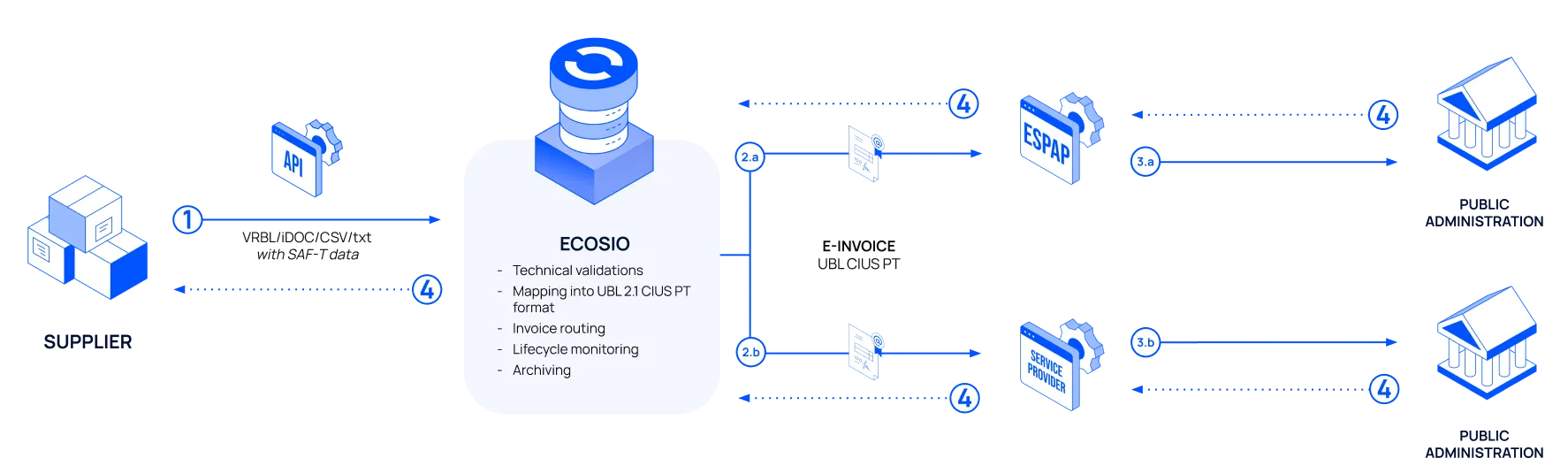
- You send the invoice data from your ERP or business software to ecosio in a structured format, such as VRBL. The data includes SAF-T information previously generated via your certified billing software.
- Once received, ecosio converts the structured format into the UBL 2.1 format and validates that all mandatory fields are present in accordance with technical requirements. ecosio sends the invoice in one of two ways.
- If the public administration is connected to eSPap, the invoice is sent to the FE-AP portal (FE-AP).
- If the public administration is identified as not connected to eSPap, the invoice is sent to their service provider.
- The invoice reaches the public administration in one of two ways, depending on how it was sent.
- If the invoice was sent to the FE-AP portal, eSPap routes the invoice to the public administration identified in the invoice.
- If the invoice was sent to a service provider, they send the invoice to the public administration identified in the invoice as the final recipient.
- Life cycle statuses can be sent back to ecosio via eSPap and service providers, and made available in the Monitor and through integrations.
Legal and technical resources
The following official documents define the legal and technical framework for e-invoicing and reporting in Portugal.
- Decreto-Lei n.º 111-B/2017: Establishes the public procurement e-invoicing obligation and transposes EU Directive 2014/55/EU into Portuguese law.
- Decreto-Lei n.º 14-A/2020: Introduces phased deadlines and transitional rules for suppliers and public entities.
- eSPap technical and functional standards: Provides CIUS-PT technical specifications and validation artefacts.
Updated 9 days ago