
E-invoicing in Australia
Australia has adopted Peppol for e-invoicing. The Australian Taxation Office acts as the Peppol authority. Peppol access points must be accredited by the Australian Taxation Office.
As of July 2022, non-corporate Commonwealth entities are required to be able to receive e-invoices. The Australian Taxation Office promotes using Peppol for B2G transactions.
Australia doesn't mandate B2B or B2C e-invoicing. However, the Australian Government and the Australian Taxation Office encourage Peppol e-invoicing. As a result, the number of Peppol-enabled businesses is rising steadily.
Terms and abbreviations
The following terms and abbreviations are specific to e-invoicing in Australia.
| Abbreviation | Term | Description |
|---|---|---|
| ATO | Australian Taxation Office | Australian tax authority. Also acts as the Peppol authority. |
| NCE | Non-corporate Commonwealth entity | A government body that is legally and financially part of the Commonwealth of Australia. |
| PINT A-NZ | Peppol International specifications for Australia and New Zealand | Specialisations of Business Interoperability Specifications (BIS) using the Peppol International (PINT) methodology for Australia and New Zealand. |
Mandate at a glance
The following table contains a summary of the Australian e-invoicing mandate.
Learn more about compliance transaction terms and concepts.
| Aspect | Description | Requirement |
|---|---|---|
| B2B | Invoices exchanged between businesses. | Voluntary |
| B2C | Invoices issued by businesses to consumers. | Voluntary |
| B2G | Invoices issued by businesses to public administrations for public procurement. | NCEs are required to be able to receive e-invoices |
| Electronic signature | Signature or seal rules for authenticity and integrity of e‑invoices. | Not required |
| Legal archiving | Minimum retention period for e‑invoices. | Five years |
| Model | E-invoicing flow model used by the country. | Interoperability |
| Platform | Government-managed platform or network used for e-invoicing. | Peppol |
| Supported format for e-invoicing | E-invoicing formats used in the country. | |
| Automatic updates | Whether invoice status updates synchronise automatically in the Monitor. | Yes |
Timeline
All NCEs required to be able to receive e-invoices
ecosio's solution
ecosio is an accredited Peppol service provider in Australia. This means that ecosio acts as your sender access point for the accounts receivable flow and the receiver access point for the accounts payable flow. ecosio doesn't send any e-invoicing data to the ATO.
Accounts receivable
The following diagram and steps illustrate the AR process.
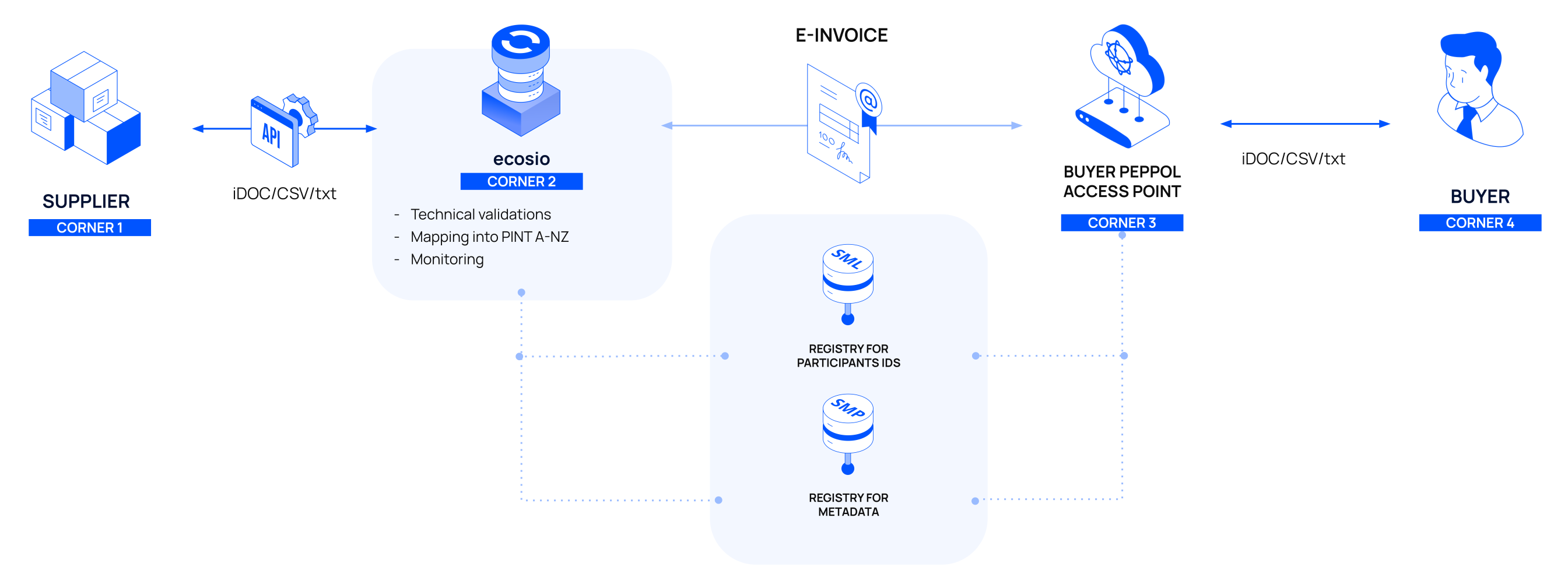
- You (corner 1) send the invoice data from your ERP system to ecosio in the agreed format.
- ecosio (corner 2) validates the received invoice data and converts it into the relevant PINT A-NZ format.
- ecosio sends the invoice to the buyer's access point (corner 3).
- The buyer's access point validates the invoice.
- Depending on the results of the validation, one of the following happens:
- If the validation succeeds, the buyer's access point transmits the invoice to the buyer's ERP system (corner 4).
- If the validation fails, the buyer's access point notifies ecosio and the buyer's ERP system.
- ecosio stores the e-invoice data so that you can access it via the Monitor or the Messaging APIs.
Accounts payable
The following diagram and steps illustrate the AP process.
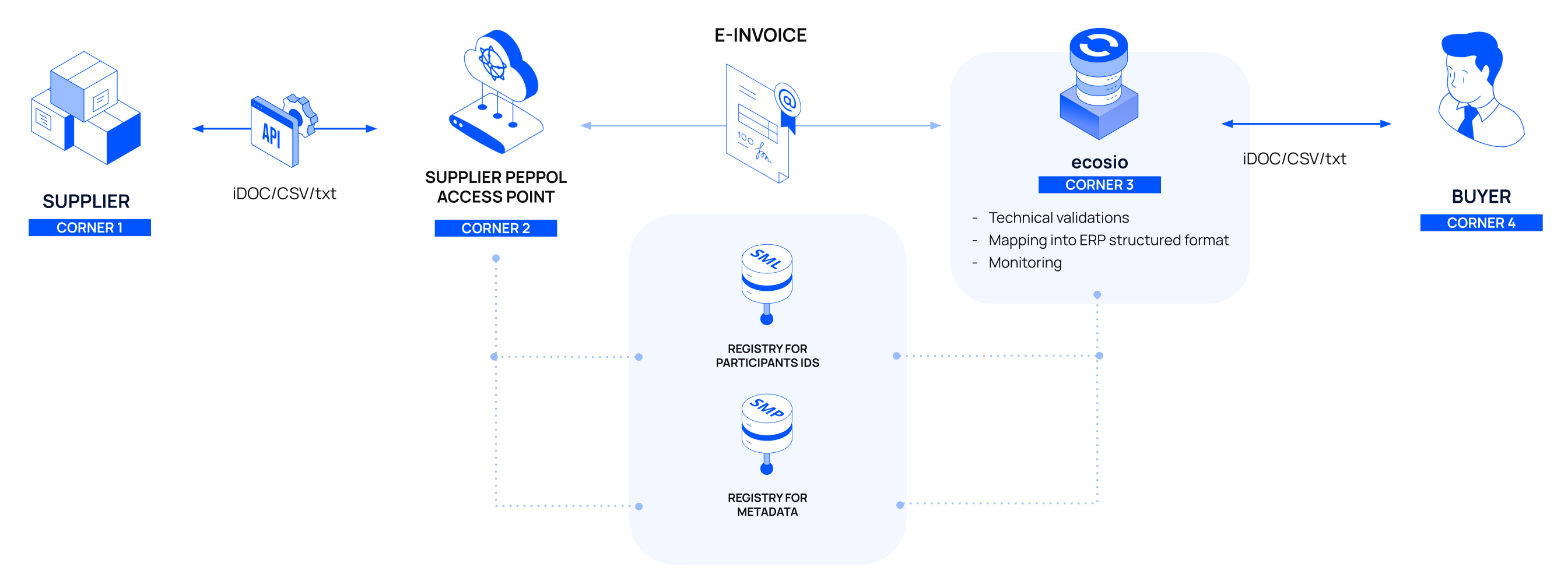
- The supplier's ERP system (corner 1) sends the invoice data to their access point (corner 2).
- The supplier's access point transmits the invoice to ecosio (corner 3) in the relevant PINT A-NZ format.
- ecosio validates the invoice.
- Depending on the results of the validation, one of the following happens:
- If the validation succeeds, ecosio converts the invoice to the agreed format and makes it available to you (corner 4).
- If the validation fails, ecosio notifies the supplier's access point.
Archiving
ecosio stores invoice data for three months. During this time, you can download all the required data for long-term archiving. Australian law requires you to retain records for a minimum of five years.
Updated 1 day ago