
Compliance for India
India mandates registration of some B2B and B2G invoices and transport documents through Invoice Registration Portals (IRPs) in the Goods and Services Tax (GST) e-invoice system. You access IRP services through the GST e-invoice portal. The GST e-invoicing system is operated under the Goods and Services Tax Network (GSTN).
Businesses with a total turnover over ₹5 crore must issue e-invoices for B2B transactions. B2G e-invoicing is mandatory when supplying to GST-registered government entities.
Document requirements
B2B invoices must be registered through an IRP. B2G e-invoices must also be registered when supplying to GST-registered government entities. There is no existing mandate for B2C transactions.
India compliance summary
Learn more about compliance transaction terms and concepts.
| Aspect | Description | Requirement |
|---|---|---|
| B2B | Invoices exchanged between businesses. | Mandatory for businesses with total turnover over ₹5 crore. |
| B2C | Invoices issued by businesses to consumers. | Optional |
| B2G | Invoices issued by businesses to public administrations for public procurement. | Mandatory when supplying to GST-registered government entities. |
| Electronic signature | Signature or seal rules for authenticity and integrity of e‑invoices. | Invoices are digitally signed by an IRP. |
| Legal archiving | Minimum retention period for e‑invoices. | 6 years |
| Model | The e-invoicing flow model used by the country. | Clearance |
| Platform | The government-managed platform for e-invoicing. | Managed by GSTN through IRPs. |
| Supported format | The e-invoicing format legally required by the country. | JSON per the GST e-invoice schema is mandatory for registration. |
| Automatic updates | Whether invoice status updates synchronise automatically in Monitor. | Yes |
Format
India’s e-invoice format is based on a local JSON schema defined for GST e-invoicing. For technical specifications, see the GST documentation.
Invoice types
The document type code element within the invoice must contain one of the following codes.
| Document | Code | Description |
|---|---|---|
| Credit note | CN | Used to correct amounts or settle a balance between a supplier and a buyer. |
| Debit note | DN | A document issued by a supplier to apply additional charges or increase the total value of a previously issued e-invoice. |
| Invoice | INV | An invoice for goods or services from a supplier to a buyer. |
Automated e‑invoicing flow
ecosio enables you to automate the registration and retrieval of compliant e-invoices for India.
Accounts receivable flow
The following diagram and steps illustrate the AR process for e-invoices in India.
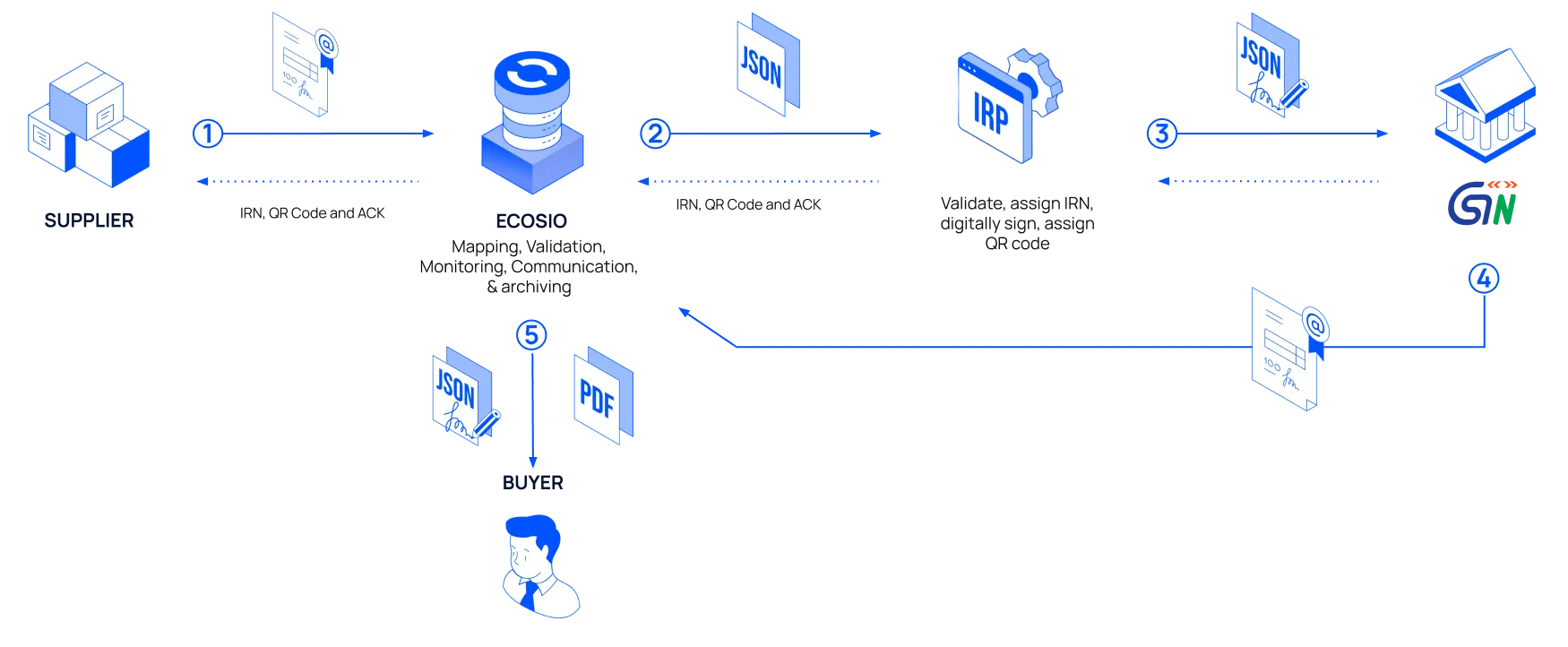
- You send the invoice data from your ERP or business software to ecosio in a structured format, such as VRBL, CSV, or IDoc.
- ecosio validates the invoice data and converts it into the JSON format required by the IRP.
- The invoice is forwarded to an IRP in the GST e-invoicing system for registration. The IRP generates an Invoice Reference Number (IRN), digitally signs the invoice, and generates a QR code containing key invoice data.
- The IRP returns the validated, signed invoice to ecosio.
- You deliver the invoice to the buyer using your agreed delivery method, for example, as a PDF that includes the QR code.
Accounts payable flow
The following diagram illustrates the AP process for e-invoices in India.
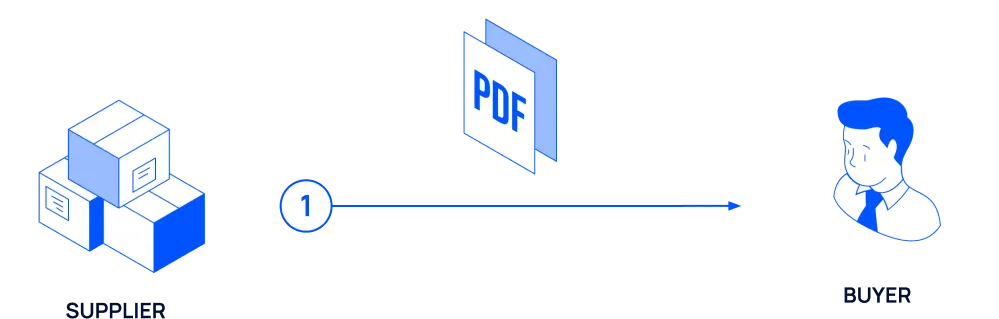
You receive the invoice from the supplier using your agreed delivery method, for example as a PDF. You can verify the QR code using GST e-invoice verification options, for example by scanning it using the mobile app or by uploading the signed invoice data to the GST e-invoice portal.
E-transport requirements
India mandates transport controls for the movement of goods through the e-way bill framework. The e-way bill is a digital document used to declare the movement of goods within India. The e-way bill system is operated by the National Informatics Centre (NIC), a government organisation that provides digital services and platforms. You report transport details to NIC, and NIC validates the submission and generates the e-way bill number and validity period.
Before the NIC can generate an e-way bill, you submit transport details and supporting document details. The GSTN E Way Bill API Developer's Portal lists the required information depending on your requirements.
You can report e-way bill data to NIC in three ways, depending on your business process:
- Create the e-way bill together with an e-invoice.
- Create the e-way bill from an already registered e-invoice using the Invoice Reference Number (IRN).
- Create a standalone e-way bill.
For official guidance, see the NIC project page.
Outbound
ecosio enables you, as a supplier, to automate the transmission of e-way bill data to NIC. The following diagram and steps illustrate this process.
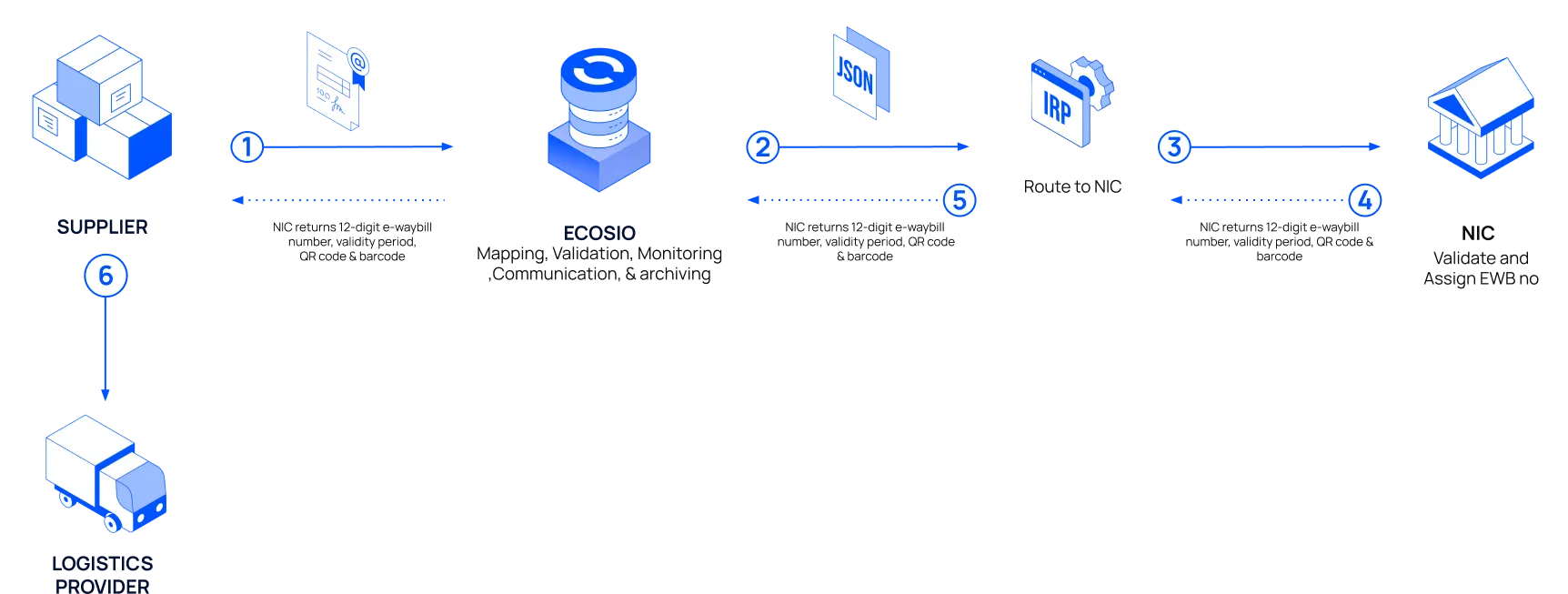
- You send the e-way bill data from your ERP or business software to ecosio in a structured format, such as VRBL.
- ecosio validates the data and converts it into the JSON format required by NIC.
- ecosio submits the e-way bill data for creation. If you create the e-way bill together with an e-invoice, ecosio first submits the e-invoice to an IRP in the GST e-invoicing system for registration, which generates the IRN and routes the relevant data onwards for e-way bill generation.
- NIC validates the submission and generates an e-way bill number and validity period.
- The generated e-way bill details are returned to ecosio and made available for you to obtain.
- You provide the carrier with the e-way bill number for use during transit.
Inbound
The following diagram and steps illustrate the inbound process for e-way bills in India.
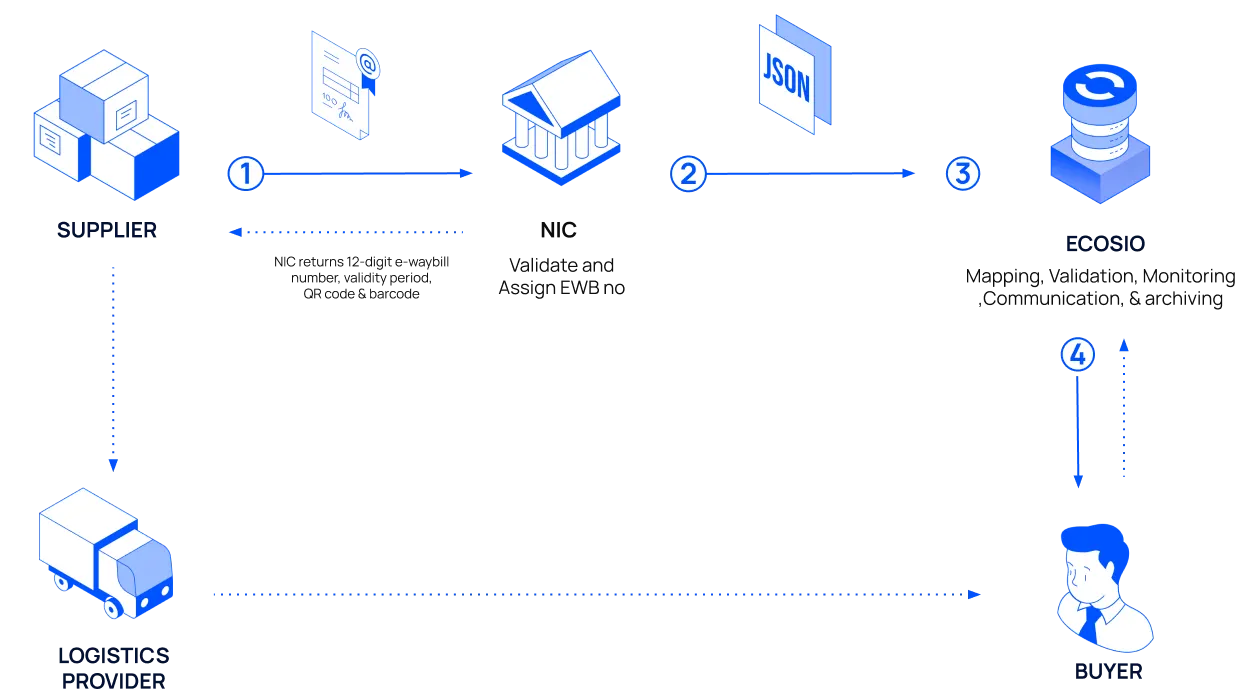
- The supplier reports the transport details to NIC and specifies you as the recipient.
- NIC validates the submission and generates an e-way bill number and validity period.
- ecosio retrieves the e-way bill data and sends it to your system.
- The supplier provides the e-way bill number to the carrier for use during transit.
Legal resources
The following official documents define the legal and technical framework for e-invoicing in India.
- Central Goods and Services Tax Rules, 2017 (Rule 48): Legal basis for GST invoicing and the e-invoicing mechanism.
- GST Tutorials: Official user guides for GST portal processes.
- GSTN E-invoicing Overview: Overview of e-invoicing under GST.
Updated 9 days ago