
Compliance for Greece
Greece requires businesses to submit invoice and accounting data to the Independent Authority for Public Revenue (AADE) through myDATA. This reporting includes sales invoices, expenses, payroll, and other tax-relevant entries.
Issued invoice data is sent immediately when you use a certified provider. Businesses can send other records later, such as expenses, based on AADE deadlines.
In parallel, B2G e-invoicing is mandatory, and Greece is rolling out B2B structured e-invoicing in phases. E-transport is also mandated for reporting for the movement of goods.
Certified e-invoicing providers are AADE-approved service providers that can issue structured e-invoices and submit the required data to myDATA on your behalf. This is mandatory for B2G e-invoicing. For other scopes, businesses can use certified providers as an alternative route.
Document requirements
Greece requires structured e-invoicing for B2G invoicing and is rolling out mandatory structured e-invoicing for domestic B2B transactions in phases.
Greece compliance summary
Learn more about compliance transaction terms and concepts.
| Aspect | Description | Requirement |
|---|---|---|
| Invoices exchanged between businesses. | Mandatory for large businesses and for all other businesses from 2 November 2026, with a gradual implementation period until 31 January 2027. | |
| Invoices issued by businesses to consumers. | Structured e-invoicing is not required. Businesses must still report | |
| Invoices issued by businesses to public administrations for public procurement. | Mandatory | |
| Electronic signature | Signature or seal rules for authenticity and integrity of e‑invoices. | Optional |
| Legal archiving | Minimum retention period for e‑invoices. | 10 years for real estate and some public contracts. 5 years for all other invoices. |
| Model | The e-invoicing flow model used by the country. | Clearance |
| Platform | The government-managed platform for e-invoicing. | AADE manages myDATA for reporting and identifier assignment. |
| Supported format | The e-invoicing format legally required by the country. | Based on the EN 16931 standard and Peppol BIS |
| Automatic updates | Whether invoice status updates synchronise automatically in Monitor. | Yes |
Format
Greece’s B2G e-invoicing requirements are aligned to the European standard EN 16931. In practice, suppliers commonly exchange B2G e-invoices using Peppol BIS Billing 3.0, which is a Peppol specification that implements EN 16931 and is typically exchanged as a UBL 2.1 XML document.
For B2B transactions, businesses may still exchange a human-readable PDF, such as by email, while meeting the myDATA reporting obligation. Once myDATA accepts the invoice data, AADE assigns a unique registration number known as a MARK for the submitted invoice data. The MARK confirms the transmission. You can reference the MARK on the invoice’s human-readable copy, such as a PDF.
If you generate or share a PDF copy for readability, it’s only a copy and doesn't replace the compliant electronic invoice. The PDF must include the MARK and a QR code to support invoice verification.
In Greece, myDATA also uses bookkeeping classifications to categorise transactions:
- Income classifications apply to issued (AR) documents.
- Expense classifications apply to received (AP) documents.
Depending on the reporting method, you submit classifications together with the invoice data or as a follow-up submission or correction.
Invoice types
The Invoice Type Code element within the invoice must contain one of the codes for invoices or credit notes from the UNTDID 1001 code list.
Automated e-invoicing flow
ecosio enables you to automate the transmission of compliant e-invoices for both accounts receivable (AR) and accounts payable (AP) flows in Greece.
Accounts receivable flow
The following diagram and steps illustrate the current AR process for income classification sales invoices in Greece.
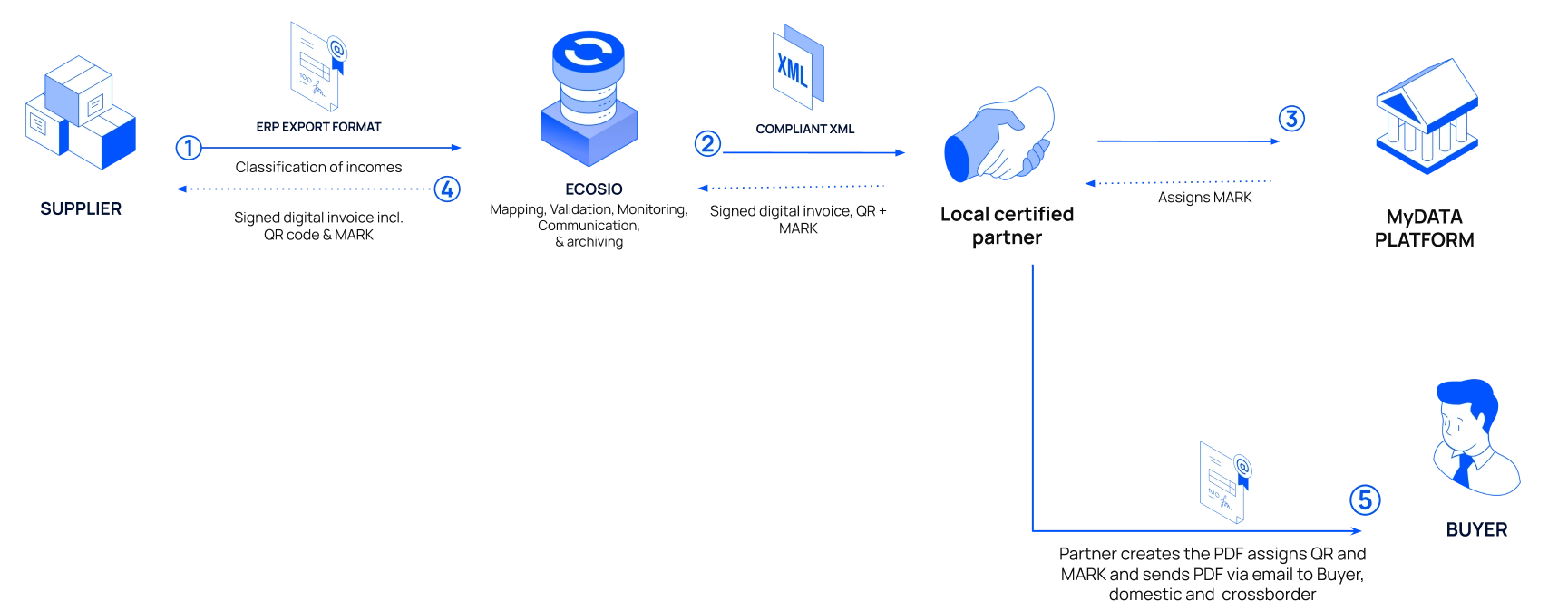
- You send the invoice data from your ERP or business software to ecosio in a structured format, such as VRBL, CSV, or IDoc.
- ecosio validates the invoice data and converts it into the required XML format. ecosio then sends the invoice data to an AADE-certified e-invoicing provider for submission to myDATA.
- The certified provider sends the invoice to myDATA.
- myDATA verifies the invoice and assigns a MARK, which is sent to the certified provider and back to ecosio. ecosio sends the verified invoice to your ERP or business software.
- You can generate a human-readable PDF copy for convenience. If you do, it must include the MARK and a QR code. For mandated scopes, the compliant invoice is the structured electronic invoice, not the PDF.
Accounts payable flow
The following diagram and steps illustrate the current AP process for expense classification invoices in Greece.
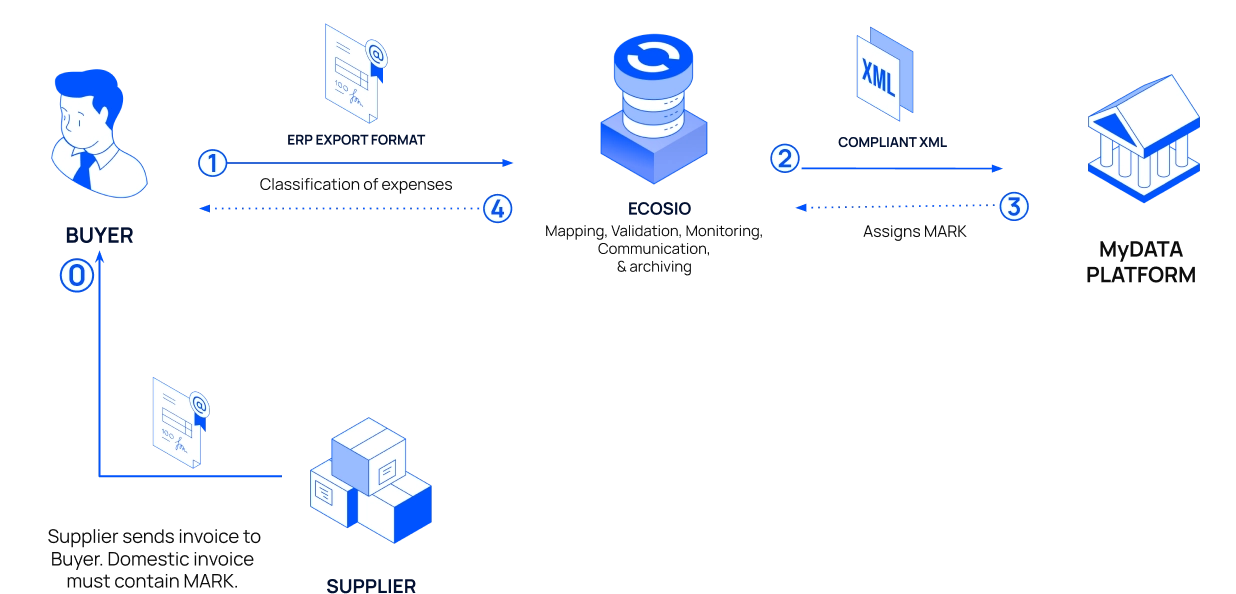
- The supplier sends the invoice to the buyer.
- For domestic mandated scopes, the supplier must issue the invoice as a structured e-invoice and report it to myDATA. myDATA then assigns a MARK.
- For cross-border invoices, suppliers often send invoices via email or another agreed channel. If either party is subject to Greek myDATA reporting rules, you must still report the relevant invoice data to myDATA according to AADE requirements.
- You send the AP expense invoice data to ecosio in a structured format, such as VRBL, CSV, or IDoc.
- ecosio validates the invoice data and converts it into the required XML format. ecosio then sends the invoice data to an AADE-certified e-invoicing provider for submission to myDATA.
- myDATA verifies the invoice and assigns a MARK, which is sent to the certified provider and back to ecosio.
- ecosio sends the verified invoice containing the MARK to your ERP or business software.
E-transport
In-scope entities in Greece must issue electronic delivery documents and report transport details through myDATA in real time. This includes entities within the scope of Article 1 of Law 4308/2014, such as professional sellers of agricultural, industrial, and craft products operating in open markets and farmers subject to the regular VAT regime.
From 1 January 2027, additional e-transport reporting requirements apply to loading, transshipment, receipt, and quantity checks. See the AADE announcement on revised e-transport deadlines for details, including product classification requirements from 1 January 2028.
Automated e-transport flow
ecosio enables you, as the supplier, to automate the transmission of compliant e-transport documents. The following diagram and steps illustrate this process.
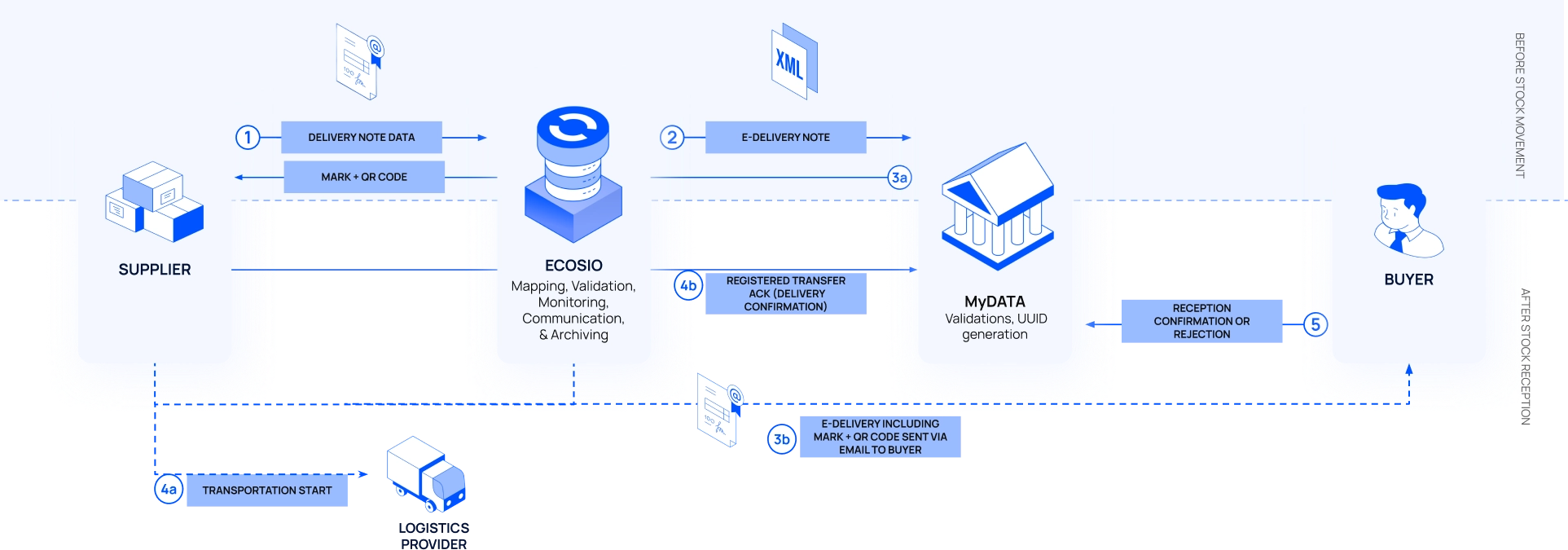
- You send the delivery note data from your ERP or business software to ecosio in a structured format, such as VRBL.
- ecosio validates the delivery note data and converts it into the required XML format. ecosio then sends the delivery note to an AADE-certified e-invoicing provider for submission to myDATA.
- myDATA processes the delivery note:
- myDATA verifies the delivery note and assigns a MARK, which is sent to ecosio. ecosio sends the verified delivery note containing the MARK to your ERP or business software.
- Once the supplier receives the MARK and QR code, they send a human-readable delivery note, such as a PDF, to the buyer via email. The supplier can decide whether ecosio sends the email or whether their software sends it directly.
- The carrier can now transport the goods:
- The goods can now leave the warehouse and the carrier can deliver the goods. The carrier must always have the delivery note as a PDF for use during transit.
- At the moment the carrier leaves the warehouse, the supplier must inform myDATA by sending a Registered Transfer acknowledgment via ecosio. This message confirms that the transport has departed.
- Once the goods are received by the buyer, the buyer must send confirmation to myDATA accepting or rejecting the goods.
Legal resources
The following official documents define the legal and technical framework for e-invoicing and myDATA reporting in Greece.
- AADE myDATA portal: Official entry point for myDATA information and services.
- Directive 2014/55/EU: EU directive on electronic invoicing in public procurement, transposed into Greek law for B2G e-invoicing.
- Joint Ministerial Decision 63446/2021: National framework and specifications for B2G e-invoicing.
- myDATA technical specifications (AADE): Technical specification hub for myDATA.
Updated about 9 hours ago