
Compliance for Germany
Germany’s e-invoicing requirements combine a portal-based approach for public procurement (B2G) with a direct exchange approach for domestic business transactions (B2B). For B2G exchange, suppliers typically submit e-invoices through federal or state submission portals, using transmission channels such as Peppol, email, or manual upload.
Businesses established in Germany must be able to receive electronic invoices for domestic B2B transactions. Issuance requirements apply in phases from 1 January 2027 and 1 January 2028.
Document requirements
Germany requires structured electronic invoices aligned to the European standard EN 16931.
Germany compliance summary
Learn more about compliance transaction terms and concepts.
| Aspect | Description | Requirement |
|---|---|---|
| Invoices exchanged between businesses. | Mandatory to receive e-invoices. Issuance mandatory from 1 January 2027 for businesses with an annual revenue over €800,000. Mandatory for all businesses from 1 January 2028. | |
| Invoices issued by businesses to consumers. | Optional | |
| Invoices issued by businesses to public administrations for public procurement. | Mandatory | |
| Electronic signature | Signature or seal rules for authenticity and integrity of e‑invoices. | Optional |
| Legal archiving | Minimum retention period for e‑invoices. | 8 years |
| Model | The e-invoicing flow model used by the country. | Interoperability |
| Platform | The government-managed platform for e-invoicing. | Federal and state portals for |
| Supported format | The e-invoicing format legally required by the country. | Compliant with the EN 16931 standard |
| Automatic updates | Whether invoice status updates synchronise automatically in Monitor. | Yes |
Format
Germany’s e-invoice requirements are aligned to EN 16931. Invoices are commonly exchanged as UBL 2.1 or CII. For public procurement, the format follows Germany’s national CIUS known as XRechnung.
For domestic B2B exchange, Peppol BIS includes XRechnung validations and is becoming a common implementation choice. ZUGFeRD is also used for domestic B2B exchange. It combines a human-readable PDF with structured CII data.
TipYou can use ecosio’s validators to check that your German documents match their intended format before sending them.
Invoice types
The Invoice Type Code element within the invoice must contain one of the codes from the UNTDID 1001 code list.
| Document | Code | Description |
|---|---|---|
| Corrected invoice | 384 | Used to correct or cancel a previously issued invoice. |
| Credit note | 381 | Used to reduce or cancel an invoice. |
| Prepayment invoice | 386 | An invoice claiming advance payment for goods or services. |
| Final construction invoice | 877 | Used to invoice the final amount for construction work. |
| Invoice | 380 | Standard sales invoice. |
| Partial construction invoice | 875 | Used to invoice a partial amount for construction work. |
| Partial final construction invoice | 876 | Used to invoice a partial final amount for construction work. |
| Partial invoice | 326 | An invoice for a part of the total order or project value. |
| Self-billed invoice | 389 | An invoice process based on an agreement between a supplier and a buyer, where the buyer prepares the invoice and sends it to the supplier with the payment. |
Automated e-invoicing flow
ecosio enables you to automate the transmission of compliant e-invoices for both accounts receivable and accounts payable processes in Germany. For B2B exchange, you can send and receive e-invoices using Peppol or email.
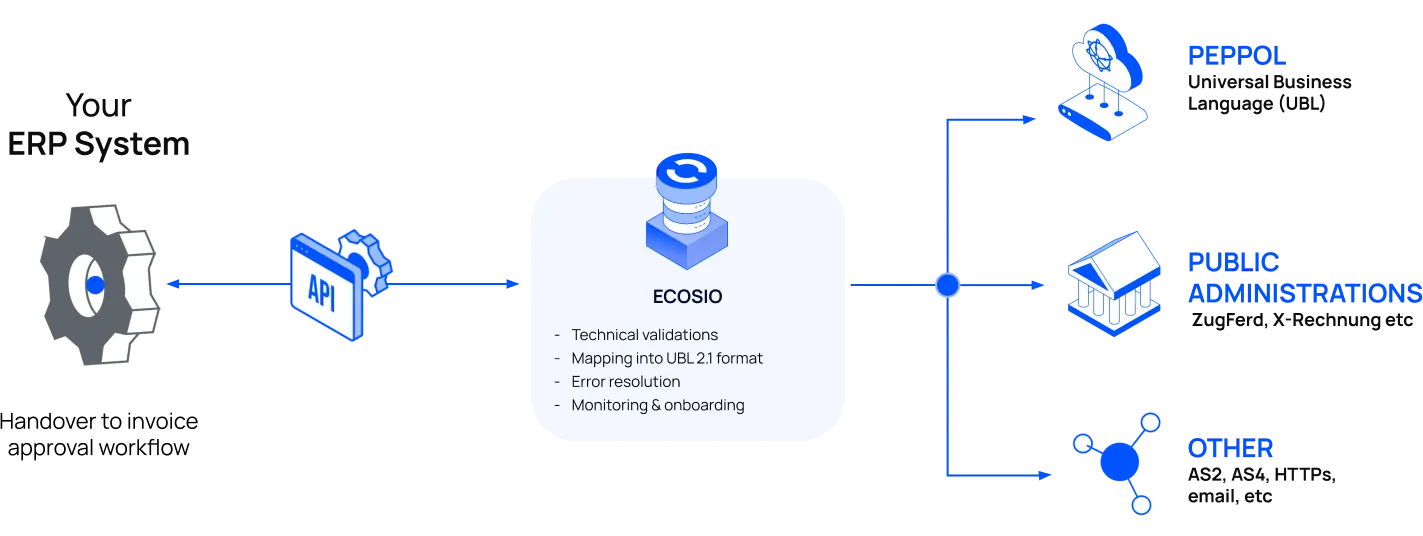
Accounts receivable
The following flows show how you can send e-invoices using Peppol or email.
Peppol flow
The following diagram and steps illustrate the AR process for e-invoices in Germany using the Peppol 4-corner model.
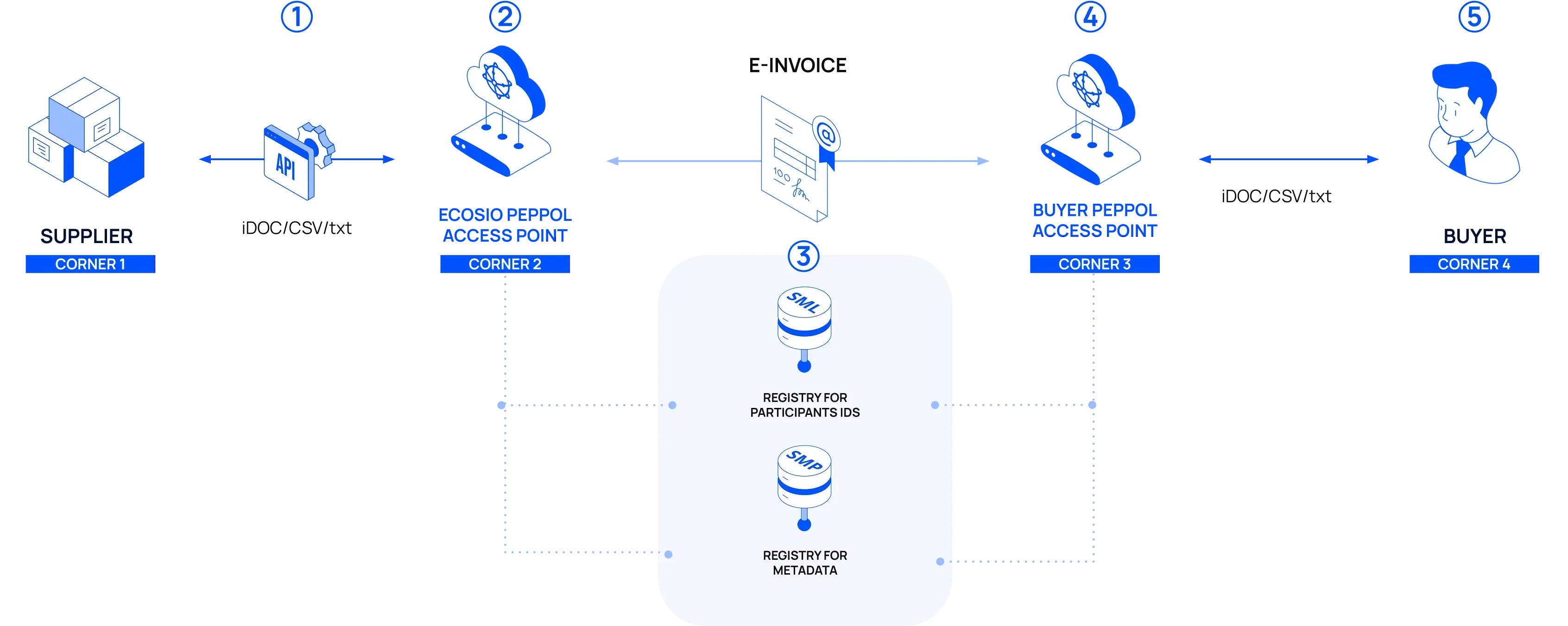
- You, Corner 1, send invoice data from your ERP or business software to ecosio in a structured format, such as VRBL.
- ecosio, as your Access Point and Corner 2, converts the data into UBL 2.1 format, validates it against applicable business rules, and prepares it for transmission.
- ecosio transmits the invoice via the agreed channel to the recipient.
- The buyer’s Access Point, Corner 3, retrieves the invoice and converts it into the format required by their ERP or business software.
- The buyer’s Access Point delivers the invoice to their ERP or business software, which is Corner 4.
Email flow
The following diagram and steps illustrate the accounts receivable process for e-invoices in Germany using email exchange.
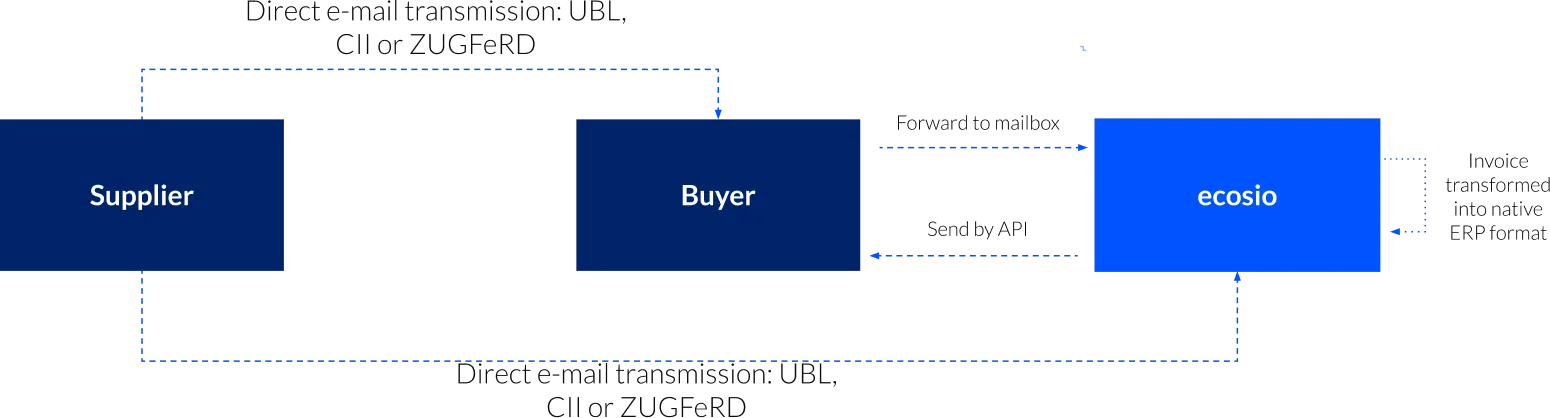
- You send the invoice by email to one of the following recipients:
- The buyer’s e-invoicing email address.
- Your dedicated ecosio e-invoicing email address for validation and conversion.
- If you send the invoice to ecosio, ecosio validates the attachment and converts it to the format required by the buyer’s ERP or business software.
- The buyer receives the email and retrieves the invoice attachment, or ecosio delivers the invoice to the buyer’s ERP or business software.
Accounts payable
The following flows show how you can receive e-invoices using Peppol or email.
Peppol flow
The following diagram and steps illustrate the AP process for e-invoices in Germany using the Peppol 4-corner model.
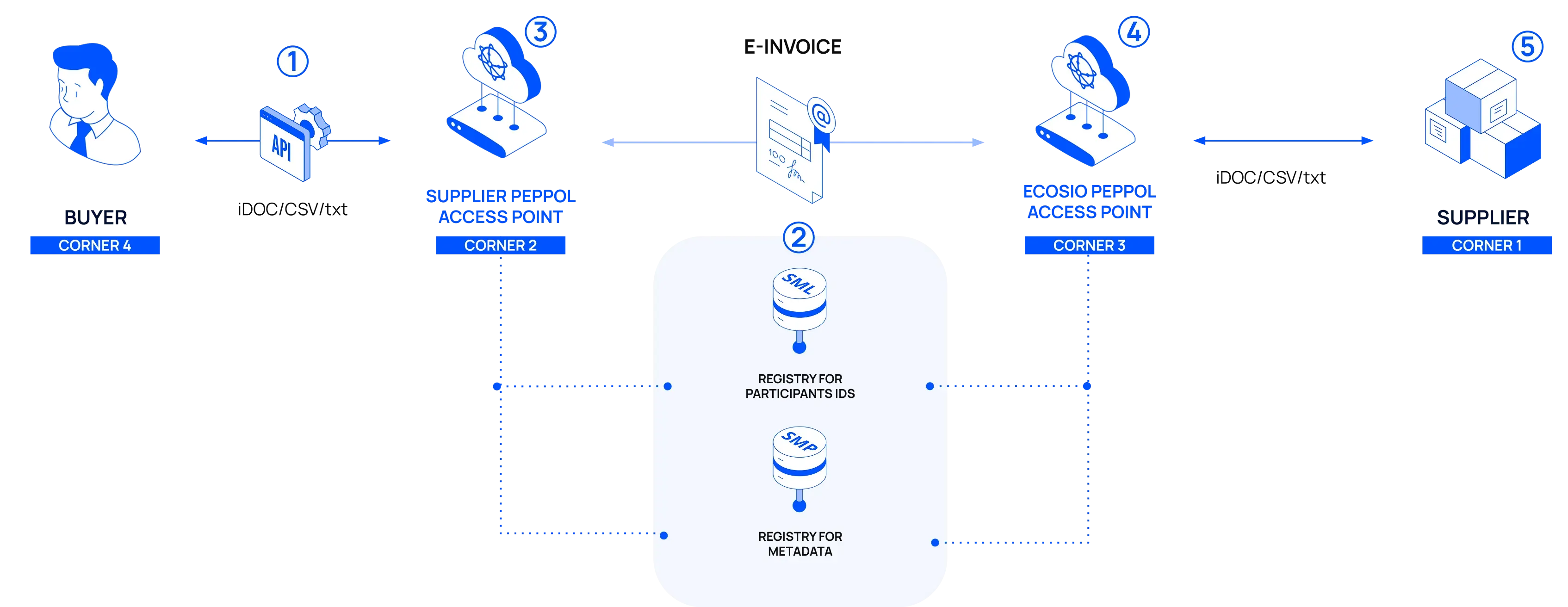
- The supplier, Corner 1, sends the invoice to their Access Point in a structured format, such as VRBL.
- The supplier’s Access Point, Corner 2, validates the invoice and maps it into the Peppol BIS standard format.
- The supplier’s Access Point queries the SML and SMP to locate ecosio as your Access Point and retrieve delivery details.
- ecosio, as your Access Point and Corner 3, retrieves the invoice and converts it into the format required by your ERP or business software.
- ecosio sends the invoice to your ERP or business software, which is Corner 4.
Email flow
The following diagram and steps illustrate the accounts payable process for e-invoices in Germany using email exchange.
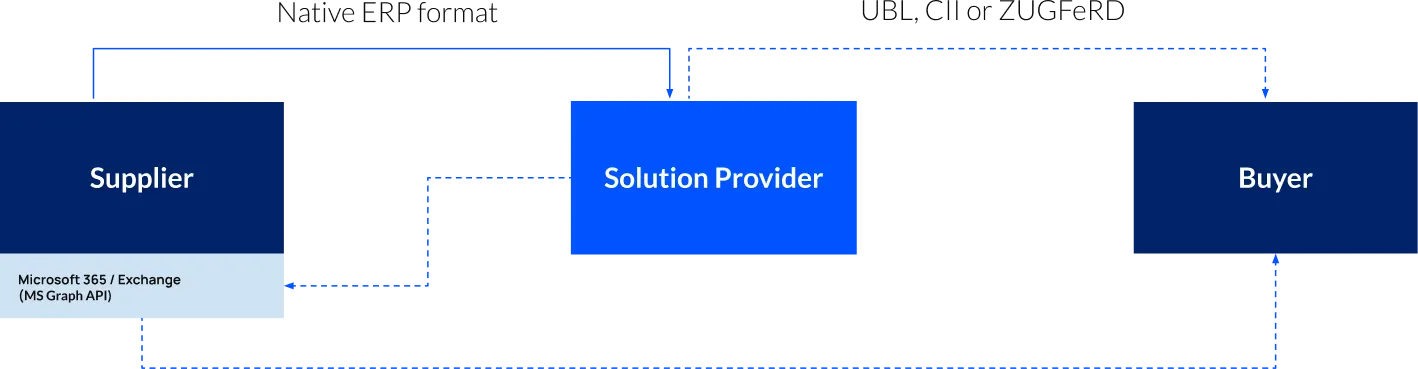
- The supplier sends the invoice to your email in a structured format, such as VRBL, CSV, or IDoc.
- If the email is sent to your ecosio email, the invoice attachment is validated and converted to the format required by your ERP or business software.
- You receive the invoice in your mailbox or ERP or business software.
Legal resources
The following official documents define the legal and technical framework for e-invoicing in Germany.
- Growth Opportunities Act (Wachstumschancengesetz): Introduces the phased rollout of mandatory structured e-invoicing for domestic B2B transactions.
- XRechnung standard overview: Official information and specifications for XRechnung, Germany’s CIUS for public sector e-invoicing.
- eRechnung-Bund portal: Official information about federal public sector e-invoicing.
Updated 9 days ago