
Compliance for France
France currently uses a centralised B2G model via Chorus Pro. From 1 September 2026, France moves to a decentralised Y‑model overseen by the Direction générale des Finances publiques (DGFiP), the French tax authority. Approved platforms, known in French as plateformes agréées (PAs), exchange e‑invoices between businesses and send required regulatory data to the DGFiP within 24 hours. The DGFiP’s central directory stores routing information, while DGFiP systems receive regulatory data and status updates from PAs. For B2G, Chorus Pro remains, and suppliers can choose to send documents via Chorus Pro or a PA.
The reform also introduces e‑reporting and mandates the reporting of cross‑border B2B invoices, B2C transactions, and related payments via a PA to the DGFiP from 1 September 2026.
Document requirements
All B2G invoices must be sent to France’s public administrations through Chorus Pro. From 1 September 2026, all VAT‑registered businesses established in France must be able to receive e‑invoices. Large and mid‑sized businesses must issue e‑invoices through a PA and submit e‑reporting via a PA to the DGFiP. From 1 September 2027, these issuance and e‑reporting mandates extend to all businesses. During the initial phase, the DGFiP will apply operational tolerance to support implementation.
France compliance summary
Learn more about compliance transaction terms and concepts.
| Aspect | Description | Requirement |
|---|---|---|
| Invoices exchanged between businesses. | Domestic e‑invoicing: Reception mandatory for all VAT‑registered businesses established in France from 1 September 2026. Issuance mandatory for large and mid‑sized businesses from 1 September 2026 and for all businesses from 1 September 2027. Cross-border e‑invoicing: E-reporting mandatory for large and mid‑sized businesses from 1 September 2026, extending to all businesses from 1 September 2027. | |
| Invoices issued by businesses to consumers. | E‑invoicing: Optional. E‑reporting: Mandatory from 1 September 2026 for large and mid‑sized businesses, extending to all businesses from 1 September 2027. | |
| Invoices issued by businesses to public administrations for public procurement. | Mandatory via Chorus Pro or a PA. | |
| Electronic signature | Signature or seal rules for authenticity and integrity of e‑invoices. | Optional. Qualified electronic signature or seal in accordance with EU Regulation on electronic identification and trust services |
| Legal archiving | Minimum retention period for e‑invoices. | 10 years |
| Model | The e-invoicing flow model used by the country. | Decentralised exchange with |
| Platform | The government-managed platform for e-invoicing. | Approved platform (PA) required for B2B exchange and e‑reporting to the DGFiP. B2G invoices can be sent through Chorus Pro or via a PA. |
| Supported format | The e-invoicing format legally required by the country. | E-invoicing: Core formats are E-reporting: |
| Automatic updates | Whether invoice status updates synchronise automatically in Monitor. | Yes |
Format
France’s core formats are defined by the AFNOR Standard and based on the EN 16931 standard: UBL 2.1, CII, and Factur-X, a Franco-German standard for XML and PDF hybrid e-invoices. Parties can agree other structured formats if they meet the EN 16931 standard. DGFiP supports UBL and CII for e-reporting.
TipYou can use ecosio’s validators to check that your German documents match their intended format before sending them.
Invoice types
The Invoice Type Code element within the invoice must contain one of the following codes defined by the AFNOR Standard.
| Document | Code | Description |
|---|---|---|
| Commercial invoice | 380 | An invoice for goods or services from a seller to a buyer. |
| Correction invoice | 384 | Used to correct or cancel a previously issued invoice. A reference to the original invoice is mandatory. |
| Credit note | 381 | Used to correct amounts or settle a balance between a seller and a buyer. It is not required to provide a previous invoice reference. |
| Credit note for advance payment invoice | 503 | A credit note that cancels or adjusts amounts previously invoiced on a prepayment invoice. |
| Factored credit note | 396 | Credit note related to assigned invoices. |
| Factored invoice | 393 | Invoice related to assigned receivables under a factoring arrangement. |
| Factored corrective invoice | 472 | An invoice that corrects a previously issued factored invoice. A reference to the original invoice is mandatory. |
| Invoice information for accounting purposes | 751 | A document containing accounting-related information such as monetary totals, seller ID, and VAT. It may not be a complete invoice according to legal requirements. |
| Prepayment invoice | 386 | An invoice to pay amounts for goods and services in advance. These amounts are subtracted from the final invoice. |
| Self-billed advance invoice | 500 | An invoice raised by the buyer to request or record a prepayment under a self-billing arrangement. |
| Self-billed corrective invoice | 471 | An invoice issued by the buyer that corrects or cancels a previously self‑billed invoice; a reference to the original invoice is mandatory. |
| Self-billed credit note | 261 | A document which indicates that the customer is claiming credit in a self billing environment. |
| Self-billed factored invoice | 501 | An invoice issued by the buyer in a self‑billing environment relating to receivables assigned under a factoring arrangement. |
| Self-billed factored corrective invoice | 473 | A self‑billed invoice that corrects a previously issued self‑billed factored invoice. A reference to the original invoice is mandatory. |
| Self-billed factored credit note | 502 | A credit note issued by the buyer in a self‑billing environment relating to assigned invoices under a factoring arrangement. |
| Self-billed invoice | 389 | An invoice process based on an agreement between a supplier and a buyer, where the buyer prepares the invoice and sends it to the supplier with the payment. |
Automated e‑invoicing flow
ecosio enables the automated transmission of compliant e-invoices for both Accounts Payable (AP) and Accounts Receivable (AR) mandated e-invoices in France. ecosio is an approved platform in France, authorised by the DGFiP to exchange e‑invoices and send regulatory data to French tax authority systems.
France defines standard data‑exchange flows for e‑invoicing and e‑reporting. The key ones for e-invoicing are:
- Flow 1: The regulatory invoice data sent by the issuer platform in UBL or CII to the DGFiP. Every issuing platform (PA or Chorus Pro) is required to extract this regulatory data from the invoice and send it to the DGFiP within 24 hours.
- Flow 2: Covers the domestic invoice exchange between businesses via their PAs or with the public sector in UBL, CII, or Factur‑X. This flow is not sent to the DGFiP, but its data is the source for flow 1.
- Flow 6: Provides status updates across exchanges in France’s Y‑model. The supplier’s PA, the buyer’s PA, or the DGFiP can issue these updates.
Accounts receivable flow
If you send invoices to public administrations or private companies VAT-registered and established in France, ecosio automates the entire submission and reporting process. The following diagram and steps illustrate the AR process for domestic B2B and B2G e-invoices in France.
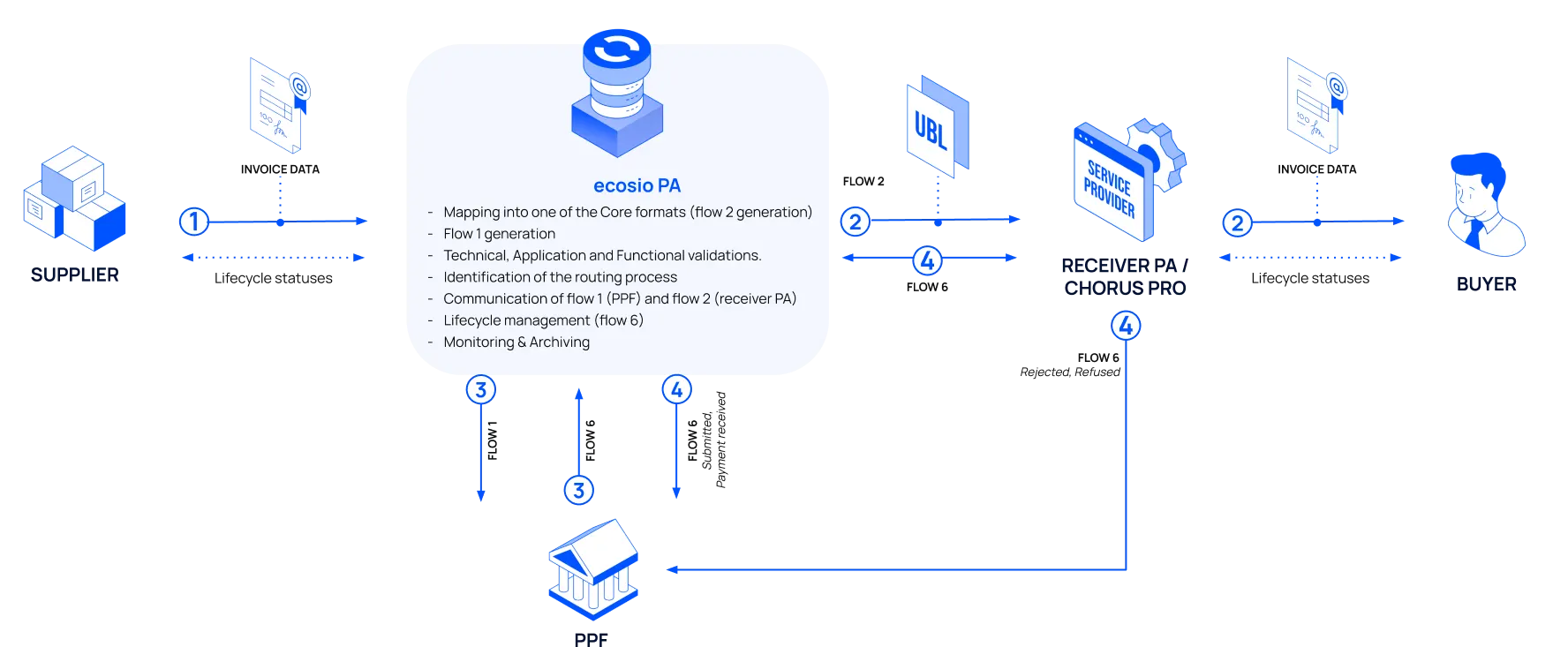
- You send the invoice data from your ERP or business software to ecosio in a structured format, such as IDoc. ecosio converts it to a core format (flow 2), validates it, extracts the regulatory data (flow 1), and synchronises with the global directory to determine the buyer’s PA.
- ecosio sends the invoice via the Peppol network to the buyer’s PA (or to Chorus Pro for B2G flows). The buyer’s PA makes it available for them to retrieve.
- In parallel with flow 2, the regulatory invoice data is sent to the DGFiP (flow 1), and a status update is returned by the DGFiP to confirm receipt of the invoice (flow 6).
- Statuses are exchanged between the supplier and buyer via their respective PAs, and with the DGFiP for mandatory status updates (flow 6).
Accounts payable flow
If you receive invoices from suppliers VAT‑registered and established in France, ecosio registers your organisation in the DGFiP's global directory as the buyer so invoices are discoverable and correctly routed, then automatically retrieves and integrates them into your system. The following diagram and steps illustrate the AP process for domestic B2B and B2G e-invoices in France.
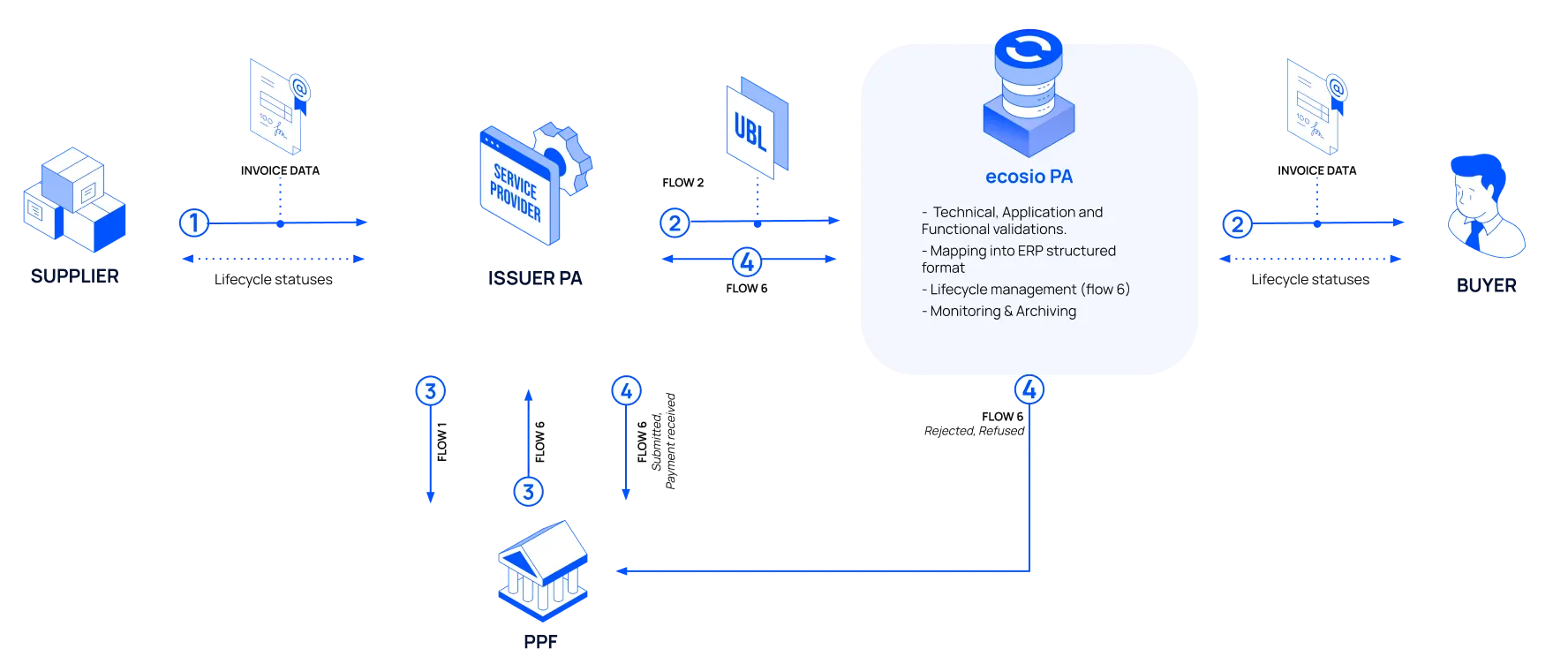
- The supplier sends the invoice via their PA to ecosio in a core format (flow 2).
- ecosio receives the invoice, validates it, and converts it to your ERP or business software's format.
- In parallel with invoice issuance, the supplier’s PA sends the regulatory invoice data to the DGFiP (flow 1), and a status update is returned by the DGFiP to the supplier’s PA to confirm receipt of the invoice (flow 6).
- Statuses are exchanged between the supplier and buyer via their respective PAs, and with the DGFiP for mandatory status updates (flow 6).
Automated e-reporting flow
ecosio enables the automated transmission of compliant e-reporting in France. If you sell direct to consumers, or send or receive cross-border invoices, ecosio automates the entire reporting process.
France’s e-reporting uses flow 10, which consists of transaction and payment data for cross‑border and B2C operations aggregated per period per SIREN number and transmitted via the PA to the DGFiP.
The following diagram and steps illustrate the e-reporting process in France.
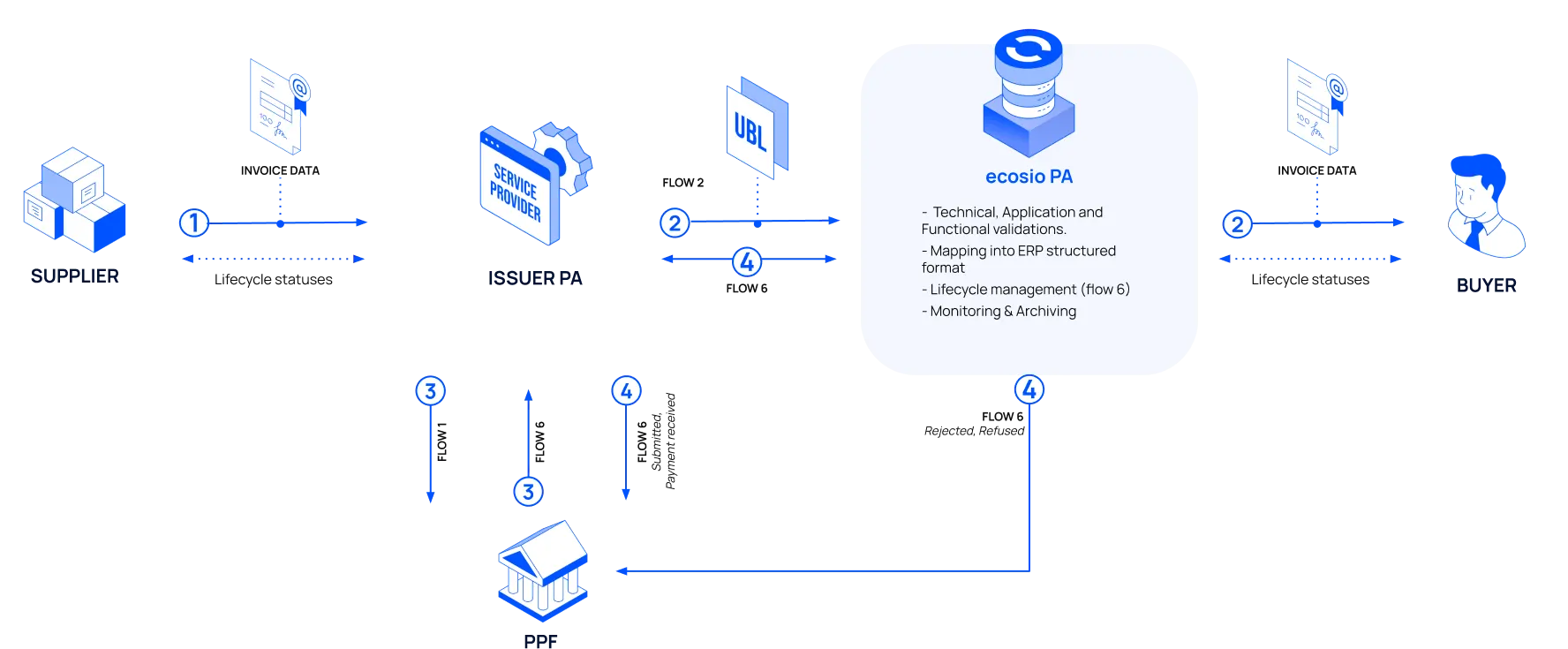
- For each reporting period, the following aggregated information is sent to ecosio:
- Daily summaries of all B2C transactions, grouped by the company’s French identity number (SIREN) and currency.
- All inbound and outbound cross-border invoices
- The corresponding payment data
- ecosio converts the information into the UBL format (flow 10), validates it, and sends it to the DGFiP.
- A status update is returned by the DGFiP to confirm receipt of the information (flow 6).
Legal and technical resources
The following official documents define the legal and technical framework for e-invoicing in France.
- External specifications for electronic invoicing: Official documents describing the formats and methods for e‑invoicing and e‑reporting in France.
- Electronic invoicing: a practical guide to getting started on September 1, 2026: Official guidance on business continuity, fallback channels, and administrative tolerance during the September 2026 launch phase.
Primary legislation
- Ordonnance n°2021‑1190 du 15 septembre 2021: Establishes the legal basis for mandatory e‑invoicing and e‑reporting between VAT‑registered entities, defines the electronic invoice, and sets roles for taxpayers and dematerialisation platforms.
- Code général des impôts (CGI): Key VAT and invoicing provisions.
Secondary legislation
- Décret n°2022‑1299 du 7 octobre 2022: Application procedures for issuing, receiving, and transmitting e‑invoices, and the obligation to send billing and payment data to the DGFiP.
- Arrêté du 7 octobre 2022: Technical and procedural specifications that complement Décret n°2022‑1299.
- Décret No. 2026-677 du 27 juillet 2026: Updates the General Tax Code and the technical and administrative framework for approved platforms, including certification, interoperability, central directory use, platform switching, and data transmission requirements.
Timeline and transition
- Décret n°2024‑266 du 25 mars 2024: Transitional regime enabling PA registration before the public test environment is active and reflecting timeline updates.
- Projet de loi de finances pour 2026: Legal text confirming the e‑invoicing and e‑reporting rollout schedule and related adjustments.
Updated 9 days ago