
Compliance for Latvia
Latvia requires structured electronic invoices for business-to-government (B2G) transactions. For domestic suppliers, invoices are submitted through elektroniskā adrese (e-adrese). Foreign suppliers can typically exchange invoices with Latvian public sector recipients via the Peppol network.
Document requirements
In Latvia, B2G e-invoicing is mandatory for all suppliers issuing invoices to public sector entities.
Latvia compliance summary
Learn more about compliance transaction terms and concepts.
| Aspect | Description | Requirement |
|---|---|---|
| Invoices exchanged between businesses. | Optional | |
| GST reporting is required for in‑scope GST‑registered businesses. | Optional | |
| Invoices issued by businesses to public administrations for public procurement. | Mandatory | |
| Electronic signature | Signature or seal rules for authenticity and integrity of e‑invoices. | Optional |
| Legal archiving | Minimum retention period for e‑invoices. | 8 years |
| Model | The e-invoicing flow model used by the country. | Centralised clearance |
| Platform | The government-managed platform for e-invoicing. | Domestic Cross-border |
| Supported format | The e-invoicing format legally required by the country. | |
| Automatic updates | Whether invoice status updates synchronise automatically in Monitor. | Yes |
Format
Latvia’s B2G mandate requires structured e-invoices that are semantically compliant with EN 16931, and must be in UBL 2.1 or CII format.
Automated e-invoicing flow
ecosio enables you to automate the transmission of mandatory B2G accounts receivable (AR) compliant e-invoices.
Accounts receivable
The following diagrams and steps illustrate the AR process for B2G e‑invoices in Latvia. The transmission differs for domestic and cross-border suppliers.

- You send the invoice data from your ERP or business software to ecosio in a structured format, such as VRBL, CSV, or IDoc.
- ecosio validates the invoice and maps it into the Peppol BIS standard format, then sends the invoice to the e-adrese system.
- The e-adrese system sends the invoice to the public entitie’s e-address in the e-adrese system.
- The e-adrese system sends acknowledgement of the invoice to ecosio.
- The public entitity receives the invoice via its e-address and processes it in its internal system.
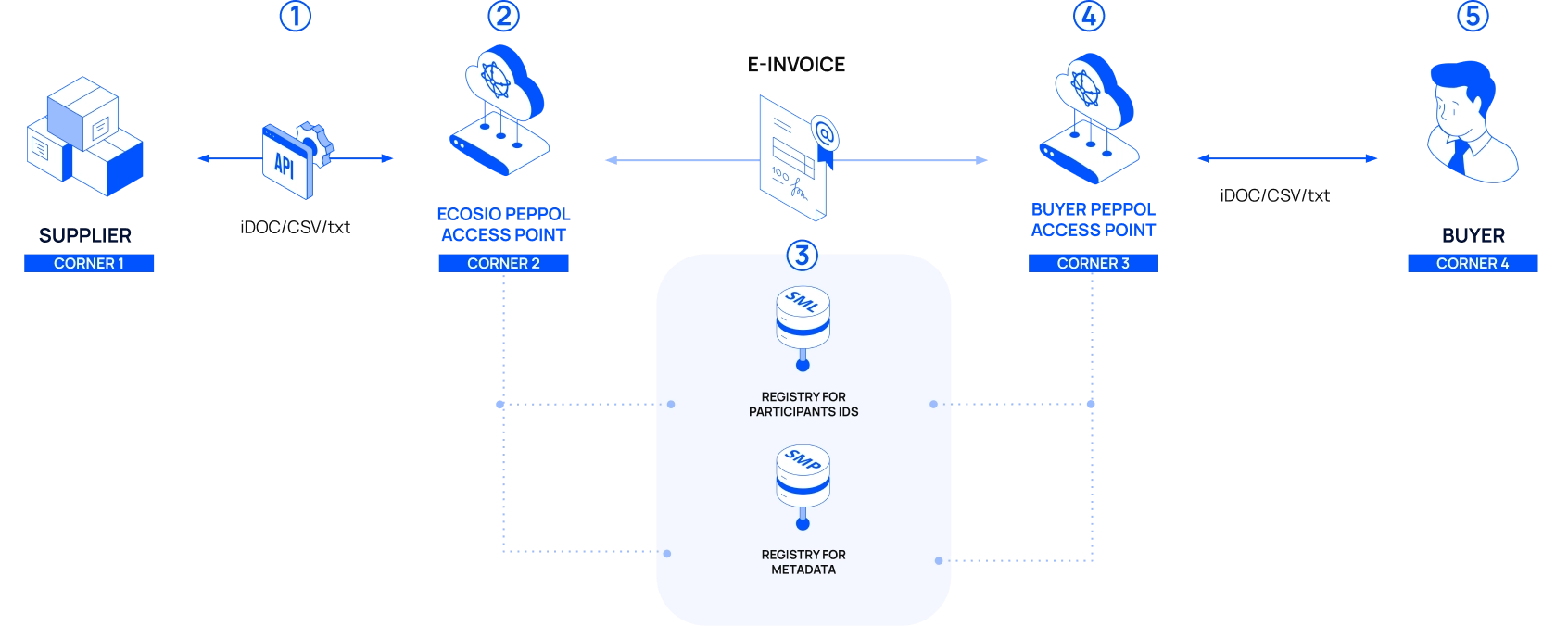
- You, Corner 1, send invoice data to ecosio in a structured format, such as VRBL, CSV, or IDoc.
- ecosio, as your Access Point and Corner 2, converts the data into UBL 2.1 format, validates it against applicable business rules, and prepares it for transmission.
- ecosio transmits the invoice via the agreed channel to the recipient.
- The buyer’s Access Point, Corner 3, retrieves the invoice and converts it into the format required by their ERP or business software.
- The buyer’s Access Point delivers the invoice to their ERP or business software, which is Corner 4.
Legal resources
The following official documents define the legal and technical framework for e-invoicing in Latvia.
- VISS e-adrese documentation: Official guidance for using e-adrese, including documentation and usage guidelines.
- VID e-invoicing guidance: Latvia’s State Revenue Service (VID) information page for e-invoicing, including FAQs and current guidance.
- Grāmatvedības likums (Accounting Law): Official publication of Latvia’s Accounting Law, which is the legal basis for accounting and record retention requirements.
Updated 8 days ago