
Compliance for Belgium
Belgium mandates that all B2G documents must be processed through the Mercurius platform, which is governed by the Federal Public Service Policy & Support’s Belgian Digital Transformation Office (BOSA). BOSA is Belgium's public institution responsible for tax collection and administration.
Document requirements
B2G and invoices B2B must be processed through the Mercurius platform.
Belgium compliance summary
Learn more about compliance transaction terms and concepts.
| Aspect | Description | Requirement |
|---|---|---|
| Invoices exchanged between businesses. | Mandatory | |
| Invoices issued by businesses to consumers. | Optional | |
| Invoices issued by businesses to public administrations for public procurement. | Mandatory | |
| Electronic signature | Signature or seal rules for authenticity and integrity of e‑invoices. | Optional |
| Legal archiving | Minimum retention period for e‑invoices. | 10 years |
| Model | The e-invoicing flow model used by the country. | Interoperability Peppol 4-corner model |
| Platform | The government-managed platform for e-invoicing. | Managed by BOSA through the Mercurius platform |
| Supported format | The e-invoicing format legally required by the country. | Based on the EN 16931 standard and Peppol BIS |
| Automatic updates | Whether invoice status updates synchronise automatically in Monitor. | Yes |
Format
Belgium's e-invoice format is based on the EN 16931 standard and Peppol BIS.
Invoice types
The Invoice Type Code element within the invoice must contain one of the following codes from the Peppol BIS Billing invoice type codes.
| Document | Code | Description |
|---|---|---|
| Invoice | 380 | An invoice for goods or services from a supplier to a business. |
| Credit note | 381 | Used to correct amounts or settle a balance between a supplier and a buyer. |
| Debit note | 383 | A document issued by a supplier to apply additional charges or increase the total value of a previously issued e-invoice. |
| Self-billed invoice | 389 | A document that a buyer must create and report to the tax authorities to account for an invoice received from a foreign supplier, which is an import. This is a statutory tax reporting requirement and is separate from the self-billing process used in other industries. |
Automated e-invoicing flow
ecosio enables the automated transmission of compliant e-invoices for both AP and AR mandated e-invoices in Belgium, which uses the Peppol framework for the transmission of electronic documents.
Accounts receivable flow
The following diagram and steps illustrate the current AR process for e-invoices in Belgium using the Peppol 4-corner model.
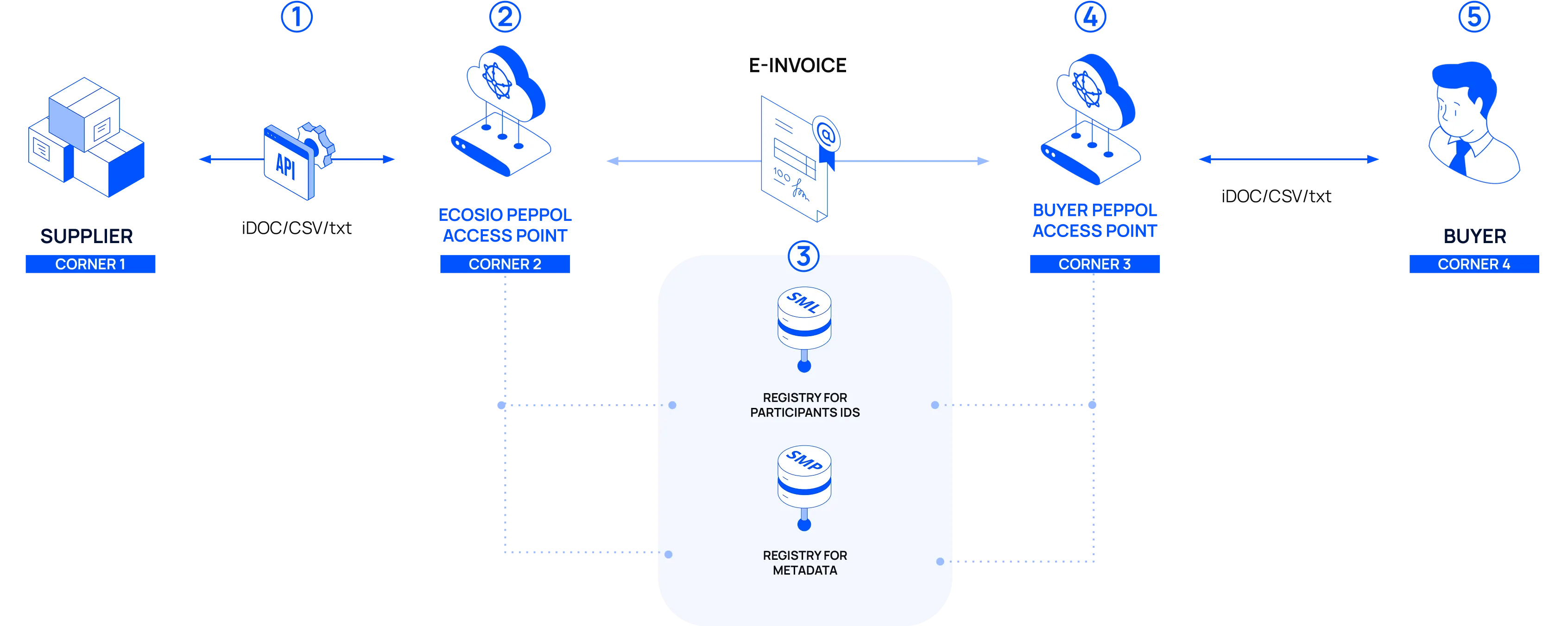
- You, Corner 1, send the invoice data from your ERP or business software to ecosio in a structured format, such as VRBL.
- ecosio, as your Access Point and Corner 2, validates the invoice and maps it into the Peppol BIS standard format.
- ecosio, as your Access Point, queries the SML and SMP to locate the buyer’s Access Point and retrieve delivery details.
- The buyer’s Access Point, Corner 3, uses the SML and SMP to receive the invoice.
- The buyer’s Access Point maps the invoice into the format expected by the buyer, Corner 4, and delivers it to their ERP or business software.
Accounts receivable process from 2028
NoteBelgium plans to introduce real-time reporting to tax authorities by 1 January 2028. This will include a transition from the Peppol 4-corner model to the Peppol 5-corner model.
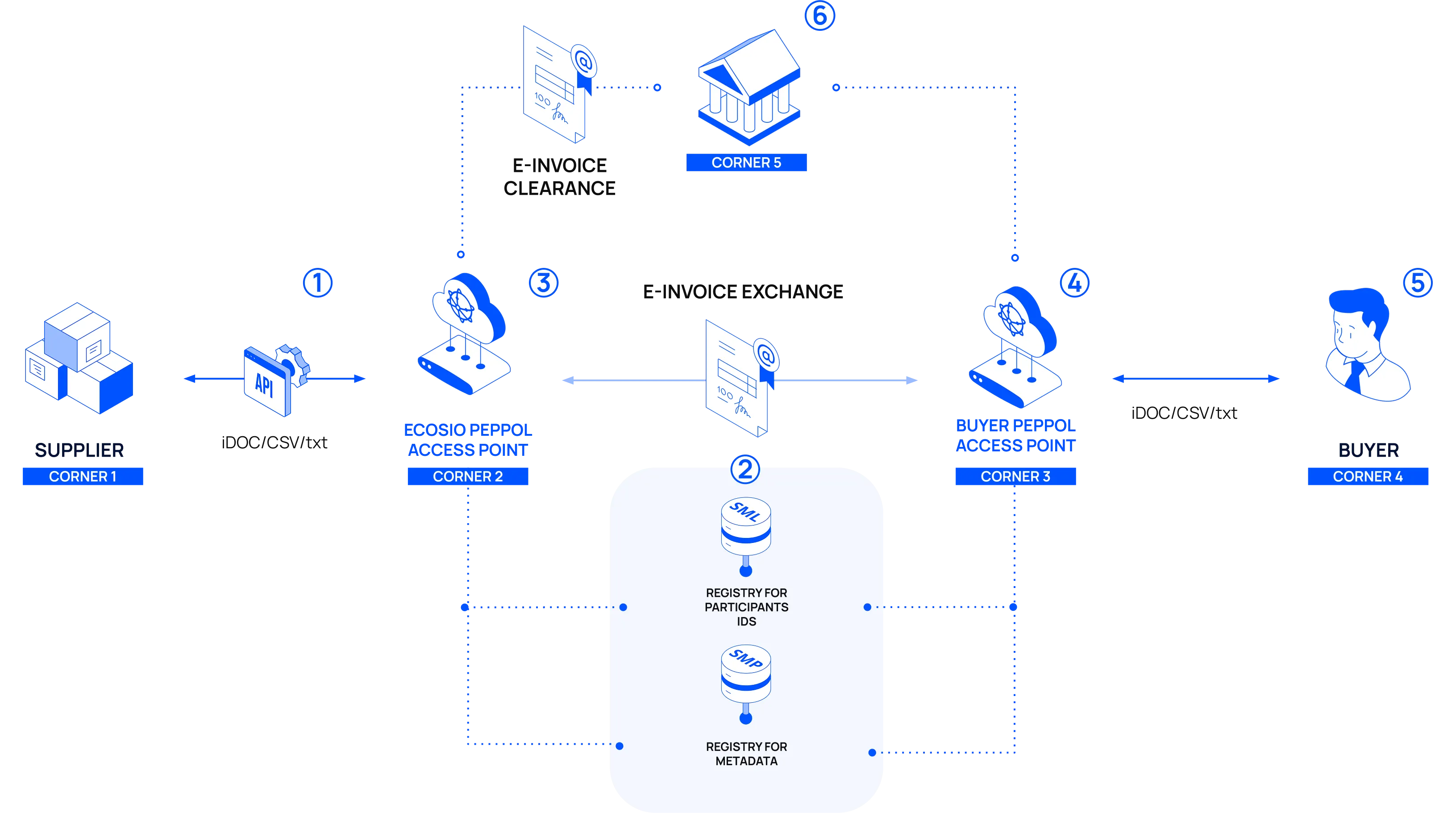
When the supplier’s Access Point, Corner 2, sends the invoice to the buyer’s Access Point, Corner 3, they also send a copy to BOSA, Corner 5.
Accounts payable flow
The following diagram and steps illustrate the AP process for e-invoices in Belgium using the Peppol 4-corner model.
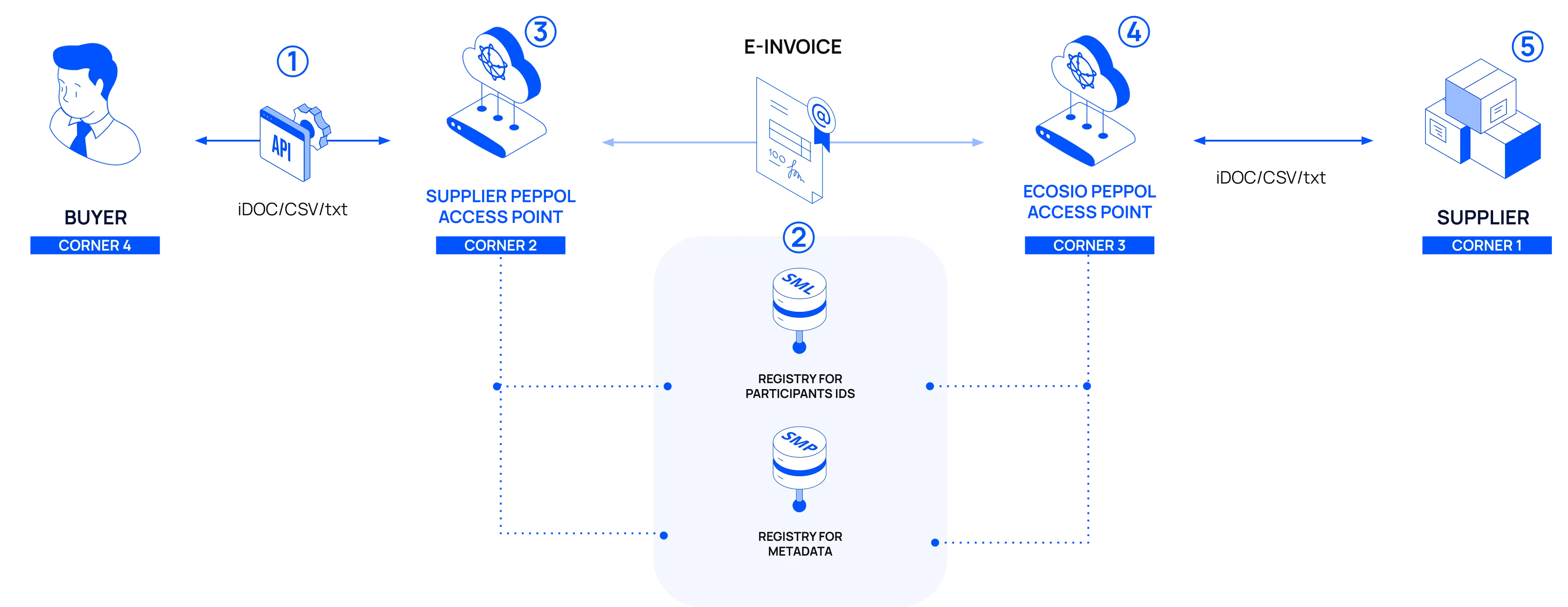
- The supplier, Corner 1, sends the invoice to their Access Point in a structured format, such as CSV.
- The supplier’s Access Point, Corner 2, validates the invoice and maps it into the Peppol BIS standard format.
- The supplier’s Access Point queries the SML and SMP to locate ecosio as your Access Point and retrieve delivery details.
- ecosio, as your Access Point and Corner 3, retrieves the invoice and converts it into the format required by your ERP or business software.
- ecosio sends the invoice to your ERP or business software, which is Corner 4.
Accounts payable process from 2028
NoteBelgium plans to introduce real-time reporting to tax authorities by 1 January 2028. This will include a transition from the Peppol 4-corner model to the Peppol 5-corner model.
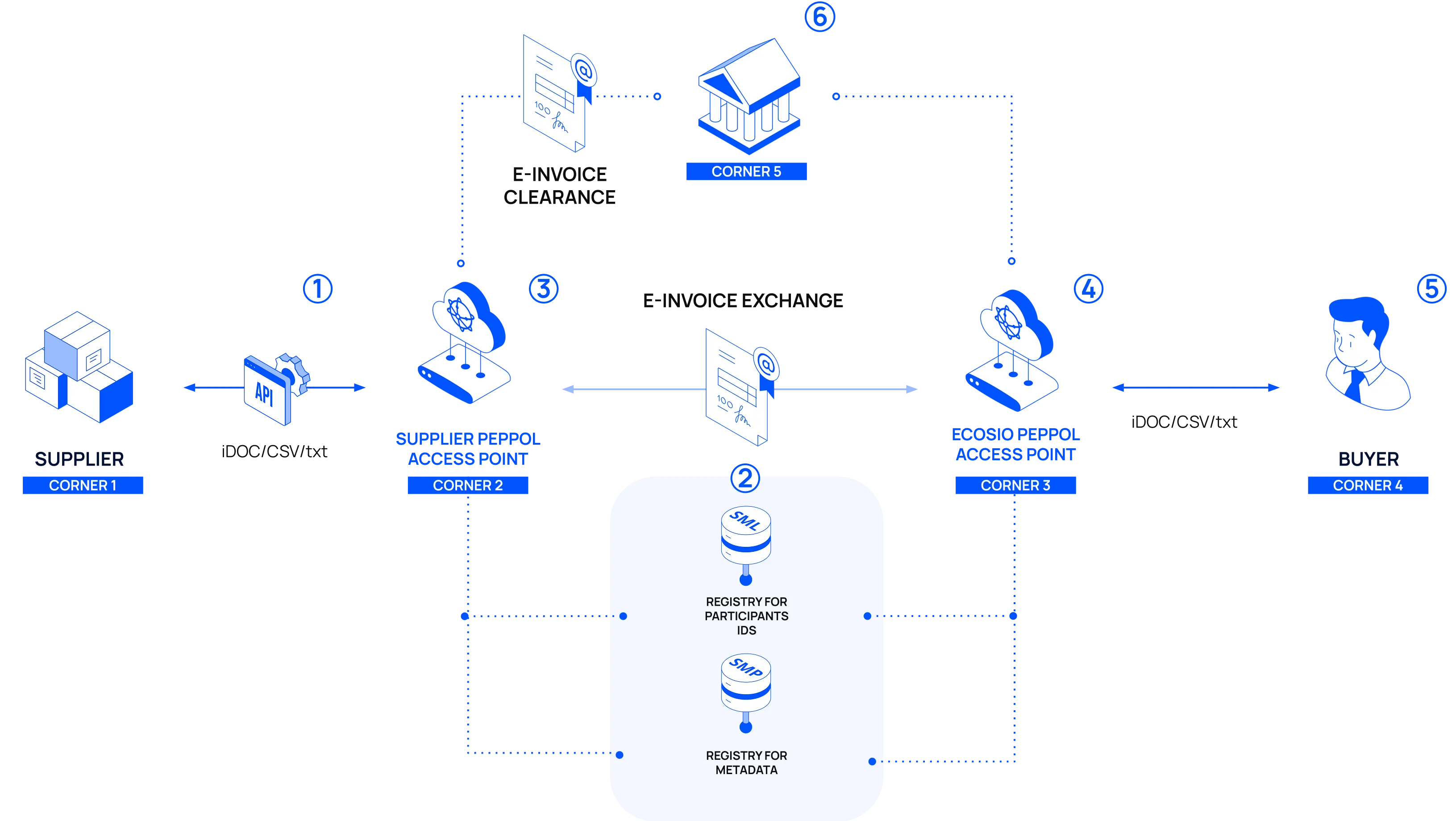
The transition to the Peppol 5-corner model will add the following step to the Accounts Payable process:
- A copy of the invoice data is sent to BOSA before or immediately after the delivery to the buyer’s Access Point.
Legal resources
The following official documents define the legal and technical framework for e-invoicing in Belgium.
- Belgian Federal Government E-invoicing: Official documentation for e-invoicing in Belgium.
- Peppol Belgium Country Profile: Documentation about the use of Peppol for e-invoicing in Belgium.
Updated 8 days ago