
Compliance for Singapore
Singapore uses the InvoiceNow framework, which is based on the Peppol standard. InvoiceNow enables businesses to exchange structured e-invoices between finance systems.
Singapore extends the standard Peppol four‑corner model by introducing the Inland Revenue Authority of Singapore (IRAS) as a fifth corner, which enables businesses to submit invoice data for Goods and Services (GST) reporting. GST-registered businesses that are in scope of the mandate must register on InvoiceNow and connect their invoicing solution to the InvoiceNow network using an IMDA‑accredited Access Point (AP) provider.
Under the GST InvoiceNow Requirement, in-scope GST-registered businesses must submit invoice data to IRAS. How you submit the data depends on how you exchange invoices:
- If you exchange invoices through InvoiceNow (Peppol), the AP submits the same invoice data to IRAS after it delivers the invoice to the buyer.
- If you exchange invoices outside InvoiceNow, such as PDF email, paper invoices, or point‑of‑sale systems, the IRSP extracts invoice data from the invoice or sales systems and submits it to IRAS using an InvoiceNow-Ready Solution (IRSP). An IRSP is your invoicing solution, and it connects to the InvoiceNow network through an IMDA-accredited AP provider, such as ecosio.
Document requirements
IRAS oversees Singapore’s GST InvoiceNow requirement.
Singapore compliance summary
Learn more about compliance transaction terms and concepts.
| Aspect | Description | Requirement |
|---|---|---|
| Invoices exchanged between businesses. | GST reporting is required for in‑scope GST‑registered businesses. | |
| Invoices issued by businesses to consumers. | Optional | |
| Invoices issued by businesses to public administrations for public procurement. | Invoice exchange with government agencies is handled via the government’s required or preferred channel (typically InvoiceNow). GST invoice data submission is required for in-scope transactions. | |
| Electronic signature | Signature or seal rules for authenticity and integrity of e‑invoices. | Optional |
| Legal archiving | Minimum retention period for e‑invoices. | 5 years |
| Model | The e-invoicing flow model used by the country. | Continuous transaction controls Peppol 5-corner model |
| Platform | The government-managed platform for e-invoicing. | InvoiceNow (Peppol), with GST reporting to the IRAS. |
| Supported format | The e-invoicing format legally required by the country. | |
| Automatic updates | Whether invoice status updates synchronise automatically in Monitor. | Yes |
Format
Singapore’s InvoiceNow exchange and GST submission use the SG Peppol BIS Billing 3.0 specification.
Invoice types
Under the GST InvoiceNow Requirement, businesses submit invoice data for documents that serve as a bill for payment, including:
- Sales invoices and tax invoices
- Credit notes and debit notes
- Simplified tax invoices
- Other similar billing documents
IRAS submission types and flows
IRAS defines six flows for data submission. These flows determine when IRAS receives data and who submits it. The following tabs show the accounts receivable (AR) and accounts payable (AP) flows for each method of exchange.
For InvoiceNow (Peppol) exchange, the relevant IRAS flows are type 1A for accounts receivable and type 1B for accounts payable.
Type 1A: Accounts receivable
The following diagram and steps illustrate the AR process for type 1A submissions, which are supply invoices or credit notes issued via InvoiceNow (Peppol).
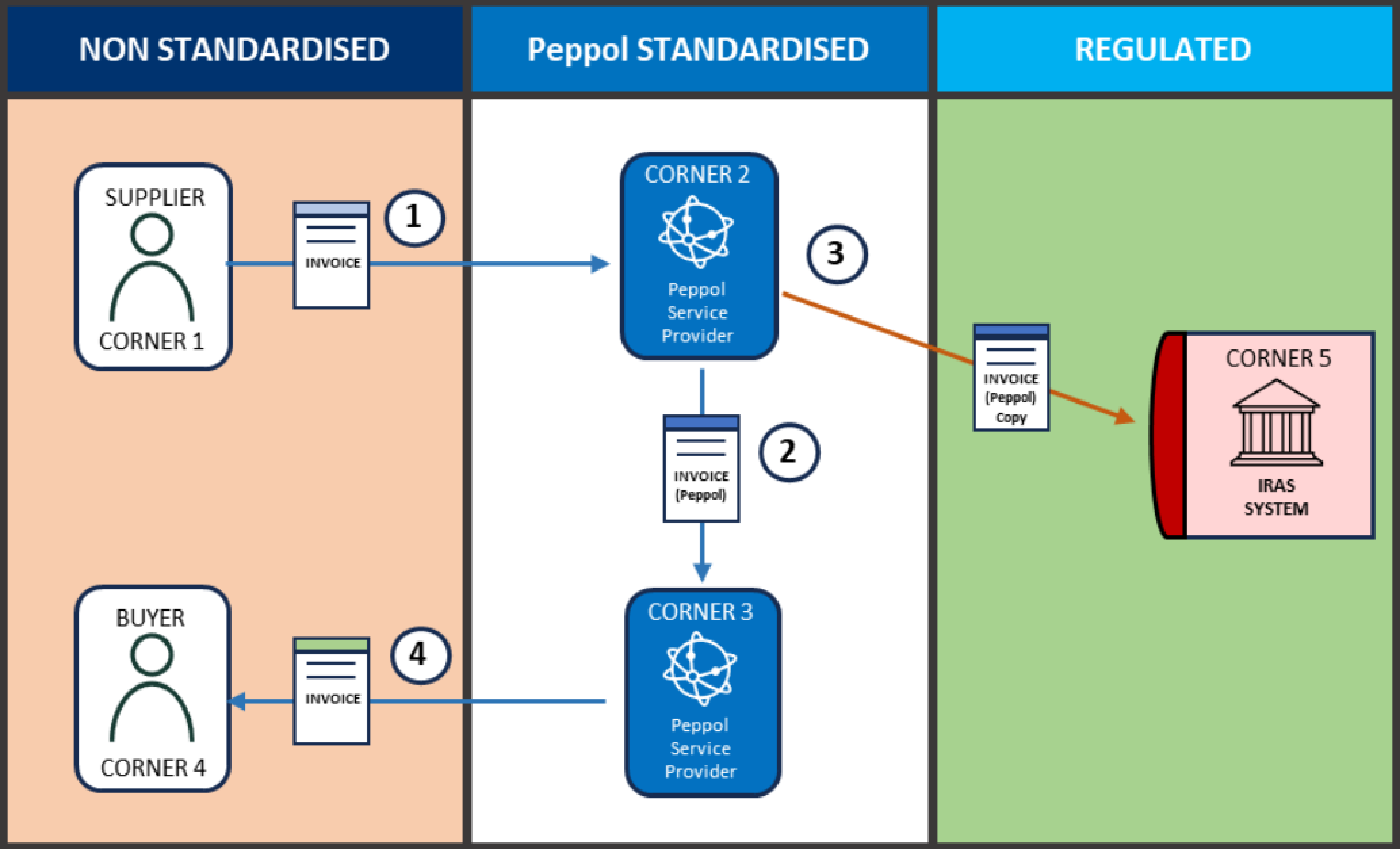
- You (corner 1) send the invoice data from your ERP or business software to ecosio in a structured format, such as VRBL, CSV, or IDoc.
- ecosio (corner 2) validates the invoice and converts it into the SG Peppol format, then sends the invoice to the buyer’s AP (corner 3).
- After successful delivery, a copy of the same invoice data is sent to IRAS (corner 5).
- The buyer (corner 4) receives the invoice in their financial system.
Type 1B: Accounts payable
The following diagram and steps illustrate the AP process for type 1B submissions, which are purchase invoices or credit notes derived from a Peppol invoice.
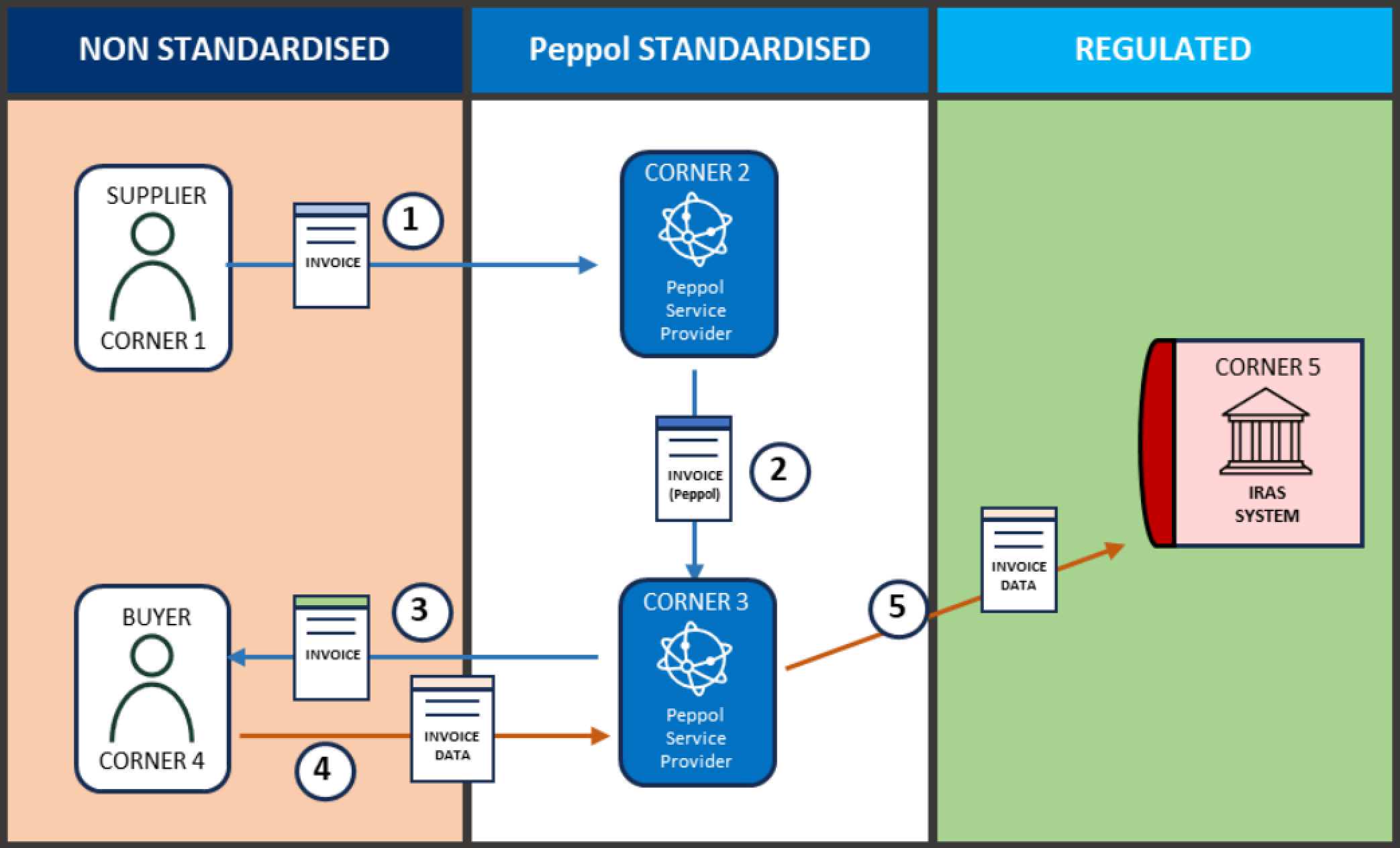
- The supplier (corner 1) sends the invoice to their Peppol AP.
- ecosio (corner 2) retrieves the invoice as your AP.
- The invoice is converted into the format required by your financial system and is made it available for you (corner 4) to retrieve.
- You accept the invoice in your financial system and send it to ecosio as your AP.
- The accepted invoice data is extracted and sent to IRAS (corner 5) at a regular interval.
This is distinct from the AR Type 1A flow, as buyer submission occurs only after acceptance.
If you use manual flows to exchange invoices, such as PDF, paper, or EDI, the relevant IRAS flows are type 2A for AR and type 3A for AP.
Type 2A: Accounts receivable flow
The following diagram and steps illustrate the AR process for type 2A submissions, which are supply invoices or credit notes issued outside InvoiceNow.
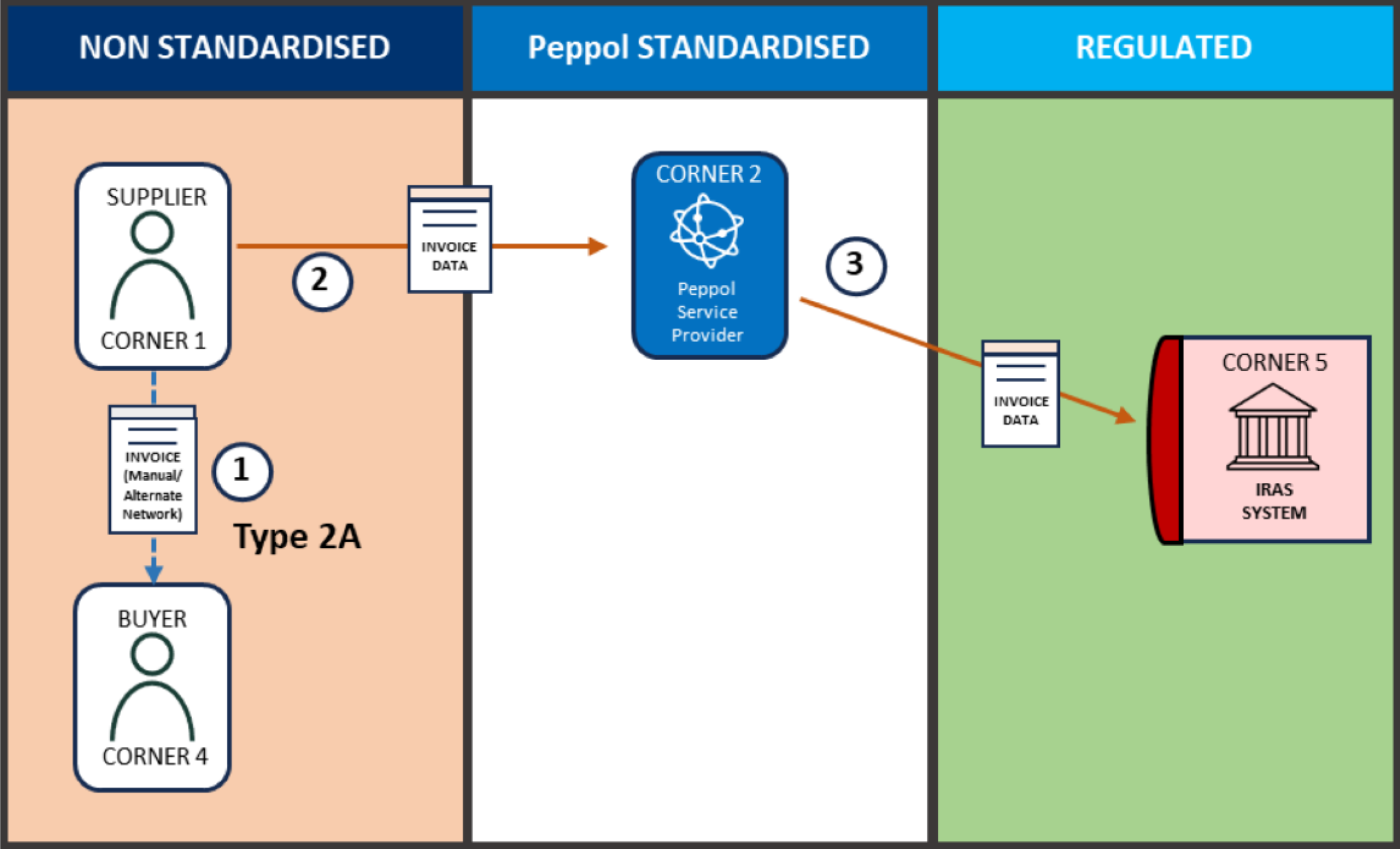
- You (corner 1) send the invoice to the buyer (corner 4) outside InvoiceNow, such as via email or paper, and the invoice is recorded in your financial system.
- You send the invoice from your financial system to ecosio (corner 2) as your AP.
- ecosio extracts the invoice data and sends it to IRAS (corner 5).
Type 3A: Accounts payable
The following diagram and steps illustrate the AP process for type 3A submissions, which are purchase invoices or credit notes received outside InvoiceNow.
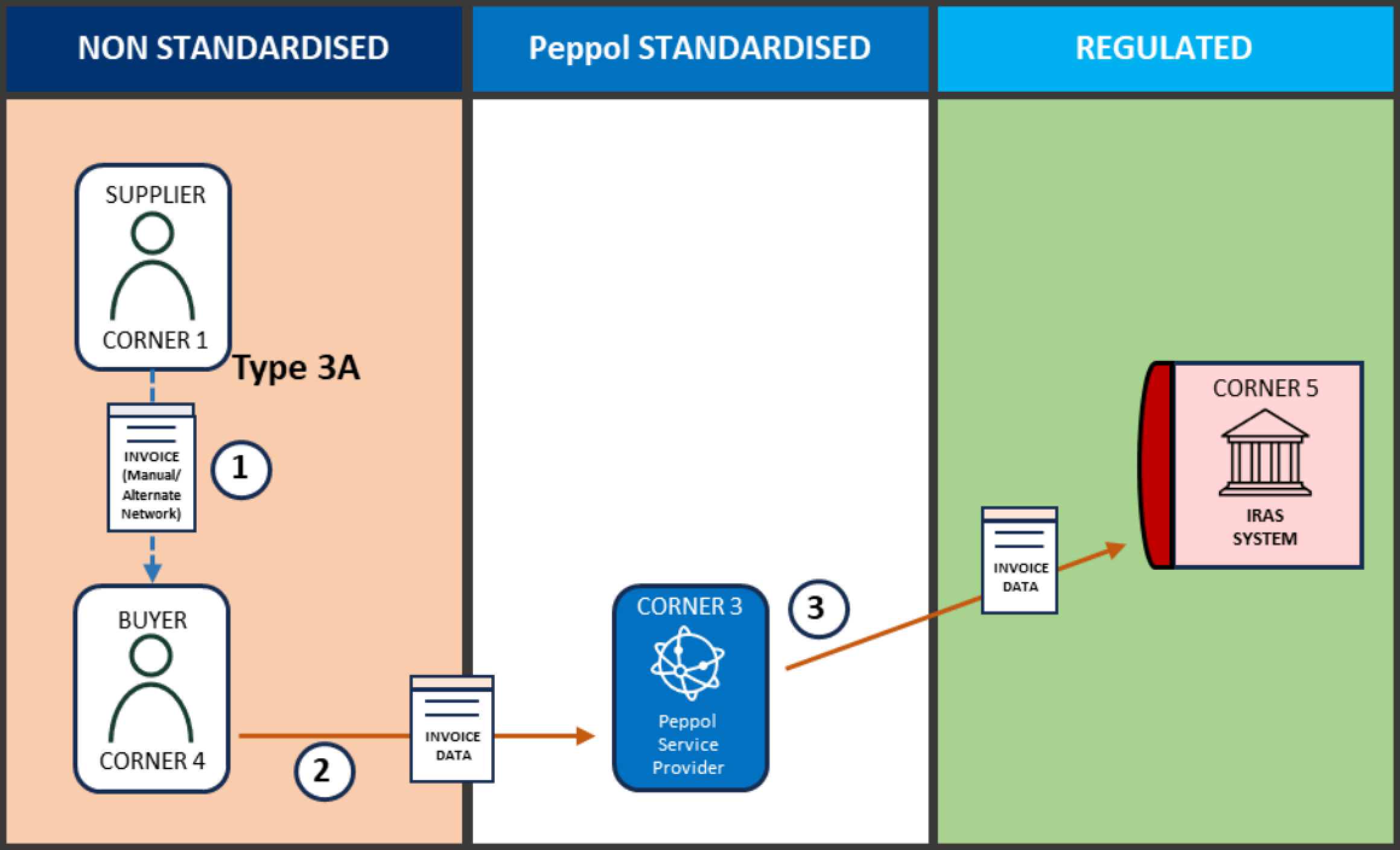
- The supplier (corner 1) sends the invoice to you (corner 4) outside InvoiceNow, such as via email or paper.
- You accept the invoice in your financial system and send it to ecosio as your AP (corner 3).
- ecosio extracts the accepted invoice data and sends it to IRAS (corner 5) at a regular interval.
When transactions are reported to IRAS in aggregated totals, for example from point-of-sale (POS) systems or permitted employee expense/petty cash claims, the relevant IRAS flows are 2B and 3B.
Type 2B: Accounts receivable
The following diagram and steps illustrate the AR process for type 2B submissions, which are sales invoices issued via POS systems or simplified tax invoices.
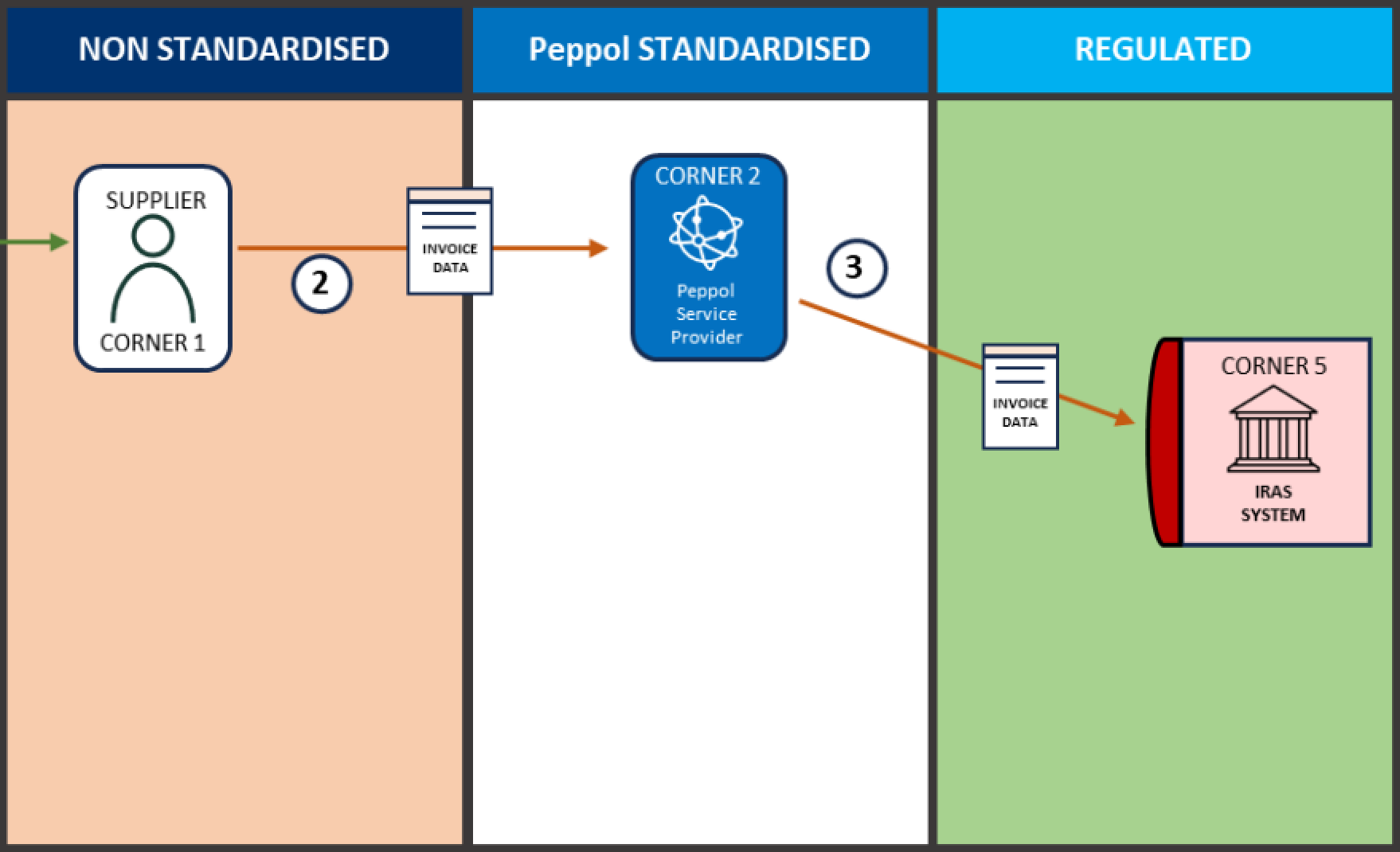
- You (corner 1) capture your sales in POS or a similar systems.
- You aggregate your totals according to your business practice, such as daily totals, and send the data to ecosio (corner 2) as your AP.
- The data is extracted and sent to IRAS (corner 5) at a regular interval.
Type 3B: Accounts payable
The following diagram and steps illustrate the AP process for type 3B submissions, which are petty cash purchases or employee expense claims.
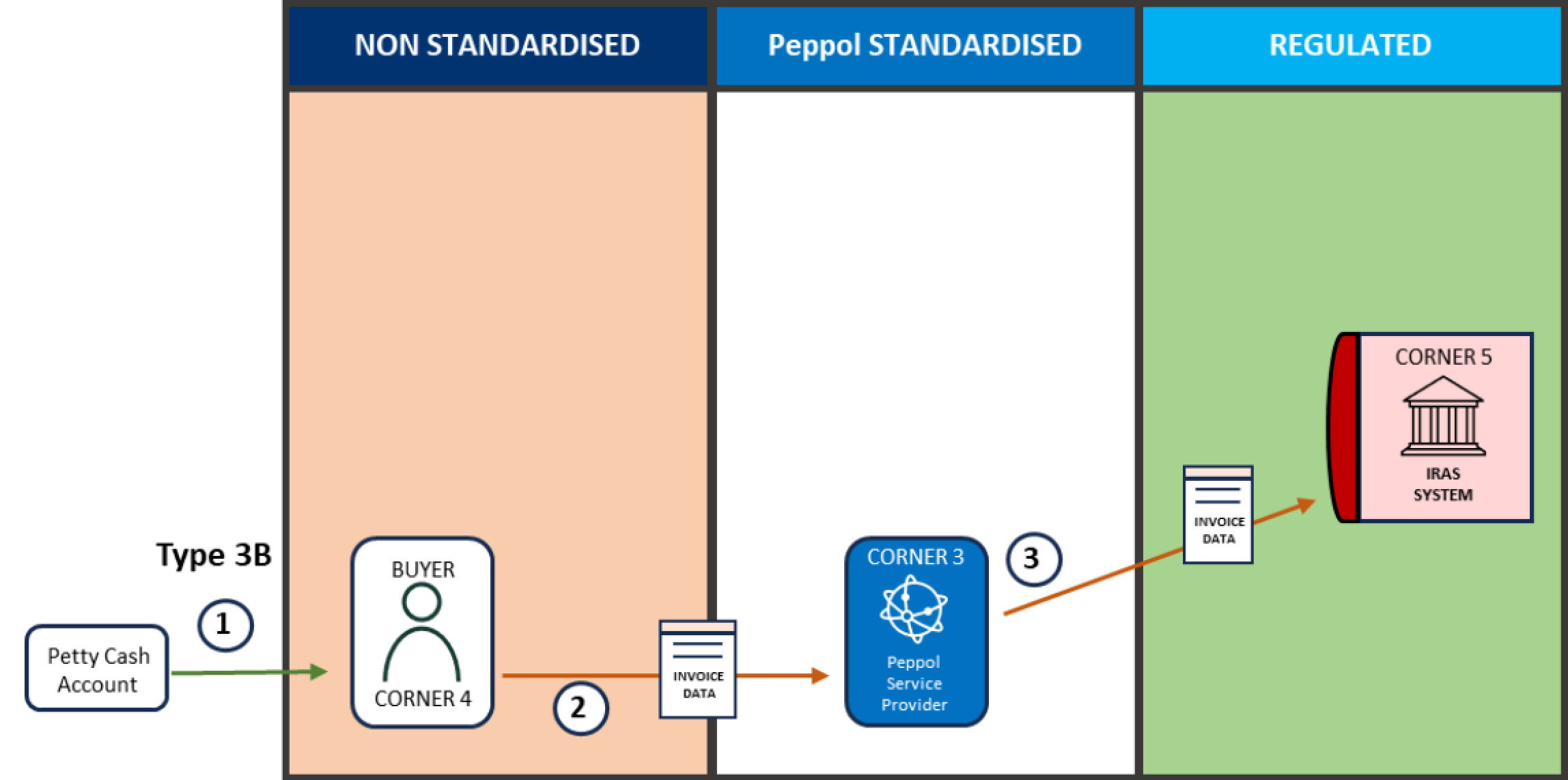
- You (corner 4) record your petty cash purchases or employee expenses an expense process or accounting system.
- You aggregate your totals according to your business practice, such as weekly totals, and send the data to ecosio (corner 3) as your AP.
- The data is extracted and sent to IRAS (corner 5) at a regular interval.
Legal and technical resources
The following official documents define the legal and technical framework for e-invoicing in Singapore.
- Goods and Services Tax Act (Cap. 117A): Establishes Singapore’s GST regime and tax invoice requirements.
- Goods and Services Tax (General) Regulations: Defines GST invoicing rules, including credit notes, simplified invoices, and record keeping.
- IRAS e-Tax Guide: Guidance on the GST InvoiceNow Requirement and how to comply.
- Singapore Peppol Guide: Guidance and resources for using Peppol/InvoiceNow in Singapore.
- InvoiceNow Technical Playbook: Technical guidance for implementing InvoiceNow, including onboarding, architecture, and exchange requirements.
Updated 8 days ago