
Compliance for Malaysia
Malaysia mandates that B2B and B2G invoice documents must be processed through the MyInvois Portal, which is accessed through MyTax and governed by Inland Revenue Board of Malaysia (IRBM), Malaysia's public institution responsible for tax collection and administration.
Document requirements
All B2B and B2G invoices must be processed through MyInvois Portal. B2C invoices can also be processed through the portal upon a buyer’s request.
Malaysia compliance summary
Learn more about compliance transaction terms and concepts.
| Aspect | Description | Requirement |
|---|---|---|
| B2B | Invoices exchanged between businesses. | Mandatory |
| B2C | Invoices issued by businesses to consumers. | Optional upon buyer request |
| B2G | Invoices issued by businesses to public administrations for public procurement. | Mandatory |
| Electronic signature | Signature or seal rules for authenticity and integrity of e‑invoices. | Mandatory |
| Legal archiving | Minimum retention period for e‑invoices. | 10 years |
| Model | The e-invoicing flow model used by the country. | Centralised model |
| Platform | The government-managed platform for e-invoicing. | Managed by IRBM through the MyInvois Portal |
| Supported format | The e-invoicing format legally required by the country. | UBL and JSON |
| Automatic updates | Whether invoice status updates synchronise automatically in Monitor. | Yes |
Format
Malaysia's e-invoice format uses XML or JSON.
Invoice Types
The Invoice Type Code element within the invoice must contain one of the following codes from MyInvois’s list of invoice types.
| Document | Code | Description |
|---|---|---|
| Invoice | 01 | An invoice for goods or services from a supplier to a buyer. |
| Credit note | 02 | Used to correct amounts or settle a balance between a supplier and a buyer. |
| Debit note | 03 | A document issued by a supplier to apply additional charges or increase the total value of a previously issued e-invoice. |
| Refund note | 04 | A document issued by a supplier to confirm the return of funds to the buyer. This applies specifically when the transaction involves a monetary refund. |
| Self-billed invoice | 11 | A document that a Malaysian buyer must create and report to the tax authorities to account for an invoice received from a foreign supplier, which is an import. This is a statutory tax reporting requirement and is separate from the self-billing process used in other industries. |
| Self-billed credit note | 12 | A document created by a Malaysian buyer to reduce the total value of a previously issued self-billed invoice. It’s used to correct errors or record discounts and returns when the original payment wasn't yet made and the reduction doesn't involve a refund. |
| Self-billed debit note | 13 | A document created by a Malaysian buyer to apply additional charges to increase the total value of a previously issued self-billed invoice. |
| Self-billed refund note | 14 | A document created by a Malaysian buyer to confirm the return of funds. This applies when the original payment was already made and the reduction involves a refund to the buyer. |
Automated e-invoicing flow
ecosio enables you to automate the transmission of compliant e-invoices for both AP and AR e-invoices in Malaysia.
Accounts receivable flow
The following diagram and steps illustrate the AR process for e-invoices in Malaysia.
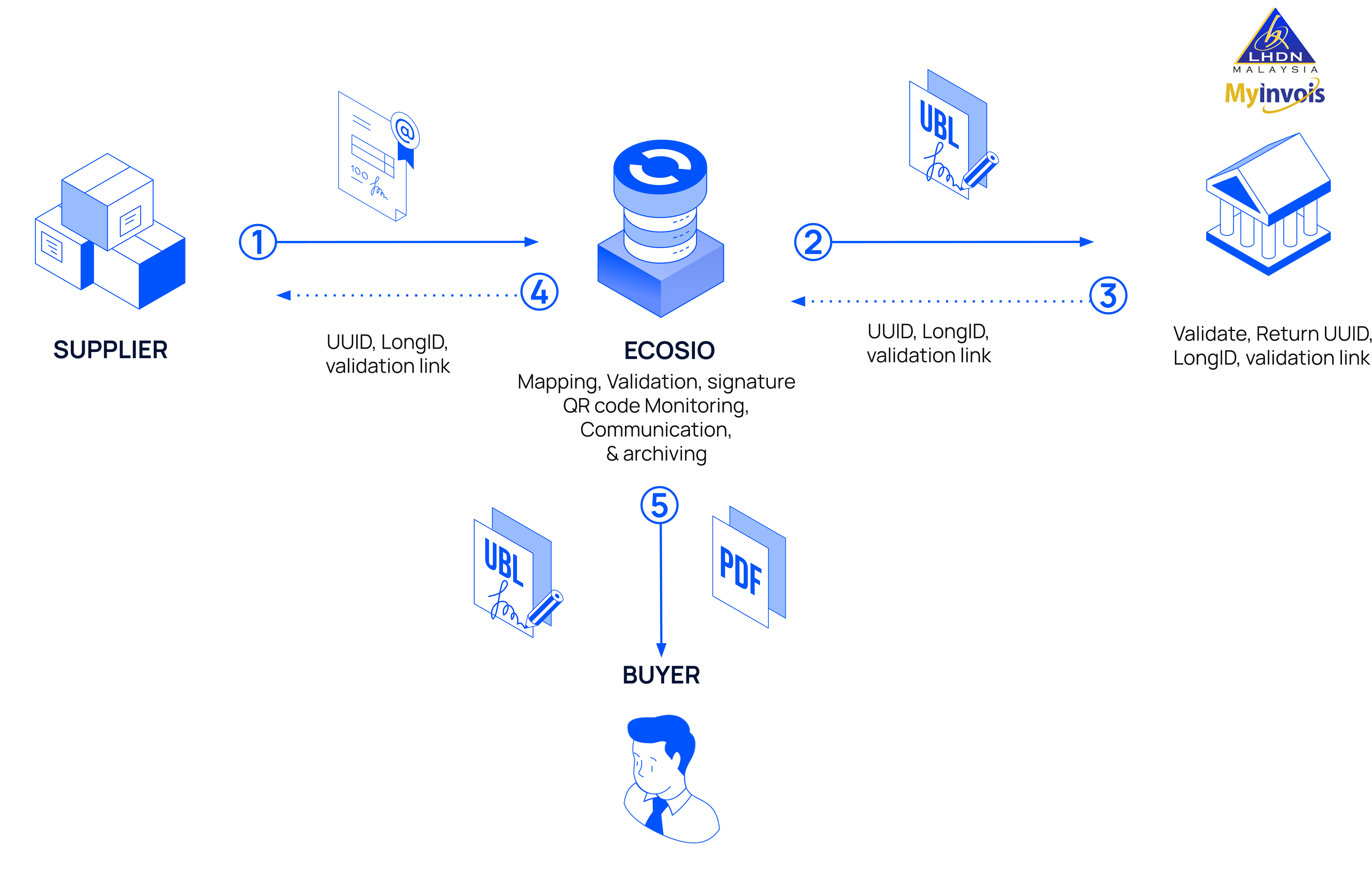
- You send the invoice data from your ERP or business software to ecosio in a structured format, such as XML.
- ecosio validates the invoice, maps it into the UBL format expected by MyInvois, and sends it to your MyInvois portal for validation by IRBM.
- Upon validation, IRBM assigns:
- A universal unique identifier (UUID)
- The date and time of validation
- Information required to generate the validation link, including the long ID and base URL
- ecosio retrieves this information, generates a PDF invoice containing the mandatory QR code for compliance, and sends it to your system.
- ecosio also converts the invoice into the buyer’s ERP or business software’s format, and makes it available for them to obtain.
Accounts payable flow
The following diagram and steps illustrate the AP process for e-invoices in Malaysia.
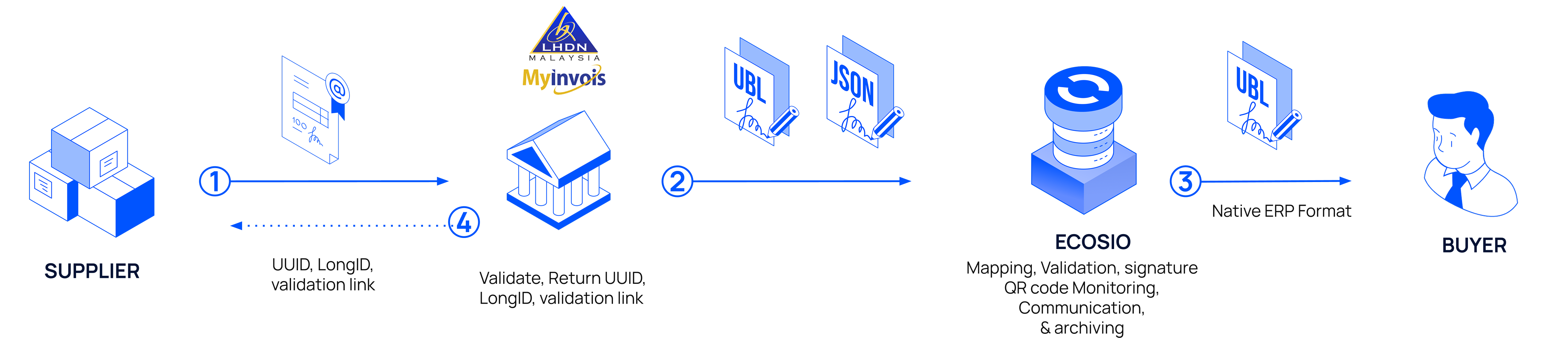
- The supplier sends the invoice to MyInvois in a UBL or JSON format.
- MyInvois processes the invoice and returns a UUID, long ID, and validation link.
- ecosio retrieves this information, converts it into your ERP or business software’s format, and sends it to your system.
- ecosio also converts the invoice into the supplier’s ERP or business software’s format, and makes it available for them to obtain.
Resources
The following official documents define the legal and technical framework for e-invoicing in Malaysia.
- E-invoice Guideline: Official overview of Malaysia’s e‑invoicing framework, including scope, timelines, formats, validation and archiving.
- E-invoice Specific Guideline: Official implementation rules for taxpayers and providers.
- IRBM E-invoicing Overview: IRBM’s main information hub for e‑invoicing and updates.
- MyInvois API & SDK: IRBM's developer guides for integrating your ERP system with MyInvois.
Updated 10 days ago