
Compliance for Serbia
Serbia mandates the exchange of B2B and B2G e-invoices through Sistem eFaktura (SEF), the central government platform managed by Poreska uprava, the Serbian Ministry of Finance and Tax Administration. In parallel, Serbia is rolling out e-transport through Sistem Elektronskih Otpremnica (SEO).
Document requirements
Serbia requires structured electronic invoices for domestic B2B and B2G e-invoices.
Serbia compliance summary
Learn more about compliance transaction terms and concepts.
| Aspect | Description | Requirement |
|---|---|---|
| Invoices exchanged between businesses. | Mandatory | |
| Invoices issued by businesses to consumers. | Not mandated for e‑invoicing. | |
| Invoices issued by businesses to public administrations for public procurement. | Mandatory | |
| Electronic signature | Signature or seal rules for authenticity and integrity of e‑invoices. | Handled by SEF as part of the platform workflow. |
| Legal archiving | Minimum retention period for e‑invoices. | End of the calendar year of issue, plus an additional 10 years. |
| Model | The e-invoicing flow model used by the country. | Centralised |
| Platform | The government-managed platform for e-invoicing. | Sistem eFaktura (SEF) |
| Supported format | The e-invoicing format legally required by the country. | |
| Automatic updates | Whether invoice status updates synchronise automatically in Monitor. | Yes |
Format
Serbia requires structured electronic invoices in UBL 2.1 XML for submission to SEF.
Invoice types
The Invoice Type Code element within the invoice must contain one of the codes from the UNTDID 1001 code list.
| Document | Code | Description |
|---|---|---|
| Advance invoice | 386 | An invoice claiming advance payment for goods or services. |
| Credit note | 381 | Used to reduce or cancel an invoice. |
| Debit note | 383 | A document issued by a supplier to apply additional charges or increase the total value of a previously issued e-invoice. |
| Invoice | 380 | Standard sales invoice. |
Automated e‑invoicing flow
ecosio enables you to automate the transmission of compliant e-invoices for both accounts receivable and accounts payable processes in Serbia.
Accounts receivable flow
The following diagram and steps illustrate the AR process for e-invoices in Serbia.
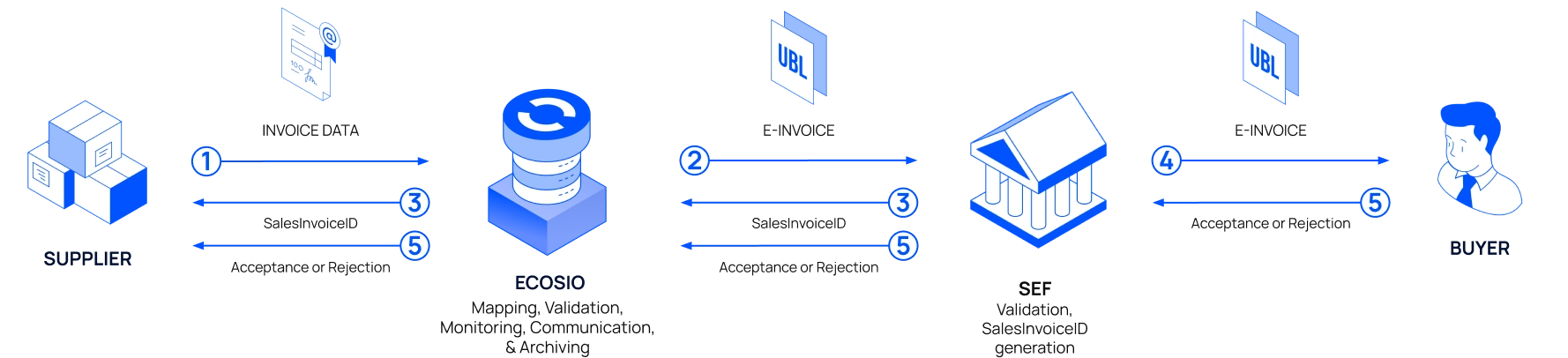
- You send invoice data from your ERP or business software to ecosio in a structured format, such as VRBL.
- ecosio converts the data to UBL 2.1, validates it against Serbian requirements, and sends it to SEF.
- SEF validates the e-invoice and returns an invoice ID to ecosio. ecosio forwards the invoice ID to your business system and shows the invoice status in the Monitor.
- The buyer retrieves the e-invoice from SEF.
- The buyer must respond to the e-invoice by either approving or rejecting it with a reason. Public sector entities have 15 days to respond, otherwise the invoice is automatically accepted. Private sector buyers have 20 days to respond, otherwise the invoice is automatically rejected.
Accounts payable flow
The following diagram and steps illustrate the AP process for e-invoices in Serbia.
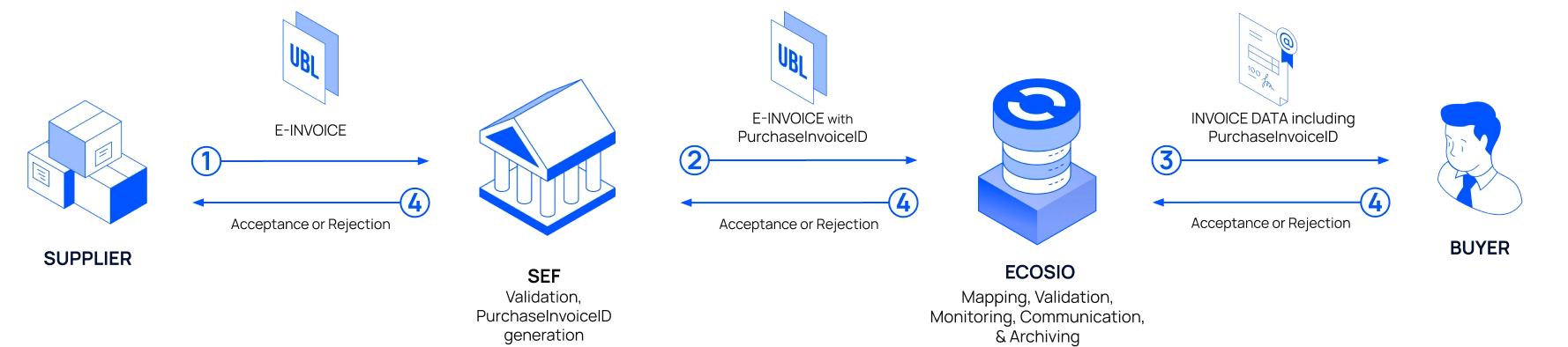
- The supplier sends the e-invoice to SEF.
- SEF validates the e-invoice and assigns an invoice ID.
- ecosio retrieves the e-invoice from SEF, validates it, converts it to your required format, and sends it to your business system.
- You respond to the e-invoice by either accepting or rejecting it within 20 days via ecosio. The status and tracking of the e-invoice is also displayed in the Monitor.
E-transport
In addition to e-invoicing, Serbia mandates that in-scope movements of goods within Serbia must be documented using electronic delivery notes through Sistem Elektronskih Otpremnica (SEO), the national e-transport platform.
Exemptions from the obligation to send electronic dispatch notes are set out in Article 3 of the Law on Electronic Dispatch Notes.
Automated e-transport flow
ecosio enables you to automate the transmission of electronic delivery notes as part of Serbia’s mandate.
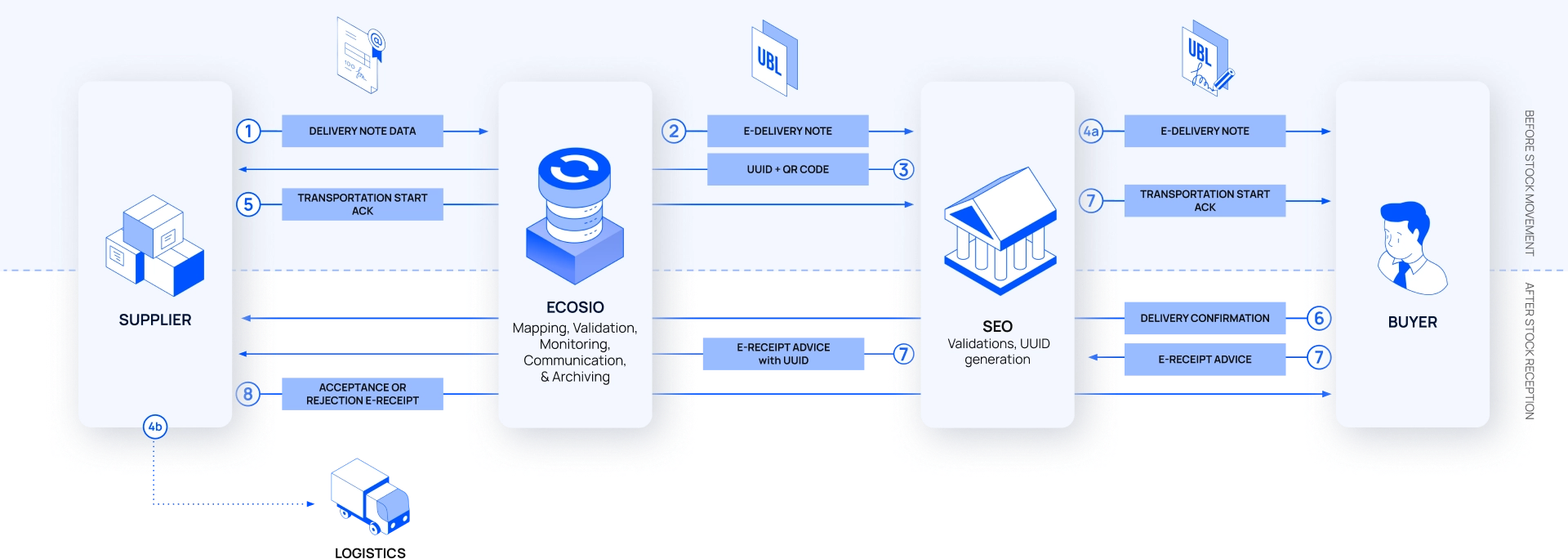
- You send the delivery note data from your ERP or business software to ecosio in a structured format, such as VRBL. This must be done before transport begins.
- ecosio converts the delivery note into the Serbian UBL 2.1-compliant format, validates it against local requirements, and sends it to SEO.
- SEO validates the delivery note and returns a unique internal document ID (UUID). SEO also generates a PDF with a QR code. ecosio sends the ID to your ERP or business software.
- The e-delivery note is made available to the following parties:
- The buyer retrieves the e-delivery note from SEO.
- The supplier is responsible for transmitting the e-delivery note to the carrier. If the carrier has an account on SEO, they can also retrieve it from SEO.
- You can cancel the registered delivery note before delivery confirmation, or send a transportation start message to ecosio. ecosio sends this message to SEO and to the buyer via SEO.
- The buyer must confirm the physical receipt of the goods in SEO no later than three working days after receipt.
- The buyer registers a receipt advice message to SEO within 8 working days from the date the goods are physically received, to accept or reject the delivery. ecosio fetches the receipt advice from SEO in UBL 2.1 XML with the envelope that contains the unique internal document ID given by SEO. ecosio then validates and converts the e‑receipt from UBL into the buyer’s ERP format for its integration.
- You respond to the e-receipt by either accepting or rejecting it via ecosio.
Legal resources
The following official documents define the legal and technical framework for e-invoicing and e-transport in Serbia.
-
Law on Electronic Invoicing: Defines the scope of entities and transactions that must use SEF, plus the rules for issuing, receiving, processing, and storing electronic invoices.
-
Electronic Invoicing Regulations: Provides implementing rules for SEF usage, including technical and operational requirements.
-
Instructions for connecting to SEF via API: Official technical guidance for API-based integration with SEF.
-
XML document validation service (UBL 2.1): Official validator for UBL 2.1 XML invoices submitted to SEF.
-
SEO API documentation: Official technical documentation for API-based integration with SEO.
-
Law on Electronic Delivery Notes (e-Otpremnica): Defines Serbia’s legal framework for mandatory electronic delivery notes.
Updated about 22 hours ago