
Compliance for Hungary
Hungary mandates real-time invoice reporting for all VAT-registered businesses via the NAV Online Invoicing System, which is governed by the National Tax and Customs Administration (NAV).
E-invoicing requirements
All B2B, B2C, and B2G invoices must be reported to NAV through the NAV Online Invoicing System.
Hungary compliance summary
Learn more about compliance transaction terms and concepts.
| Aspect | Description | Requirement |
|---|---|---|
| Invoices exchanged between businesses. | Mandatory reporting | |
| Invoices issued by businesses to consumers. | Mandatory reporting | |
| Invoices issued by businesses to public administrations for public procurement. | Mandatory exchange and reporting | |
| Electronic signature | Signature or seal rules for authenticity and integrity of e‑invoices. | Mandatory for PDF invoices. Not required for NAV XML reporting. |
| Legal archiving | Minimum retention period for e‑invoices. | 8 years |
| Model | The e-invoicing flow model used by the country. | Real-time reporting to the tax authority. |
| Platform | The government-managed platform for e-invoicing. | Managed by NAV through the NAV Online Invoicing System. |
| Supported format | The e-invoicing format legally required by the country. | NAV 3.0 XML |
| Automatic updates | Whether invoice status updates synchronise automatically in Monitor. | Yes |
Format
Hungary’s reporting format is the NAV Online Invoice 3.0 XML schema, published by NAV. For technical specifications and examples, see the XML schema definition in the NAV technical documentation.
Invoice fields
The reported invoice data must contain the following fields.
| Field | Description |
|---|---|
| CompletenessIndicator | Indicates whether the reported invoice data is marked as complete and can be used for exchange via NAV. |
| InvoiceCategoryType | Indicates the invoice category. Values: Normal, Simplified, Aggregate. |
| InvoiceOperation | Indicates the operation type for the reported invoice data. Values: Create, Modify, Storno (cancellation). |
| SelfBillingIndicator | Indicates whether the invoice is a self-billing invoice. |
Automated reporting flow
ecosio enables you to automate the real-time submission of compliant invoice data to NAV.
Accounts receivable flow
The following diagram and steps illustrate the AR process for invoice reporting in Hungary.
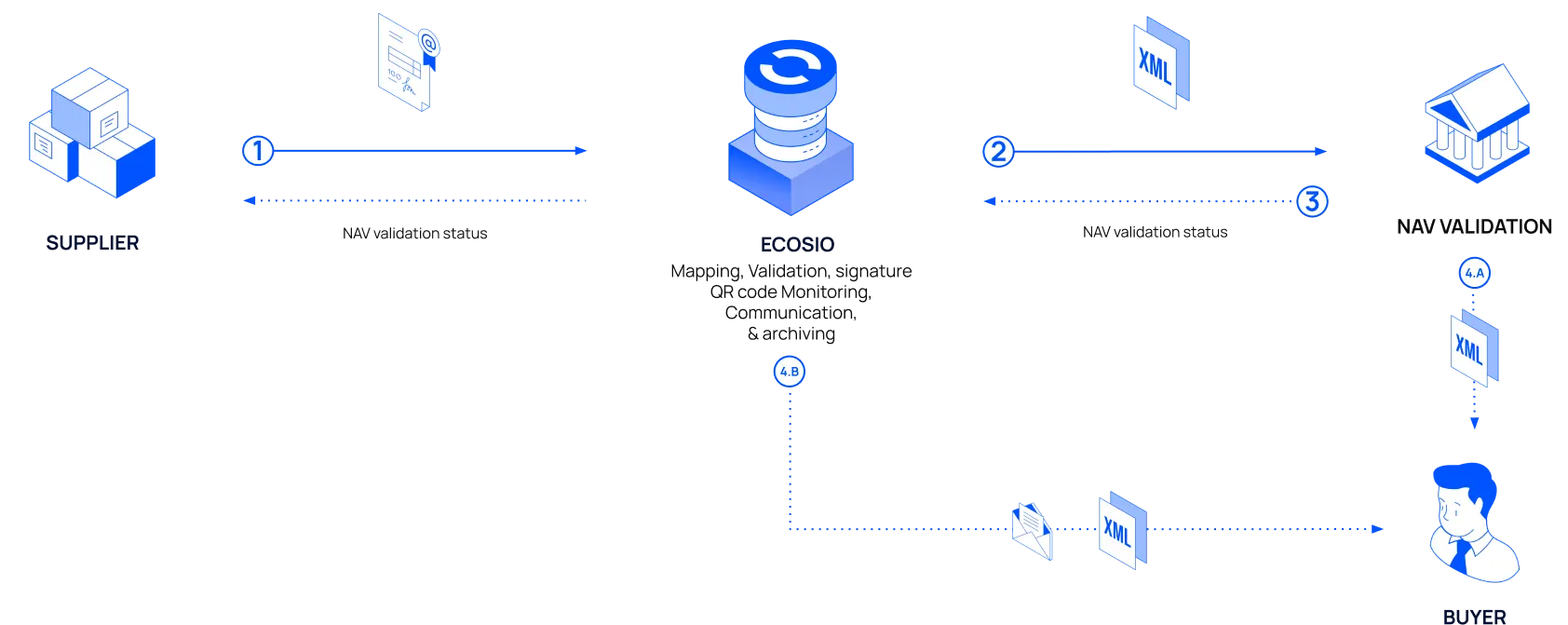
- You send the invoice data from your ERP or business software to ecosio in a structured format, such as VRBL.
- ecosio validates the invoice data, converts it to the NAV XML format, and applies country rules.
- ecosio sends the invoice data to the NAV Online Invoicing System. NAV then returns an invoice status.
- The invoice can be sent to the buyer in two ways:
- If the
completenessIndicatorfield is set totruein the invoice data, the buyer can fetch the invoice via API through NAV. - Through ecosio via EDI, if the buyer and supplier exchange structured formats.
- If the
Accounts payable flow
The following diagram and steps illustrate the AP process for invoice reporting in Hungary.
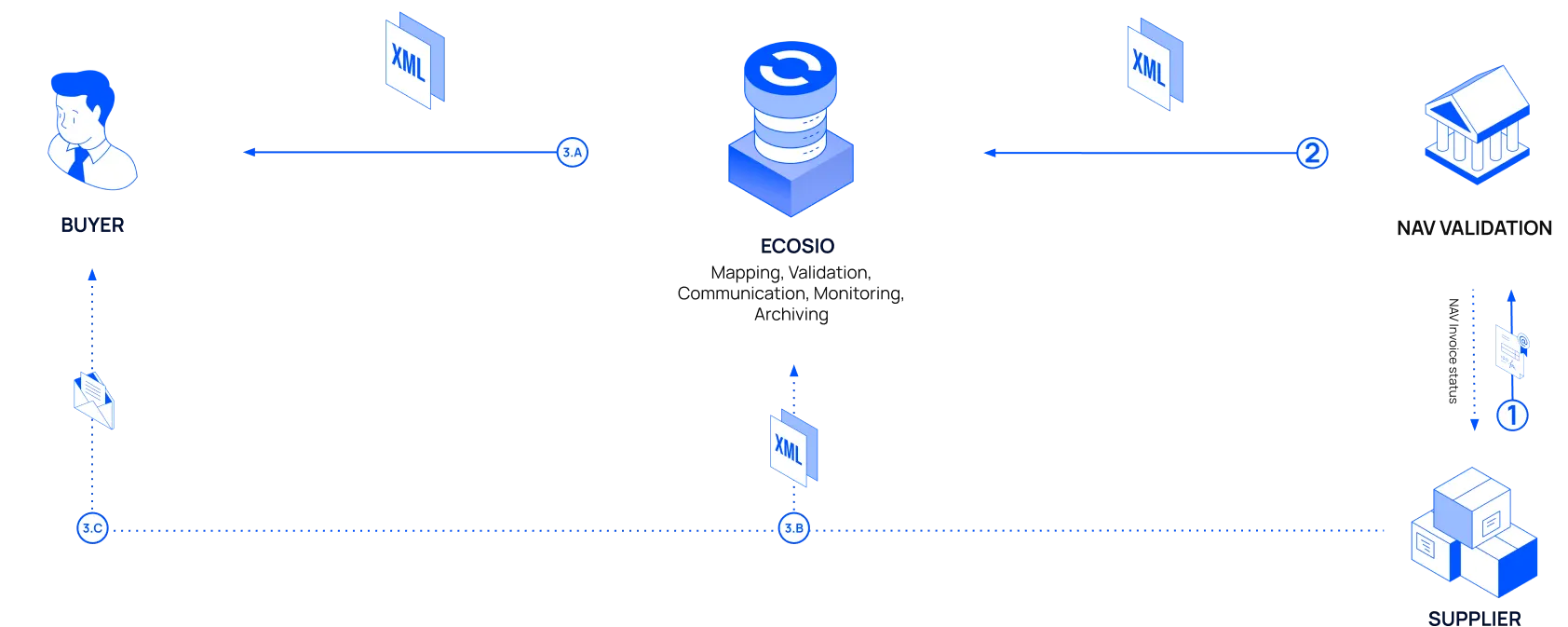
- The supplier sends the invoice to the NAV Online Invoicing System.
- NAV validates the invoice and returns a validation status to the supplier.
- The invoice can be sent to the buyer in three ways:
- If the
completenessIndicatorfield is set totruein the invoice data, the buyer can fetch the invoice via API through NAV. - Through ecosio via EDI, if the buyer and supplier exchange structured formats.
- Directly between supplier and buyer, outside of ecosio.
- If the
Legal resources
The following official documents define the legal and technical framework for invoice reporting and electronic invoicing in Hungary.
- NAV Online Invoice documentation: Technical documentation, schemas, and implementation guidance.
- Act CXLIII of 2015 on Public Procurement: Legal framework for public procurement, including public sector e-invoicing requirements.
- Government Decree No. 23/2014 (III. 13.): Invoicing rules and real-time reporting technical framework.
Updated 9 days ago