
Compliance for Peru
Overview of electronic transaction document mandates in Peru, and how to remain compliant with the National Superintendency of Customs and Tax Administration (SUNAT) and its e-invoicing framework.
Peru mandates electronic tax documents, known in Spanish as Comprobantes de Pago Electrónicos (CPEs), including e-invoices, for almost all taxpayers. You must generate each CPE as XML, digitally sign it, and then submit it for validation before the National Superintendency of Customs and Tax Administration, known in Spanish as Superintendencia Nacional de Aduanas y de Administración Tributaria (SUNAT), considers it tax-valid. You can complete these steps directly with SUNAT, or you can use Electronic Services Providers, known in Spanish as Proveedor de Servicios Electrónicos (PSE).
A PSE can issue and sign electronic tax documents on your behalf, which can reduce the effort required to manage certificates and signing logic. An Electronic Services Operator, known in Spanish as Operador de Servicios Electrónicos (OSE), then validates the signed document and returns a validation response, which SUNAT uses to register the document in the clearance flow.
Peru also mandates electronic transport documents called the Guía de Remisión Electrónica (GRE) for the movement of goods.
E-invoicing requirements
Peru mandates e-invoicing for B2B, B2G, and B2C transactions and uses a clearance model, where SUNAT or an authorised operator validates each document.
Peru compliance summary
Learn more about e-invoicing terms and concepts.
| Aspect | Description | Requirement |
|---|---|---|
| B2B | Invoices exchanged between businesses. | Mandatory |
| B2C | GST reporting is required for in‑scope GST‑registered businesses. | Mandatory as electronic receipts (boletas). Must be reported as daily summaries. |
| B2G | Invoices issued by businesses to public administrations for public procurement. | Mandatory |
| Electronic signature | Signature or seal rules for authenticity and integrity of e‑invoices. | Mandatory |
| Legal archiving | Minimum retention period for e‑invoices. | 5 years |
| Model | The e-invoicing flow model used by the country. | Clearance |
| Platform | The government-managed platform for e-invoicing. | |
| Supported format | The e-invoicing format legally required by the country. | UBL 2.1 XML |
| Automatic updates | Whether invoice status updates synchronise automatically in Monitor. | Yes |
Format
Peru’s electronic tax documents (CPEs) are issued as XML and are based on the UBL 2.1 schema.
When you issue a CPE, you must digitally sign the XML before you submit it for validation.
In Peru, the signing model depends on who issues the document:
- If you issue CPEs directly (for example, via your own systems), you sign the XML using your company’s digital certificate.
- If you outsource issuance to a PSE, the PSE can sign the XML on your behalf, using the certificate it registers for that service, based on your authorisation in SOL.
After signing, an OSE validates the signed document and returns the proof of receipt, known in Spanish as a Constancia de Recepción (CDR). SUNAT then registers the document based on the validated result.
Automated e-invoicing flow
ecosio enables you to automate the transmission of compliant electronic tax documents in Peru via a third-party PSE.
Accounts receivable flow
The following diagram and steps illustrate the current AR process for e-invoicing in Peru.
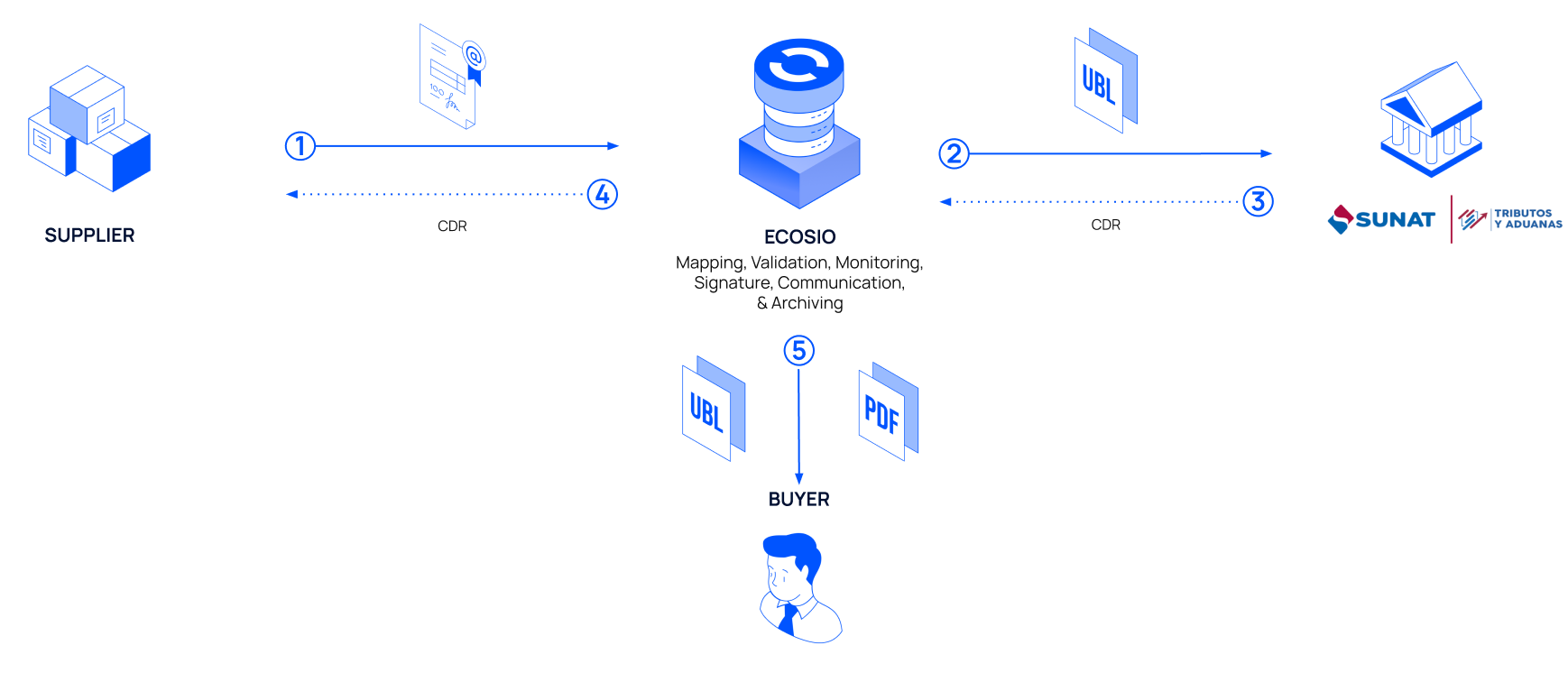
- You send the invoice data from your ERP or business software to ecosio in a structured format, such as VRBL.
- ecosio validates the invoice data and converts it into the required UBL 2.1 format. ecosio then sends the invoice to a PSE, who sends it to an OSE for validation.
- The OSE receives the invoice, validates it, and sends a CDR to the PSE which is then sent to ecosio. The OSE also reports the CDR to SUNAT.
- ecosio converts the cleared invoice data to your business or financial software’s format and sends it to your system.
- ecosio can generate the invoice in PDF format with a unique QR code and email it to the buyer, or send it to the buyer’s financial or business software in a structured format.
Accounts payable flow
The following diagram and text illustrate the current AP process for e-invoicing in Peru.

The supplier sends the invoice to your ecosio email address dedicated to inbound invoices. ecosio can then convert the invoice data into the format required by your business or financial software.
E-transport
Peru mandates the GRE as an electronic transport document for the movement of goods. GREs describe the goods and transport details and must be reported in real time.
Automated e-transport flow
The following diagram and steps illustrate the automated e-transport flow in Peru.
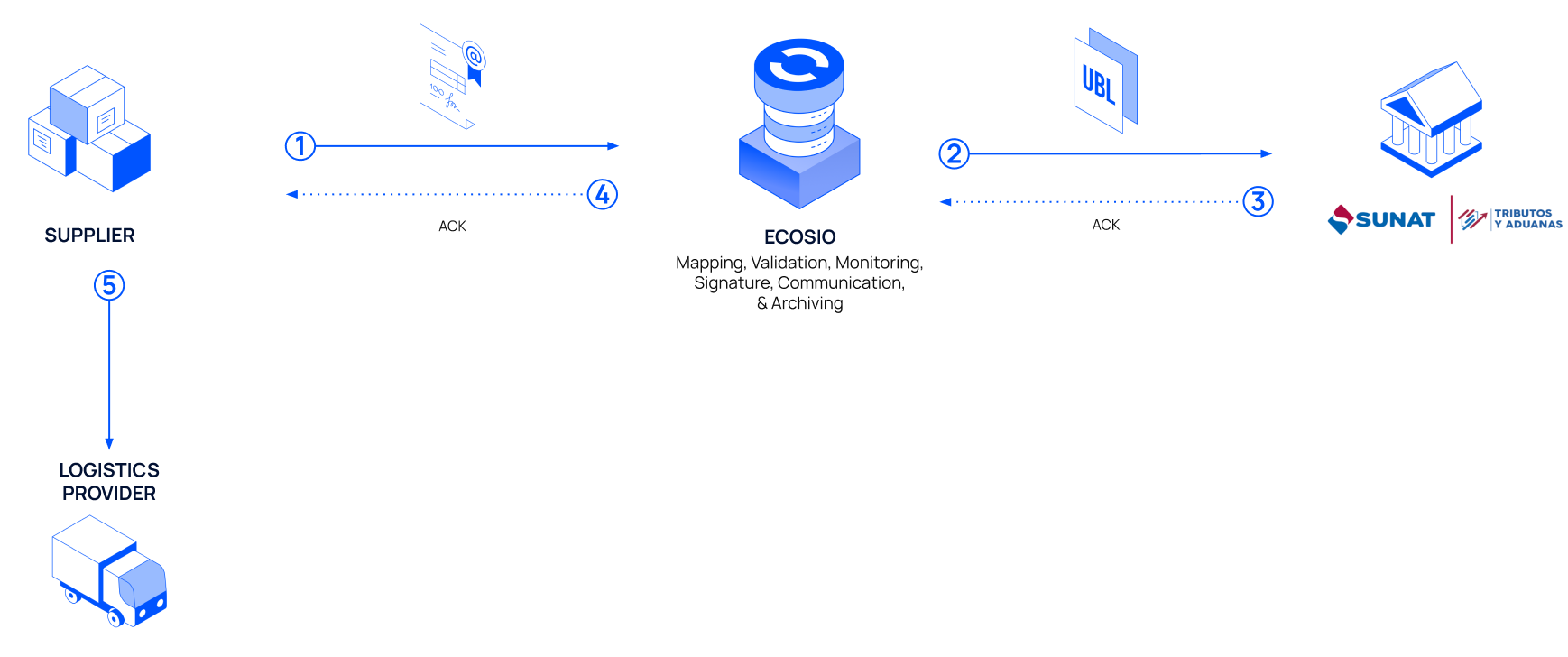
- You send the GRE from your ERP or business software to ecosio in a structured format, such as VRBL.
- ecosio validates the GRE and converts it into the required GRE XML format, then sends it to SUNAT.
- SUNAT receives the GRE, validates it, and sends a PDF, QR code, and CDR to ecosio.
- ecosio converts the received documents to your business or financial software’s format and sends it to your system.
- You send the PDF and QR code to the carrier for use during transit.
Legal resources
The following official documents define the legal and technical framework for e-invoicing and related electronic documents in Peru.
- SUNAT CPE portal: Official documentation including regulations, manuals, and technical resources.
- PSE information (SUNAT): Register of authorised electronic service providers (Proveedores de Servicios Electrónicos, or PSE).
- OSE information (SUNAT): Register of authorised electronic services operators (Operadores de Servicios Electrónicos, or OSE).
Updated 2 days ago