
Compliance for China
China operates a clearance-based e-invoicing model for VAT invoices, known as e-fapiao. Invoices are only legally valid once they are cleared by the State Taxation Administration (STA) through the Golden Tax System (GTS). Clearance by the STA also requires authentication. This is completed before issuance and is typically valid for issuing multiple invoices during a specified period.
Document requirements
In China, e-fapiao invoices are mandatory for domestic transactions.
China compliance summary
Learn more about compliance transaction terms and concepts.
| Aspect | Description | Requirement |
|---|---|---|
| Invoices exchanged between businesses. | Mandatory | |
| Invoices issued by businesses to consumers. | Mandatory | |
| Invoices issued by businesses to public administrations for public procurement. | Mandatory | |
| Electronic signature | Signature or seal rules for authenticity and integrity of e‑invoices. | Mandatory. The STA applies a digital signature during clearance. |
| Legal archiving | Minimum retention period for e‑invoices. | 30 years |
| Model | The e-invoicing flow model used by the country. | Clearance |
| Platform | The government-managed platform for e-invoicing. | Golden Tax System (GTS) |
| Supported format | The e-invoicing format legally required by the country. | Local structured XML |
| Automatic updates | Whether invoice status updates synchronise automatically in the Monitor. | Yes |
Format
China requires that invoice data is submitted for clearance in a local structured XML format. The XML is the authoritative invoice data and the STA must clear it before the invoice becomes legally valid.
The official human-readable rendering of a cleared e-fapiao is OFD (Open Fixed-layout Document). You can also generate a PDF for business convenience but OFD remains the official visual representation.
Invoice types
China defines invoices as receipts issued and obtained by entities and individuals in the buying and supplying of goods, the provision or receipt of services, and other business activities.
China’s e-invoicing system supports multiple e-fapiao types. For the ecosio-supported flow, the key invoice types are:
- General VAT e-fapiao: Simplified invoice where input VAT deduction is not claimed, including many B2C and non-deductible B2B scenarios.
- Special VAT e-fapiao: Used for transactions where the buyer may claim input VAT deduction.
- Red-letter invoice: Used to correct or reverse a previously issued invoice.
- Export invoice: A general VAT e-fapiao with 0% VAT.
Automated e-invoicing flow
ecosio enables you to automate the issuance and retrieval of compliant e-fapiao in China by integrating with the STA through an established local service provider.
Accounts receivable flow
The following diagram and steps illustrate the current AR process for e-fapiao invoices in China.
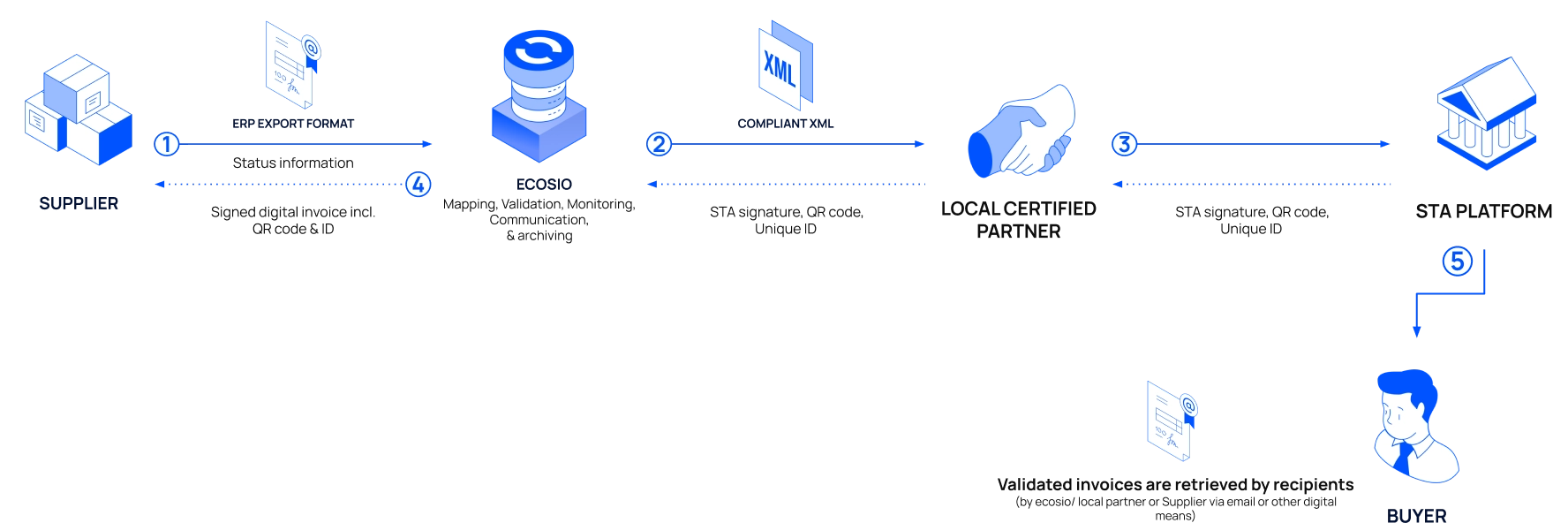
- You send the invoice data from your ERP or business software to ecosio in a structured format, such as VRBL.
- ecosio validates the invoice data and converts it to the required local XML format. ecosio then sends the invoice data to KeGuang, ecosio’s STA-authorised local service provider.
- KeGuang manages the clearance process with the STA:
a. KeGuang sends the invoice data to the STA for clearance.
b. The STA validates and clears the invoice, then assigns the official invoice identifier, QR code, and digital signature.
c. KeGuang retrieves the invoice status and cleared invoice artefacts from the STA, which ecosio then retrieves from KeGuang. - ecosio converts the cleared invoice data to your ERP or business software’s format and sends it to your system.
- The buyer accesses the cleared invoice via the STA platform.
Accounts payable flow
The following diagram and steps illustrate the current AP process for e-fapiao invoices in China.
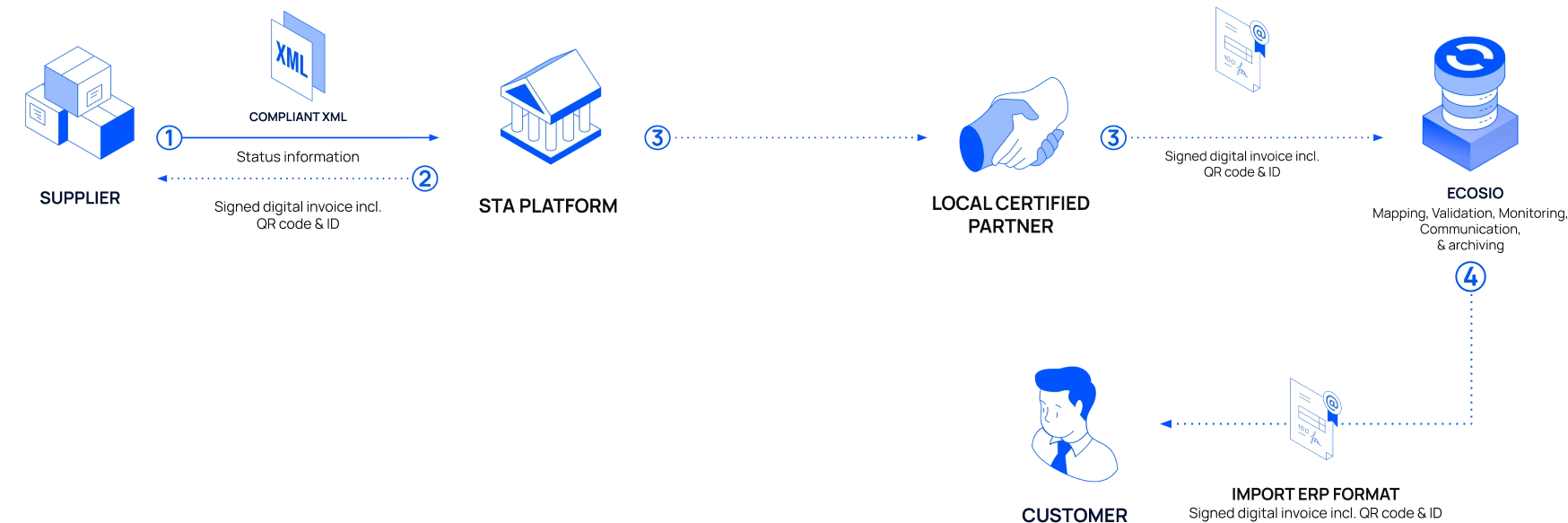
- The supplier sends the invoice data to the STA for clearance.
- The STA validates and clears the invoice, then assigns the official invoice identifier, QR code, and digital signature. The cleared invoice is then available to the supplier.
- KeGuang, ecosio’s STA-authorised local service provider, retrieves the cleared invoice data from the STA.
- ecosio receives the cleared invoice data from KeGuang, validates and converts it to your ERP or business software’s format, and sends it to your system.
Legal resources
The following official documents and portals provide legal and regulatory information for e-invoicing in China.
- STA legislation portal: Official STA legislative and regulatory library.
- Public invoice verification portal: Official portal for invoice authenticity checks.
- Implementation of the Electronic Special Value-Added Tax Invoice System: Interpretation by the STA of Guangdong.
- Invoice verification: Official STA e-fapiao verification tool.
Updated 9 days ago