
Compliance for Romania
Romania mandates that all invoices and transport documents must be processed through the RO e-Factura platform, which is governed by ANAF, Romania's public institution responsible for tax collection and administration. It's accessed through ANAF’s online portal (SPV).
Document requirements
All B2B, B2C, and B2G invoices must be processed through RO e-Factura, except for low-value B2C simplified invoices, which are typically issued through electronic fiscal registers.
Romania compliance summary
Learn more about compliance transaction terms and concepts.
| Aspect | Description | Requirement |
|---|---|---|
| B2B | Invoices exchanged between businesses. | Mandatory |
| B2C | Invoices issued by businesses to consumers. | Mandatory, with exceptions for simplified invoices |
| B2G | Invoices issued by businesses to public administrations for public procurement. | Mandatory |
| Electronic signature | Signature or seal rules for authenticity and integrity of e‑invoices. | Mandatory, issued by a trusted provider |
| Legal archiving | Minimum retention period for e‑invoices. | Five years |
| Model | The e-invoicing flow model used by the country. | Continuous Transaction Controls (CTC) |
| Platform | The government-managed platform for e-invoicing. | Managed by ANAF through the RO e-Factura platform |
| Supported format | The e-invoicing format legally required by the country. | Based on the EN 16931 standard and the country-specific RO_CIUS standard |
| Automatic updates | Whether invoice status updates synchronise automatically in Monitor. | Yes |
Format
Romania's e-invoice format is based on the EN 16931 standard and follows the country-specific CIUS, known as the RO_CIUS or CIUS-RO standard. This means all rules from EN 16931 apply, along with the additional rules defined in the RO_CIUS. For more information and examples, see the Romanian Ministry of Finance's technical information page.
Invoice types
The Invoice Type Code element within the invoice must contain one of the following codes from the UNTDID 1001 code list.
| Document | Code | Description |
|---|---|---|
| Commercial invoice | 380 | An invoice for goods or services from a supplier to a buyer. |
| Credit note | 381 | Used to correct amounts or settle a balance between a supplier and a buyer. It is not required to provide a previous invoice reference. |
| Correction invoice | 384 | Used to correct or cancel a previously sent invoice. It is mandatory to provide a reference to the original invoice. |
| Self-billed invoice | 389 | An invoice process based on an agreement between a supplier and a buyer, where the buyer prepares the invoice and sends it to the supplier with the payment. |
| Invoice information for accounting purposes | 751 | A document containing accounting-related information such as monetary totals, supplier ID, and VAT. It may not be a complete invoice according to legal requirements. |
Automated e-invoicing flow
ecosio enables you to automate the transmission of compliant e-invoices for both AP and AR e-invoices in Romania.
Accounts receivable flow
The following diagram and steps illustrate the AR process for e-invoices in Romania.
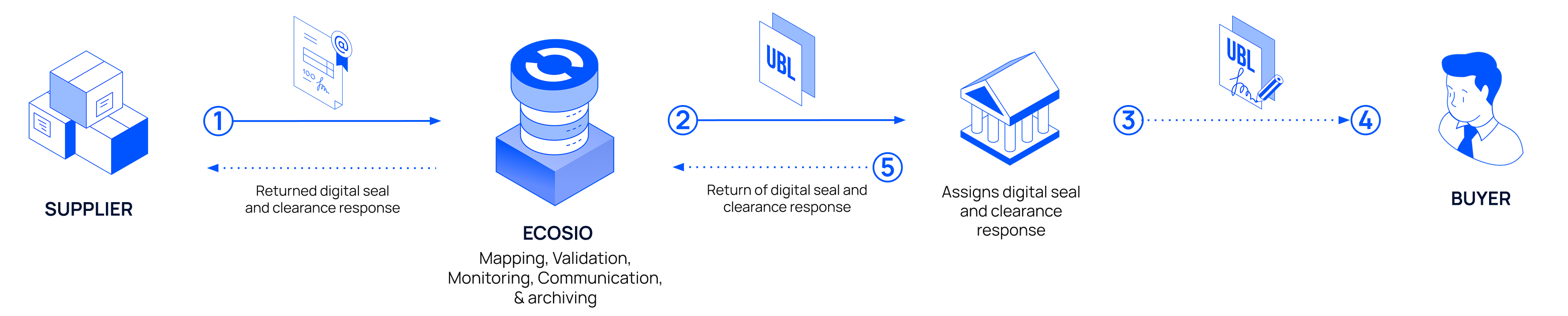
- You send the invoice data from your ERP or business software to ecosio in a structured format, such as XML.
- ecosio validates the invoice, maps it into the CIUS-RO UBL format expected by ANAF, and sends it to your ANAF SPV portal.
- ANAF processes the invoice, assigns a digital seal, and returns a clearance response. It then forwards the cleared invoice to the buyer.
- The buyer receives the cleared e-invoice from ANAF.
- ANAF provides the digital seal and clearance response. ecosio retrieves this information, converts it into your ERP or business software’s format, and sends it to your system.
Accounts payable flow
The following diagram and steps illustrate the AP process for e-invoices in Romania.
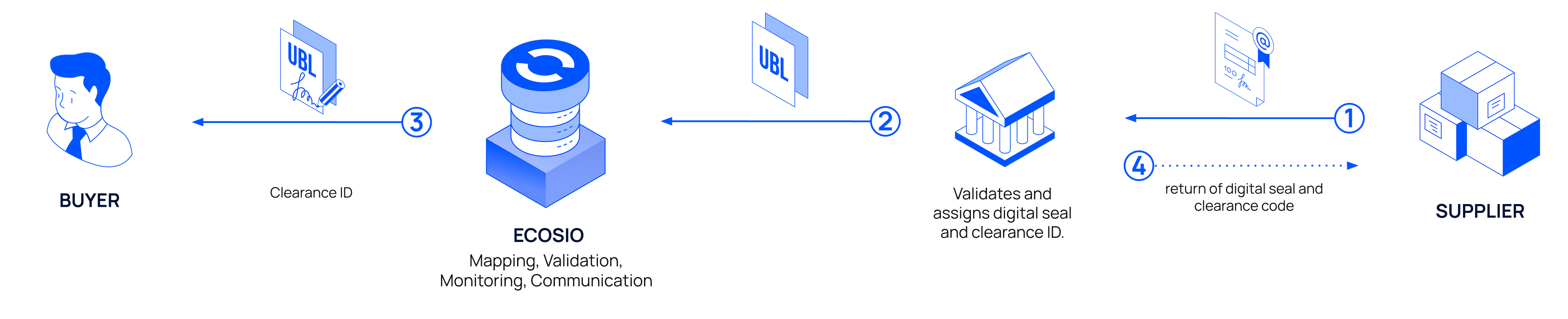
- The supplier sends the invoice to their ANAF SPV portal.
- ANAF processes the invoice, assigns a digital seal, and returns a clearance response. It then forwards the cleared invoice to you.
- ANAF provides the digital seal and clearance response. ecosio retrieves this information, converts it into your ERP or business software’s format, and sends it to your system.
- ANAF sends the digital seal and clearance response to the supplier.
E-transport
Romania mandates that all road transport of goods with high fiscal risk and all international goods transports across Romania are declared using their e-transport system. This system, which works in parallel with e-invoicing, requires companies to declare their transports via an RO e-transport document in XML format on ANAF SPV. Its purpose is to prevent tax evasion and fraud from undeclared or misdeclared goods.
Companies must declare their transports through the e-transport system before the actual transport begins. Failure to meet these requirements can result in significant fines and penalties.
The RO e-transport electronic document must contain the following information:
- The sender and recipient of the goods.
- The characteristics and value of the transported goods.
- The loading and unloading locations and the mode of transportation.
The system generates an Unique Identification Transport (UIT) code once you report the transportation of goods. This code uniquely identifies the goods. You can request the UIT code up to three calendar days before the identified transportation date starts. The code is valid for five days from that date. The UIT code must appear legible on the transportation of goods document.
Automated e-transport flow
ecosio enables you, as the supplier, to automate the transmission of compliant e-transport documents. The following diagram and steps illustrate this process.
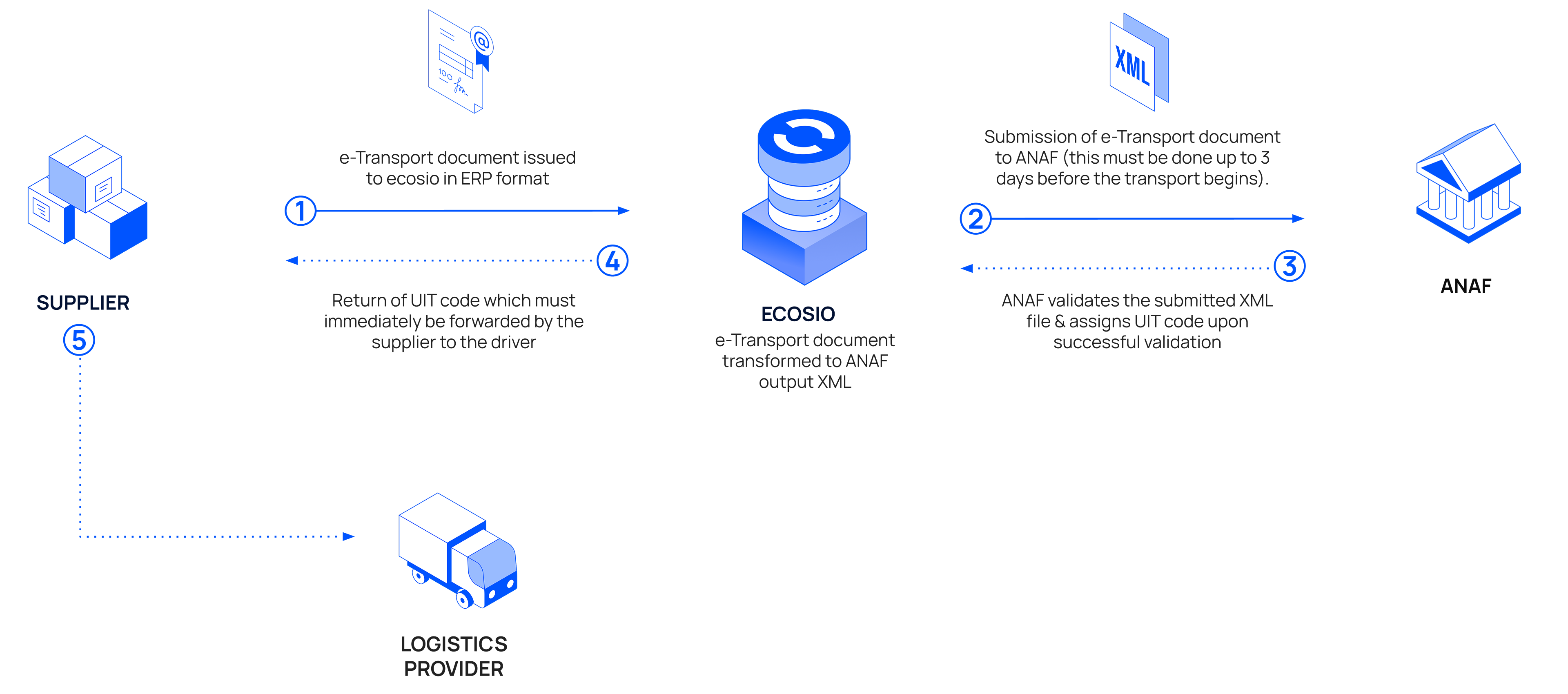
- You send the e-transport data from your ERP or business software to ecosio in a structured format, such as XML. You must do this at least three days before the transport begins.
- ecosio maps it into the CIUS-RO UBL format expected by ANAF, validates it, and sends it to your ANAF SPV portal.
- Once ANAF receives the document, it returns a UIT code. The carrier must always have this code during the transportation process.
- ecosio retrieves the UIT code from ANAF and sends it to your system.
- You provide the carrier with the UIT code.
Legal resources
The following official documents define the legal and technical framework for e-invoicing and e-transport in Romania.
- Law 199/2020: This law transposes the EU Directive 2014/55/EU, establishing the legal basis for e-invoicing in public procurement.
- Government Ordinance no. 120/2021: This ordinance is the core legal document that established the RO e-Factura system and its rules for invoice submission.
- Law no. 139/2022: This law amends and approves the initial ordinance, solidifying the legal mandate for B2B e-invoicing.
- RO-e-Transport Legislation: Official legislation for Romania's e-Transport system.
Updated 9 days ago