
Compliance for Poland
Poland mandates that all B2G invoices must be processed through the Krajowy System e-Faktur (KSeF) platform. The Ministry of Finance, Poland's public institution responsible for tax collection and administration, governs KSeF. This mandate will extend to B2B invoices in a phased rollout.
Document requirements
B2G invoices are processed through Platforma Elektronicznego Fakturowania (PEF), and are sent using the Peppol framework. Businesses will have the option to use either the KSeF or PEF format for B2G invoices.
All B2B invoices must be processed through KSeF. Businesses must be able to receive B2B invoices through KSeF and, depending on revenue, send B2B invoices. B2B invoices are mandatory for businesses with annual revenue exceeding 200 million PLN, and the mandate extends to all B2B transactions by 1 April 2026.
Poland compliance summary
Learn more about compliance transaction terms and concepts.
| Aspect | Description | Requirement |
|---|---|---|
| B2B | Invoices exchanged between businesses. | Mandatory for businesses with annual revenue exceeding 200 million PLN, extending to all B2B transactions by 1 April 2026. Processed through KSeF. |
| B2C | Invoices issued by businesses to consumers. | Optional |
| B2G | Invoices issued by businesses to public administrations for public procurement. | Mandatory. Processed through PEF or KSeF from 1 February 2026. |
| Electronic signature | Signature or seal rules for authenticity and integrity of e‑invoices. | Optional |
| Legal archiving | Minimum retention period for e‑invoices. | Five years |
| Model | The e-invoicing flow model used by the country. | Continuous Transaction Controls (CTC) |
| Platform | The government-managed platform for e-invoicing. | Managed by The Ministry of Finance through PEF or KSeF. |
| Supported format | The e-invoicing format legally required by the country. | EN 16931 standard for invoices processed through PEF. FA(3) XML schema for invoices processed through KSeF. |
| Automatic updates | Whether invoice status updates synchronise automatically in Monitor. | Yes |
Format
B2G invoices processed through PEF must be based on the EN 16931 standard.
B2B invoices processed through KSeF must be based on the FA(3) XML schema. The format is proprietary and tailored specifically to Polish VAT and legal requirements.
Invoice types
For invoices processed through PEF based on the EN 16931 standard, the Invoice Type Code element within the invoice must contain one of the following codes from the UNTDID 1001 code list.
| Document | Code | Description |
|---|---|---|
| Commercial invoice | 380 | An invoice for goods or services from a seller to a buyer. |
| Credit note | 381 | Used to correct amounts or settle a balance between a seller and a buyer. It is not required to provide a previous invoice reference. |
| Correction invoice | 384 | Used to correct or cancel a previously sent invoice. It is mandatory to provide a reference to the original invoice. |
| Self-billed invoice | 389 | An invoice process based on an agreement between a supplier and a buyer, where the buyer prepares the invoice and sends it to the supplier with the payment. |
| Invoice information for accounting purposes | 751 | A document containing accounting-related information such as monetary totals, seller ID, and VAT. It may not be a complete invoice according to legal requirements. |
For invoices processed through KSeF based on the FA(3) XML schema, the Rodzajfaktury (Invoice Type Code) element within the invoice must contain one of the following codes.
| Document | Code | Description |
|---|---|---|
| Advance invoice | ZAL | An invoice documenting the receipt of payment, or a part of that payment, before a service or activity has taken place. |
| Correction invoice | KOR | Used to correct amounts or to settle a financial balance between a supplier and a buyer for a standard or simplified invoice. |
| Correction settlement invoice | KOR_ROZ | Used to correct amounts or to settle a financial balance between a supplier and a buyer for a settlement invoice. |
| Correction advance invoice | KOR_ZAL | Used to correct amounts or to settle a financial balance between a supplier and a buyer for an advance invoice. |
| Invoice | VAT | An invoice for goods or services from a supplier to a buyer. |
| Settlement invoice | ROZ | An invoice issued after the delivery of goods or provision of services, which also documents the receipt of part of the payment. |
| Simplified invoice | UPR | Used when the total amount due doesn't exceed PLN 450 or EUR 100. |
Automated e-invoicing flow
ecosio enables the automated transmission of compliant e-invoices for both Accounts Payable (AP) and Accounts Receivable (AR) mandated e-invoices in Poland.
Accounts receivable flow
If you send invoices to buyers, ecosio automates the entire submission and clearance process. The following diagram and steps illustrate the AR process for e-invoices in Poland.

- You send the invoice data from your ERP or business software to ecosio in a structured format, such as CSV.
- ecosio validates the invoice, maps it into the FA(3) format expected by KSeF, and sends it to your KSeF portal.
- KSeF processes the invoice and forwards it to the buyer.
- KSeF assigns a clearance ID number and QR code, and sends them to ecosio.
- The buyer receives the invoice from the Ministry of Finance.
PDF copies
If you send export invoices or issue optional invoices to recipients who can't access KSeF directly, ecosio can generate a PDF copy to share with the buyer. The following diagram and steps illustrate this process.
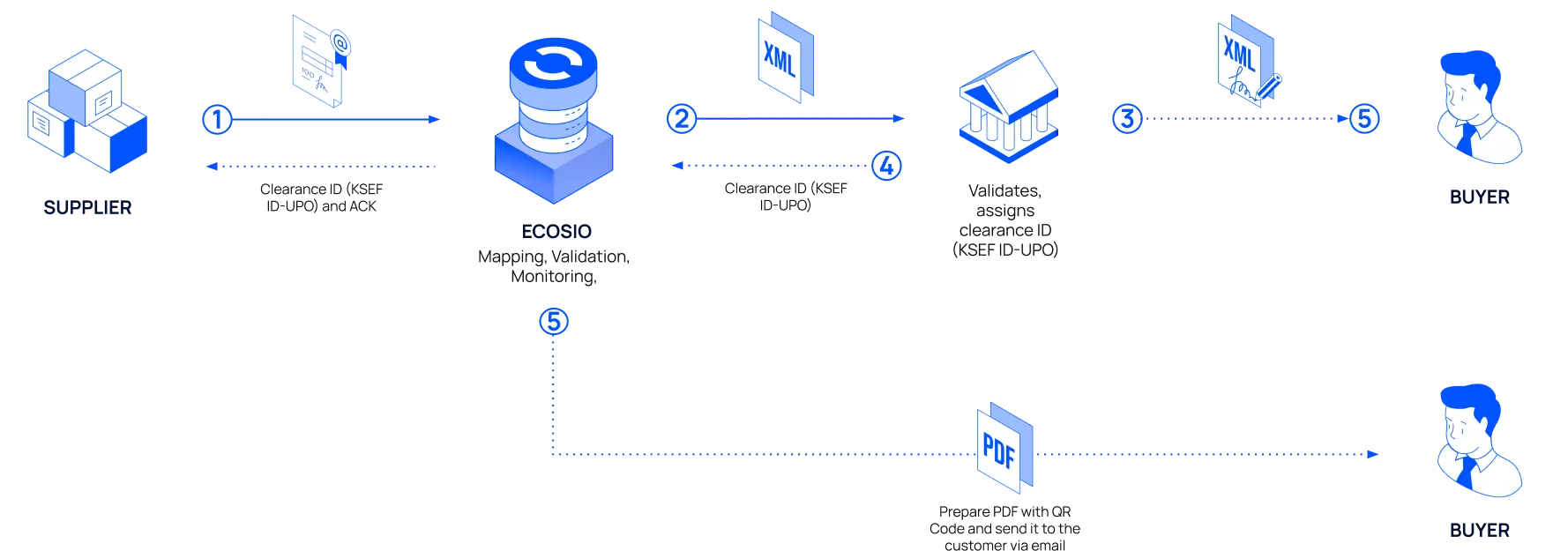
- You send the invoice data from your ERP or business software to ecosio in a structured format, such as VRBL.
- ecosio validates the invoice, maps it into the required format, and sends it to your KSeF portal.
- KSeF validates the invoice and assigns a KSeF number.
- ecosio returns the KSeF number to you.
- The buyer receives the invoice in one of two ways:
- The buyer retrieves the invoice manually, or fetches it via API to integrate it automatically in ERP or business software.
- For export invoices and optional B2C invoices, ecosio can send the PDF copy to the buyer by email if the invoice includes an email address. The PDF includes a QR code and ID.
KSeF unavailability and offline mode
If KSeF is unavailable, you can still issue invoices using an offline mode. The following diagram and steps illustrate how ecosio supports invoice issuance during KSeF unavailability, and submits the invoices when KSeF is available again.
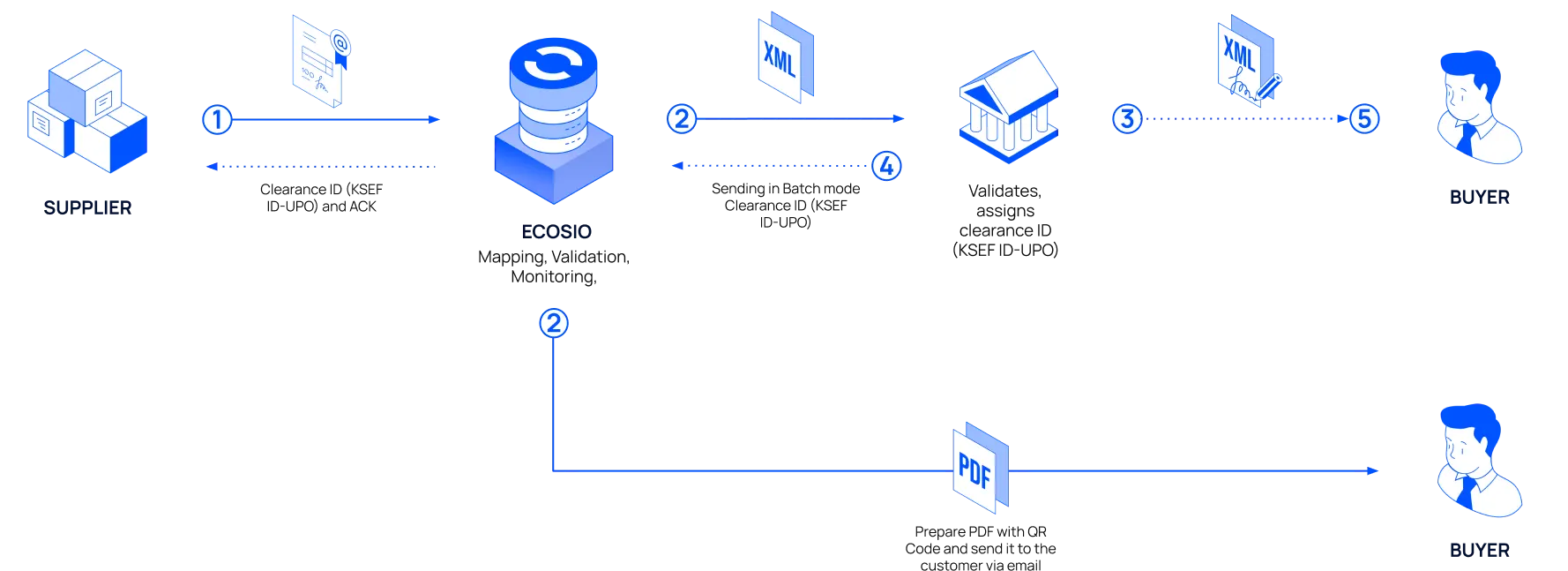
- You send the invoice data from your ERP or business software to ecosio in a structured format, such as VRBL.
- ecosio maps the invoice into the required format and validates that the mandatory fields are present. If KSeF is unavailable, ecosio keeps the invoices in the Monitor and generates a PDF in offline mode. The PDF contains two QR codes, one for the customer certificate and one for the invoice representation. ecosio can send the PDF to you or directly to the buyer.
- When KSeF is available again, ecosio submits the pending invoices to KSeF for the clearance process. ecosio submits invoices in batch mode, sending all invoices received from you every 5 minutes. KSeF assigns a KSeF number.
- KSeF sends the cleared invoice including the KSeF number back to ecosio. ecosio returns the cleared invoices and QR codes to you in batch mode.
- The buyer can use the PDF to check the invoice details by scanning the QR code and checking the KSeF number. The buyer can also retrieve the invoice via API to integrate it automatically in ERP or business software.
Accounts payable flow
If you receive invoices from suppliers, ecosio automatically retrieves and integrates them into your system. The following diagram and steps illustrate the AP process for e-invoices in Poland.

- The supplier sends the invoice to their KSeF portal.
- KSeF assigns a clearance ID number and QR code, and sends them to ecosio.
- ecosio retrieves the invoice from KSeF, converts it to your ERP or business software's format, and sends it to your system.
- KSeF sends the clearance ID and QR code to the supplier.
Legal resources
The following official documents define the legal and technical framework for e-invoicing in Poland.
- Legal basis: KSeF’s guide on the laws and regulations for e-invoicing.
- KSeF API documentation: KSeF’s developer guides for integrating your ERP system.
Updated 9 days ago