
Compliance for Finland
In Finland, B2G e-invoicing is mandatory. Public entities support receiving and processing e-invoices that meet the European EN 16931 standard. If a business has an annual turnover over €10,000, it can request to receive e-invoices from its suppliers. Suppliers must support issuance of e-invoices.
Document requirements
Finland’s e-invoicing framework is governed by the State Treasury (Valtiokonttori).
Finland compliance summary
Learn more about compliance transaction terms and concepts.
| Aspect | Description | Requirement |
|---|---|---|
| Invoices exchanged between businesses. | Optional. Businesses with an annual turnover over €10,000 can request to receive e-invoices from suppliers. | |
| Invoices issued by businesses to consumers. | Optional | |
| Invoices issued by businesses to public administrations for public procurement. | Mandatory | |
| Electronic signature | Signature or seal rules for authenticity and integrity of e‑invoices. | None |
| Legal archiving | Minimum retention period for e‑invoices. | 6 years after the end of the financial year |
| Model | The e-invoicing flow model used by the country. | Interoperability exchange Post-audit compliance |
| Platform | The government-managed platform for e-invoicing. | Typically exchanged via service providers and the Peppol network. |
| Supported format | The e-invoicing format legally required by the country. | Based on the EN 16931 standard Typically Finvoice 3.0, TEAPPSXML 3.0, or Peppol BIS 3.0 |
| Automatic updates | Whether invoice status updates synchronise automatically in Monitor. | No |
Format
Finland requires B2G invoices to meet the EN 16931 standard. You can exchange EN 16931-compliant invoices using formats such as Finvoice 3.0, TEAPPSXML 3.0, or Peppol BIS Billing 3.0 for Peppol.
Invoice types
The Invoice Type Code element within the invoice must contain one of the codes for invoices or credit notes from the UNTDID 1001 code list.
Automated e-invoicing flow
ecosio enables you to automate the transmission of compliant e-invoices for both accounts receivable and accounts payable processes in Finland.
Accounts receivable flow
The following diagram and steps illustrate the AR flow for Finland.
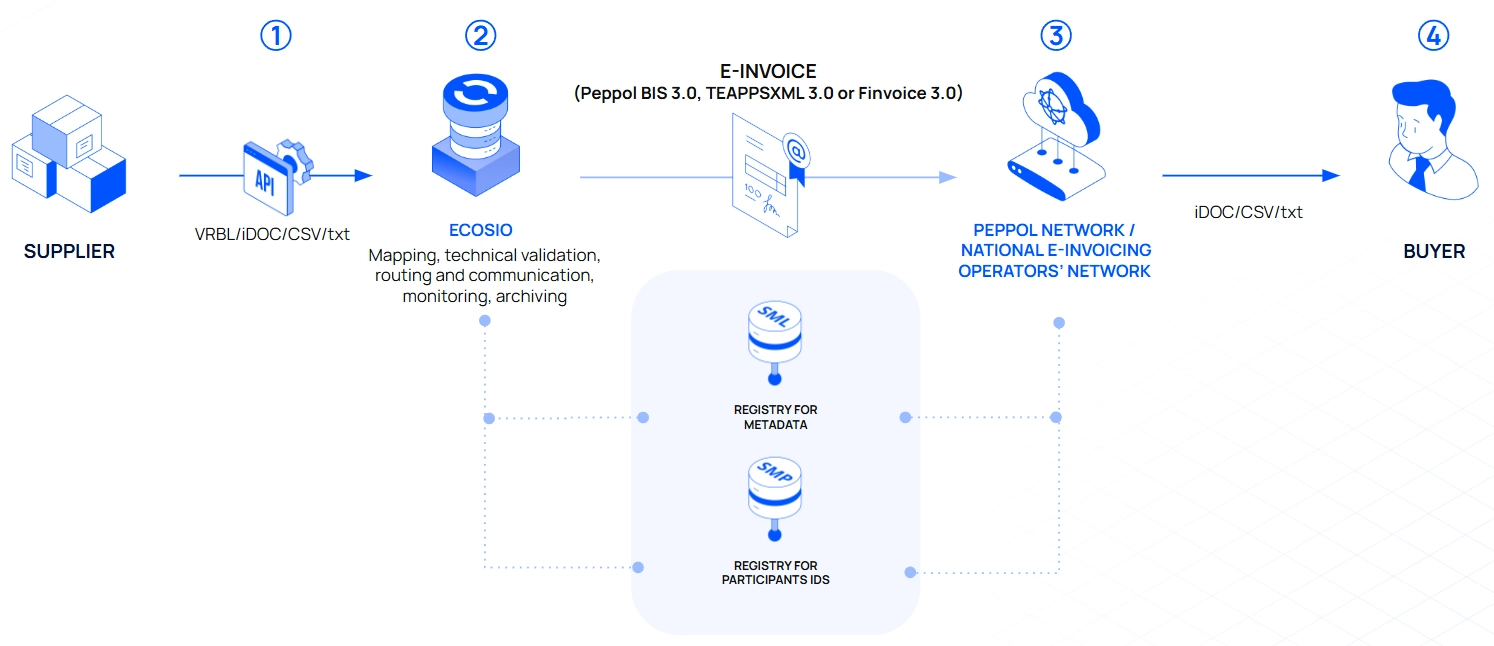
- You send the invoice data from your ERP or business software to ecosio in a structured format, such as VRBL.
- ecosio converts the data into the required format and validates it against applicable business rules.
- ecosio transmits the e-invoice via the agreed channel:
- Via the Peppol network.
- Via the national operators’ network through a partner connection.
- The recipient receives the e-invoice via their Peppol Access Point or service provider, and makes it available for posting in ERP or business software.
Accounts payable flow
The following diagram and steps illustrate the AP flow for Finland.
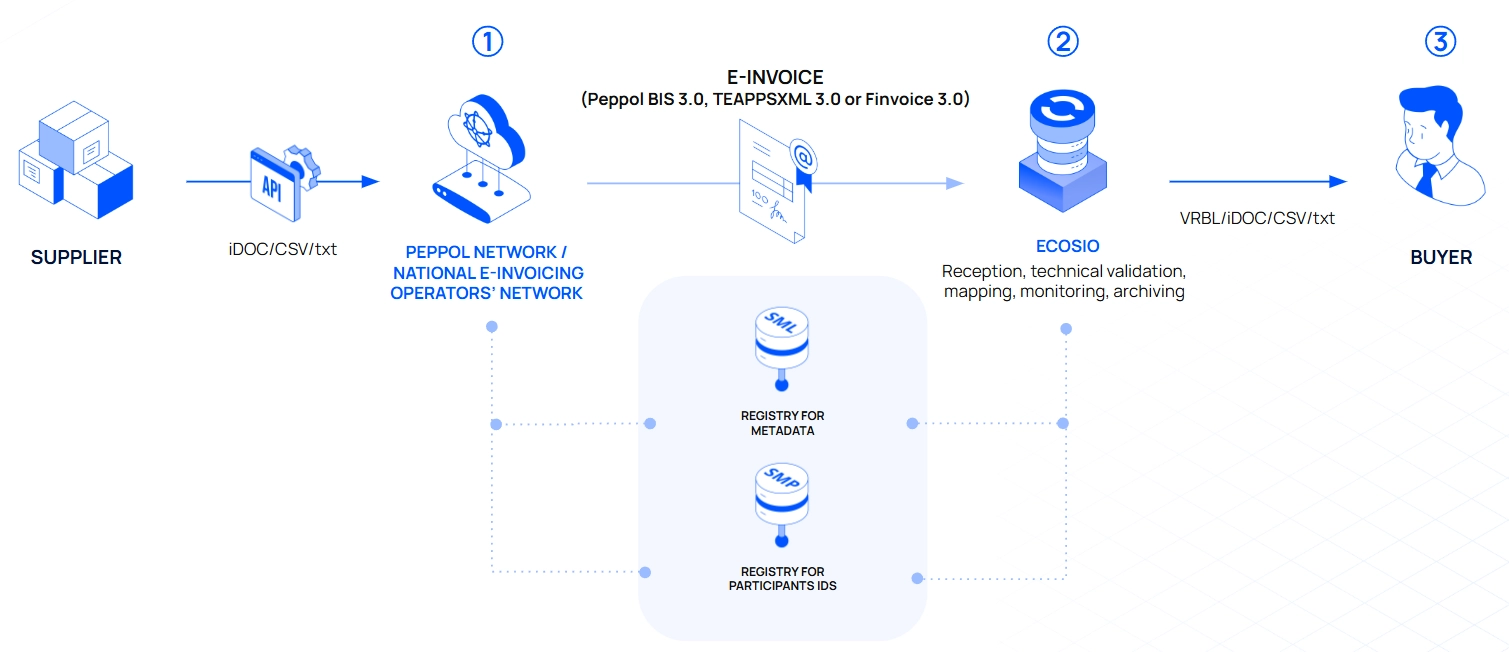
- Your supplier sends an e-invoice via the Peppol network or through the national e-invoicing operators’ network.
- ecosio retrieves the e-invoice via the applicable channel, converts it into the format required by your ERP or business software, and sends it to your system.
- You receive the invoice in your ERP or business software.
Legal resources
The following official documents define the legal and technical framework for e-invoicing in Finland.
- Directive 2014/55/EU: EU directive on electronic invoicing in public procurement.
- Act 241/2019: Implements Directive 2014/55/EU in Finland and sets the right-to-receive rule for businesses with an annual turnover over €10,000.
- Invoicing the state guidelines: State Treasury guidance for sending e-invoices to central government.
- Verkkolaskuosoite e-invoice address service: Official directory of Finnish businesses’ e-invoicing addresses.
- TEAPPSXML 3.0 specifications: Technical specification for TEAPPSXML.
- Finvoice standard documentation: Technical specification for Finvoice.
Updated 9 days ago