
Compliance for Denmark
Denmark mandates B2G e-invoicing. For B2B transactions, all businesses must be able to receive e-invoices, though B2B issuance remains voluntary. Providers of registered digital bookkeeping systems must automatically enrol their business customers for e-invoicing unless they opt out within four weeks of notification. Enrolled businesses can still agree other invoicing methods with customers and suppliers.
Most B2G flows use Peppol. Recipients use Denmark’s e-invoicing platform NemHandel when they’re only registered in the NemHandel Registry or specifically require OIOUBL format, Denmark’s national e-invoicing format.
Document requirements
Denmark requires structured electronic invoices aligned to the EN 16931 standard.
Denmark compliance summary
Learn more about compliance transaction terms and concepts.
| Aspect | Description | Requirement |
|---|---|---|
| Invoices exchanged between businesses. | Issuance voluntary. Businesses must be able to receive e-invoices. | |
| Invoices issued by businesses to consumers. | Optional | |
| Invoices issued by businesses to public administrations for public procurement. | Mandatory | |
| Electronic signature | Signature or seal rules for authenticity and integrity of e‑invoices. | Optional |
| Legal archiving | Minimum retention period for e‑invoices. | 5 years from the end of the financial year |
| Model | The e-invoicing flow model used by the country. | Post-audit |
| Platform | The government-managed platform for e-invoicing. | Peppol network and NemHandel platform |
| Supported format | The e-invoicing format legally required by the country. | Based on the EN 16931 standard. For Peppol exchange, invoices use Peppol BIS Billing 3.0 with Danish CIUS validation rules. OIOUBL 2.1 is Denmark’s national e-invoicing format and is supported by NemHandel. |
| Automatic updates | Whether invoice status updates synchronise automatically in Monitor. | Yes |
Format
Denmark accepts invoices using the Peppol BIS Billing 3.0 or OIOUBL 2.1 formats, both compliant with EN 16931 standard. NemHandel supports OIOUBL, whilst Peppol uses Peppol BIS Billing 3.0.
Invoice types
The Invoice Type Code element within the invoice must contain one of the codes for invoices or credit notes from the UNTDID 1001 code list.
OIOUBL document types
OIOUBL supports the following invoice codes.
| Document | Code | Description |
|---|---|---|
| Proforma invoice | 325 | A preliminary invoice sent before goods or services are delivered. |
| Commercial invoice | 380 | An invoice for goods or services from a seller to a buyer. |
| Credit note | 381 | Used to correct amounts or settle a balance between a seller and a buyer. |
| Delcredere invoice | 390 | Invoice for hire or rental services. |
| Factored invoice | 393 | Invoice assigned to a third party for collection. |
Peppol invoice codes
Peppol BIS Billing 3.0 supports the following invoice codes.
| Document | Code | Description |
|---|---|---|
| Request for payment | 71 | Document issued by a creditor to a debtor to request payment of one or more invoices past due. |
| Debit note related to goods or services | 80 | Debit information related to a transaction for goods or services to the relevant party. |
| Metered services invoice | 82 | Charges based on measured consumption over a defined period. |
| Debit note related to financial adjustments | 84 | Document for providing debit information related to financial adjustments to the relevant party. |
| Final payment request based on completion of work | 218 | The final payment request of a series of payment requests submitted upon completion of all the work. |
| Payment request for completed units | 219 | A request for payment for completed units. |
| Partial invoice | 326 | An invoice for a part of the total order or project value. |
| Commercial invoice which includes a packing list | 331 | Commercial transaction (invoice) will include a packing list. |
| Commercial invoice | 380 | An invoice for goods or services from a seller to a buyer. |
| Debit note | 383 | A document issued by a supplier to apply additional charges or increase the total value of a previously issued e-invoice. |
| Corrected invoice | 384 | Used to correct or cancel a previously issued invoice. |
| Prepayment invoice | 386 | An invoice claiming advance payment for goods or services. |
| Tax invoice | 388 | An invoice for tax purposes. |
| Self-billed invoice | 389 | An invoice process based on an agreement between a supplier and a buyer, where the buyer prepares the invoice and sends it to the supplier with the payment. |
| Factored invoice | 393 | Invoice assigned to a third party for collection. |
| Consignment invoice | 395 | Commercial invoice that covers a transaction other than one involving a sale. |
| Insurer's invoice | 575 | Invoice from an insurer for insurance coverage. |
| Forwarder's invoice | 623 | Invoice from a freight forwarder for services provided and costs incurred. |
| Freight invoice | 780 | Document issued by a transport operation specifying freight costs and charges incurred for a transport operation and stating conditions of payment. |
| Consular invoice | 870 | Document an exporter prepares in their country and presents to the importing country's diplomatic representation for endorsement. |
| Partial construction invoice | 875 | Used to invoice a partial amount for construction work. |
| Partial final construction invoice | 876 | Used to invoice a partial final amount for construction work. |
| Final construction invoice | 877 | Used to invoice the final amount for construction work. |
Peppol credit note codes
Peppol BIS Billing 3.0 supports the following credit note codes.
| Document | Code | Description |
|---|---|---|
| Credit note related to goods or services | 81 | Document used to provide credit information related to a transaction for goods or services to the relevant party. |
| Credit note related to financial adjustments | 83 | Document for providing credit information related to financial adjustments to the relevant party, for example bonuses. |
| Credit note | 381 | Used to correct amounts or settle a balance between a seller and a buyer. |
| Factored credit note | 396 | Credit note related to assigned invoice. |
| Forwarder's credit note | 532 | Document for providing credit information to the relevant party. |
Automated e-invoicing flow
ecosio enables you to automate the transmission of compliant e-invoices for Denmark through Peppol and NemHandel networks.
Accounts receivable flow
The following diagram and steps illustrate the current AR process for e-invoices in Denmark using NemHandel and the Peppol 4-corner model.
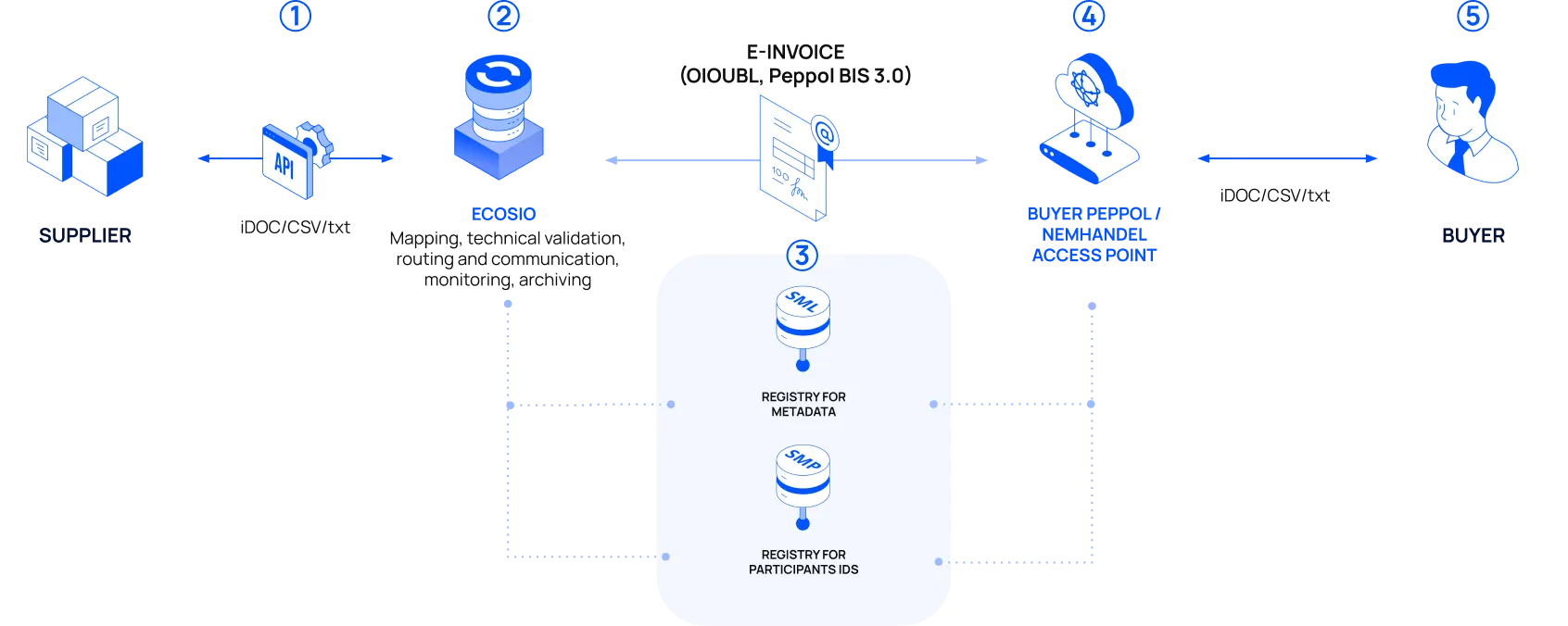
- You send the invoice data from your ERP or business software to ecosio in a structured format, such as VRBL, CSV, or IDoc.
- ecosio, as your Access Point, validates the invoice and maps it into the OIOUBL or Peppol BIS standard format.
- ecosio, as your Access Point, locates the buyer’s Access Point and retrieve delivery details.
- The buyer’s Access Point receives the invoice.
- The buyer’s Access Point maps the invoice into the format expected by the buyer and delivers it to their ERP or business software.
Accounts payable flow
The following diagram and steps illustrate the current AP process for e-invoices in Denmark using NemHandel and the Peppol 4-corner model.
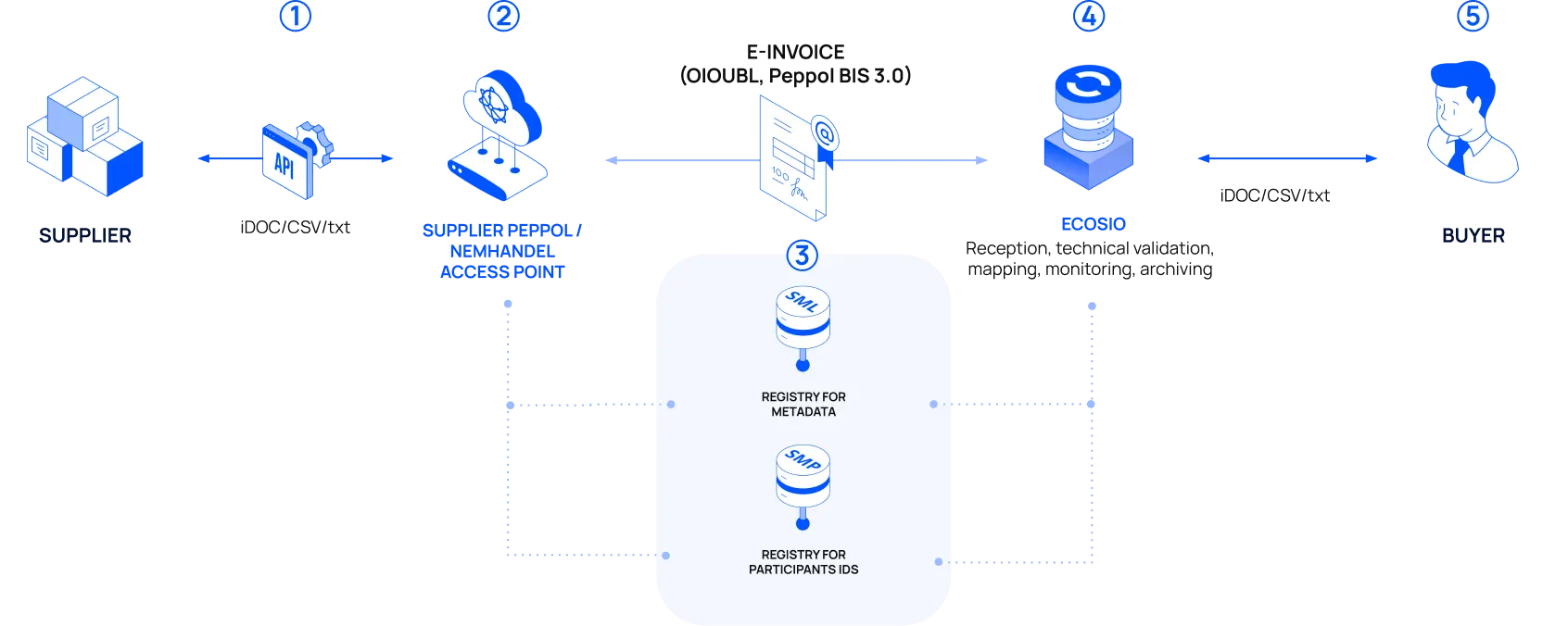
- The supplier sends the invoice to their Access Point in a structured format, such as VRBL, CSV, or IDoc.
- The supplier’s Access Point validates the invoice and maps it into the OIOUBL or Peppol BIS standard format.
- The supplier’s Access Point locates ecosio as your Access Point and retrieve delivery details.
- ecosio, as your Access Point, retrieves the invoice, validates it, and converts it into the format required by your ERP or business software.
- ecosio sends the invoice to your ERP or business software.
Legal resources
The following official documents define the legal and technical framework for e-invoicing in Denmark.
- Danish Bookkeeping Act: Sets the framework for digital bookkeeping systems that can issue, receive, and archive structured e-invoices.
- Danish CIUS package v1.17.0 and Danish Peppol BIS3‑Other package v1.2.14: Updated validation packages for Denmark’s e‑invoicing framework, mandatory from 17 August 2026.
- OIOUBL Documentation: Complete OIOUBL 2.1 and 3.0 specifications with validation and visualisation tools.
Updated about 10 hours ago